


Introduction
This article explores two foundational historical questions: did Prophet Muhammad exist, and when was the Qur’anic text formed?
To address this, it first examines the earliest available evidence—both Islamic and non-Islamic—for Muhammad as a historical figure in seventh-century Arabia. It then turns to manuscript evidence and modern scholarship on the Qur’an’s formation and transmission.
Taken together, this material offers a historically grounded account of early Islam—one often obscured in popular debates about its origins.
How Do We Know Prophet Muhammad Actually Existed?
While it has become increasingly common to question the historical existence of Prophet Muhammad—as well as figures like Moses, Jesus, and the Buddha—the evidence for Muhammad’s life in seventh-century Arabia is extensive and well supported.
As historian Fred Donner—Professor of Near Eastern History at the University of Chicago—observes:
“Muhammad is not completely a fiction of later pious imagination… we know that someone named Muhammad did exist, and that he led some kind of movement. And this fact, in turn, gives us greater confidence that further information in the massive body of traditional Muslim materials may also be rooted in historical fact.”
— Fred Donner, Muhammad and the Believers, 53.
What distinguishes Muhammad among founders of major religions is how early and how often he is mentioned in historical sources—many of them written within just a few years of his death.
Below are some of the earliest and most important examples:
1. Early Greek Source (c. 634 CE)
A Byzantine Greek text known as Doctrina Jacobi, written within two years of Muhammad’s death, refers to an Arab prophet leading a movement.
As historian Patricia Crone—former Professor of Oriental Studies, University of Cambridge—notes, this source suggests that Muhammad was already known beyond Arabia during his lifetime and shortly after his death—making him one of the few religious founders mentioned in near-contemporary records.1
2. Syriac Manuscripts (c. 634–636 CE)
Early Syriac (Syrian Christian) texts dated just a few years after Muhammad’s death refer to him and the Arab conquests.2
These independent, non-Muslim sources confirm that a leader named Muhammad was associated with a rapidly expanding movement in the region.
3. Thomas the Presbyter (c. 640 CE)
A Syriac chronicle written around 640 CE—less than a decade after Muhammad’s death—refers to raids conducted by the followers of an Arab leader identified as Muhammad in the region near Gaza.
This is one of the earliest non-Muslim references to the emerging Arab movement.
Fred Donner notes that such early attestations are significant because they indicate that the movement associated with Muhammad was already visible to outside observers within a few years of his death.3
4. The Qur’an Itself
The Qur’an mentions Muhammad by name and presents him as a messenger of God, while also referring to events during his lifetime.
Scholars such as Patricia Crone and Fred Donner agree that the Qur’an preserves material that originates from Muhammad’s own preaching in the early seventh century.
As Crone notes:
“Mohammed is also mentioned by name, and identified as a messenger of God, four times in the Qur’an… We can be reasonably sure that the Qur’an is a collection of utterances that he made in the belief that they had been revealed to him by God.”
— Patricia Crone, “What Do We Actually Know About Mohammed”, June 2008.
Donner similarly emphasizes the early dating of the Qur’an and its connection to the earliest phase of the movement associated with Muhammad:
“For example, meticulous study of the text by generations of scholars has failed to turn up any plausible hint of anachronistic references to important events in the life of the later community, which would almost certainly be there had the text crystallized later than the early seventh century C.E. Moreover, some of the Qur’an’s vocabulary suggests that the text, or significant parts of it, hailed from western Arabia. So we seem, after all, to be dealing with a Qur’an that is the product of the earliest stages in the life of the community in western Arabia… The fact that the Qur’an text dates to the earliest phase of the movement inaugurated by Muhammad means that the historian can use it.”
— Fred Donner, Muhammad and the Believers, 56.
5. The Constitution of Medina
Early Islamic sources (8th century) preserve a political document known as the Constitution of Medina, which outlines agreements between Muhammad and the tribes of Yathrib (Medina).
Modern scholars generally accept that this document reflects a real historical context from Muhammad’s lifetime.4
6. Non-Muslim Historical Accounts (7th Century)
Several non-Muslim writers from the mid-600s also refer to Muhammad:
The Armenian bishop Sebeos (writing in the 660s) describes Muhammad as a merchant who preached belief in one God and united the Arabs.5
A Nestorian chronicle known as the Khuzistan Chronicle (also from the 660s) refers to Muhammad as the leader of the Arabs during their conquests.6
These accounts are especially important because they come from outside the Islamic tradition and still confirm Muhammad’s existence and role.
Taken together, these early sources—Greek, Syriac, Armenian, and Islamic—converge on the same basic conclusion: a man named Muhammad lived in seventh-century Arabia, preached monotheism, and led a movement that rapidly expanded beyond the region.
If Muhammad is established as a historical figure, the next question naturally follows: when was the Qur’anic text itself formed?
Scholarly Findings on the Dating of the Qur’anic Text
“We can be reasonably sure that the Qur’an is a collection of utterances that he [i.e. Muhammad] made… The book may not preserve all the messages he claimed to have received, and he is not responsible for the arrangement in which we have them. They were collected after his death — how long after is controversial. But that he uttered all or most of them is difficult to doubt.”
— Patricia Crone, “What Do We Actually Know About Mohammed”, June 2008.
The Qur’an did not begin as a single written book. It originated as a series of oral recitations delivered by Prophet Muhammad over roughly 23 years, in different contexts and situations.
His companions memorized these recitations and also recorded some of them in writing—on parchment, bones, and other materials. The Prophet himself never collected these recitations into a single document and never published the Qur’anic recitations as a “book.” After his death, these recitations were collected into a written codex. According to early Muslim sources, this process began under Abu Bakr and was later standardized under the Caliph ‘Uthman (d. 656).
In modern scholarship, a small number of revisionist theories have suggested that the Qur’an was formed significantly later than the time of Muhammad—sometimes placing its final composition one to two centuries after his lifetime (e.g., John Wansbrough). Others have proposed alternative explanations for its origins, including the idea that it derives from earlier Syriac Christian liturgical material (associated with Christoph Luxenberg). However, both theories have been widely discredited (see detailed discussion here).
The dominant view among historians and manuscript scholars is that both the manuscript evidence and the internal features of the Qur’an point to a text that was established by the mid-seventh century—close to Muhammad’s lifetime and broadly consistent with the early Islamic tradition.
Several of the earliest surviving manuscripts of the Qur’an support this early dating:
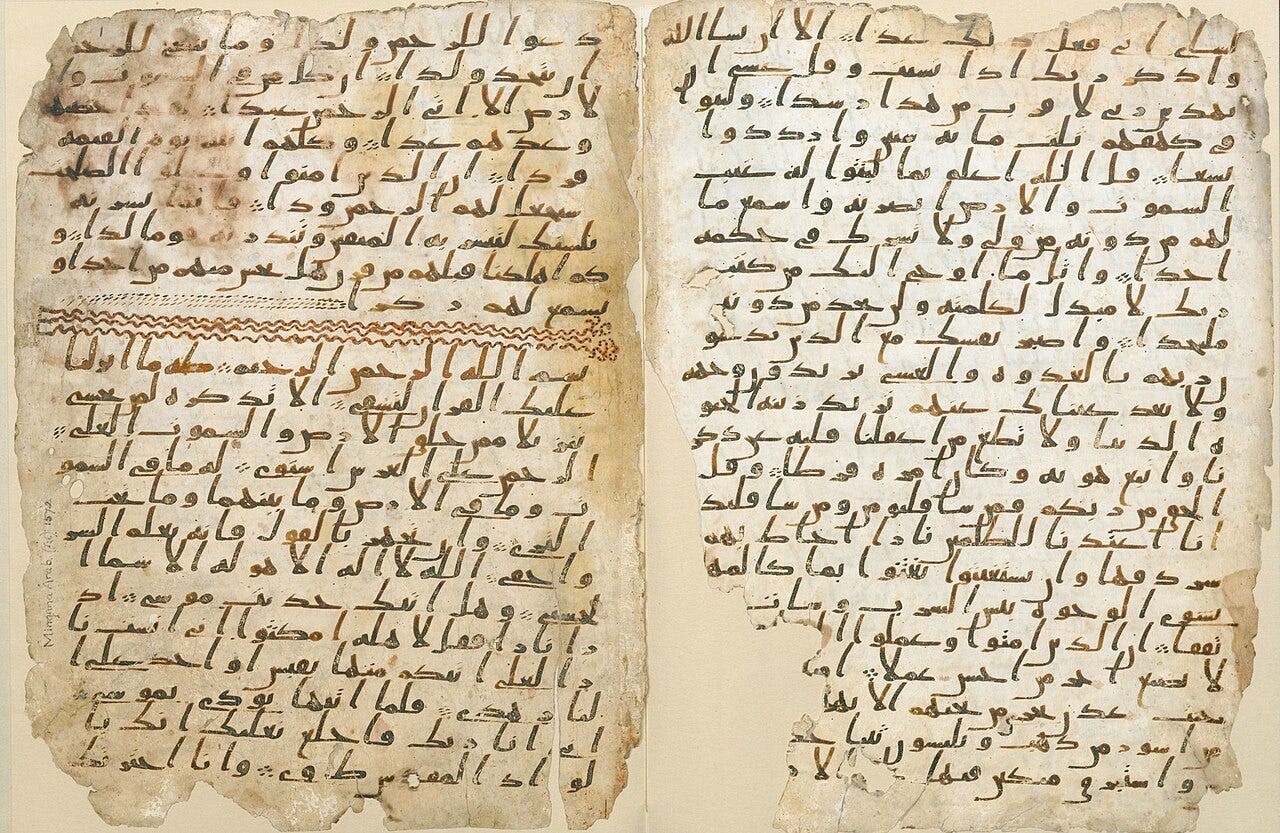
1. Birmingham Manuscript — carbon-dated to 568–645 CE, placing it within or very close to the lifetime of Prophet Muhammad.
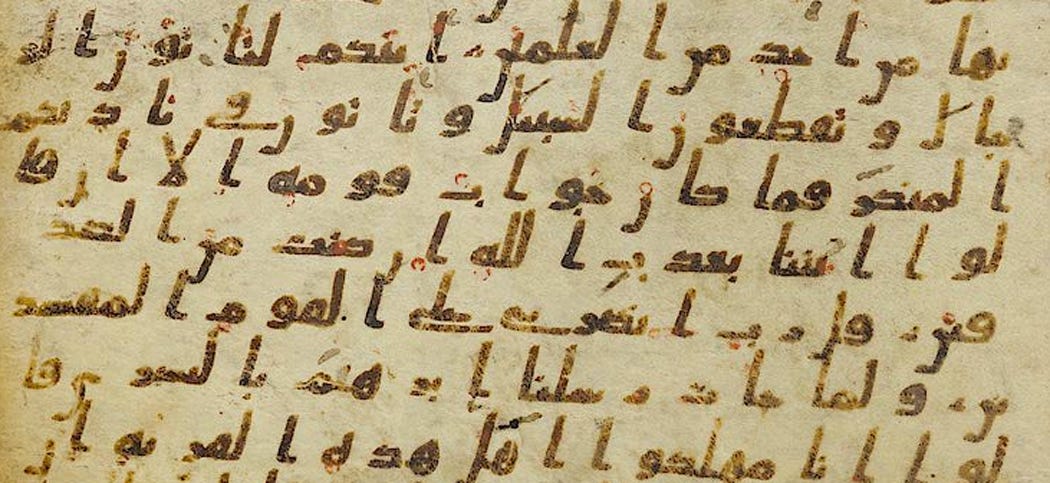
2. Tübingen Manuscript — carbon-dated to 625–673 CE, consistent with an early first-century Islamic context.
3. Sanaa Manuscript — carbon-dated to 624–656 CE (68% probability), with a broader range of 578–669 CE (95% probability).
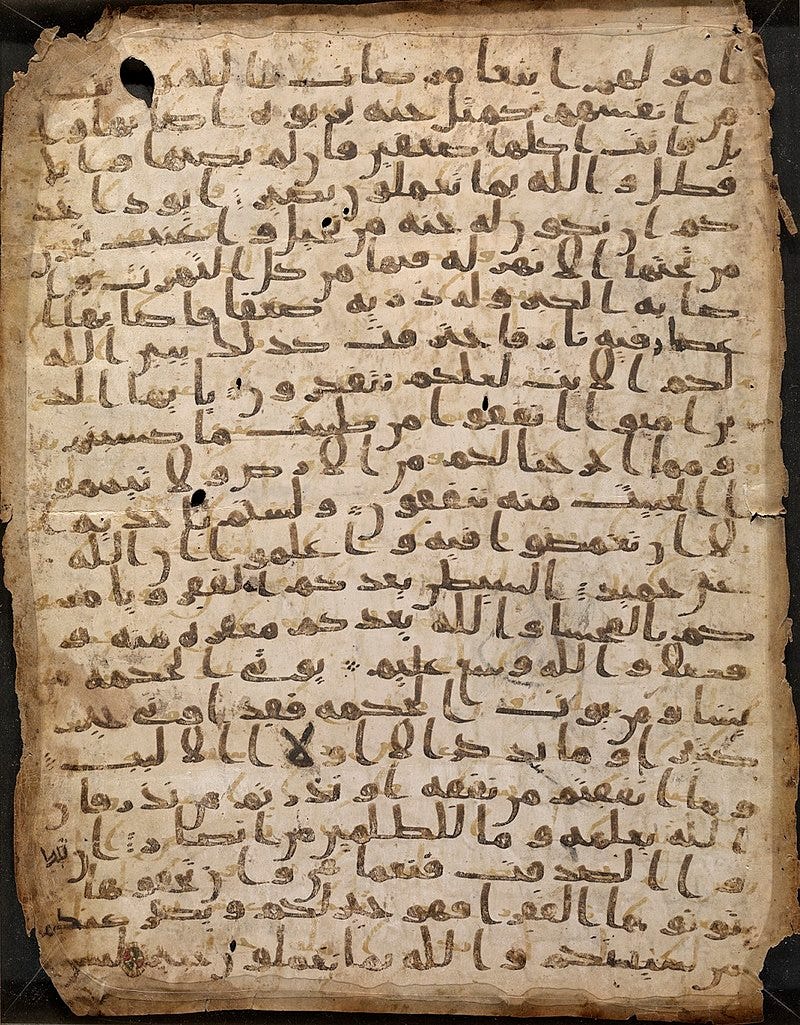
“Several tests on a Koranic manuscript called ‘Sanaa 1’… have dated it to the first half of the 7th Century.”
— Behman Sadeghi, “The Origins of the Koran,” BBC News, July 2015.
Scholarly analyses of the Qur’an and the Hadith literature (compiled roughly 200–300 years after Muhammad’s death) suggest that the Qur’anic text itself is significantly earlier in origin and broadly consistent with a mid-seventh-century dating. This aligns, in general terms, with early Islamic tradition.
One way scholars approach this question is by comparing the Qur’an with the later Hadith literature. If the Qur’an had been formed at a later stage, we would expect it to reflect many of the same political and historical concerns found in Hadith reports. However, the differences between the two corpora are striking.
For example, the Hadith literature is heavily concerned with questions of political authority and caliphal rule, whereas the Qur’an itself says little to nothing about political leadership. As Fred Donner observes:
“A much more natural way to explain the Qur’an’s virtual silence on the question of political leadership is to assume that the Qur’anic Text, as we now have it, antedates the political concerns enshrined so prominently in the hadith literature. This is what we might expect if the Qur’an text is the product of the time of Muhammad and his immediate followers.”
— Fred Donner, Narratives of Islamic Origins, 46.
A related point concerns historical references. The Hadith corpus frequently reflects later historical developments and disputes, whereas the Qur’an contains no clear references to events, factions, or controversies that emerged after Muhammad’s lifetime.
Donner notes this absence explicitly:
“In the Qur’an… we find not a single reference to events, personalities, groups, or issues that clearly belong to periods after the time of Muhammad… This suggests that the Qur’an, as it now exists, was already a ‘closed’ body of text by the time of the First Civil War (656–661), at the latest.”
— Fred Donner, Narratives of Islamic Origins, 49.
On this basis, Donner argues that the Qur’an likely reached a stable form very early in Islamic history:
“The evidence reviewed above…seems to point clearly to a relatively early date for the crystallization of the Qur’an text, and implies that this event must have been completed before the First Civil War (656-661).
…It does seem clear that the Qur’an text, as we now have it, must be an artifact of the earliest historical phase of the community of Believers.”
— Fred Donner, Narratives of Islamic Origins, 61.
This conclusion is further supported by manuscript evidence. Gregor Schoeler—former Professor and Chair of Islamic Studies at the University of Basel—similarly argues that the compilation of the Qur’an likely occurred very early:
“The compilation and redaction of the Qur’an under ‘Uthman (unanimously supported by tradition) is, if not proven, then at least extremely possible… Even if the Qur’an was not compiled under ‘Uthman (d. 656), then the compilation must have taken place no more than a few decades later… we possess the fragments of a Quranic manuscript from Sanaa that dates back to the second half of the first century AH and contains the ‘Uthmanic text, without any variants as far as we know, and even includes the first and last surahs, typically absent from non-‘Uthmanic codices.”
— Gregor Schoeler, “The Codification of the Qur’an,” in The Qur’an in Context, ed. Angelika Neuwirth and Gerhard Bowering, 794-797: 792.
Conclusion
The evidence surveyed in this article points to a clear historical conclusion.
Early non-Muslim sources, alongside Islamic tradition, support the view that Muhammad was a real figure who led a religious movement in seventh-century Arabia. At the same time, manuscript evidence and textual analysis indicate that the Qur’an was already circulating in a stable form by the mid-seventh century, close to the time of its emergence.
While many questions about the development of early Islamic history remain open, the overall picture is clear: both the figure of Muhammad and the Qur’anic text belong firmly within the historical record of the seventh century.
Ismaili Gnosis
April 24, 2026
Follow on Instagram:
ismailignosis | ismailignosis.blog
Access Full Content
on Ismaili Gnosis
Know someone who would enjoy
full access to Ismaili Gnosis?
Support Our Mission
“Whether you are giving to an Imamat institution or to any other organization which works for good, these are the same in my eyes. All giving is an act of faith. All giving is of spiritual benefit.”
— Imam Shah Rahim al-Husayni⁽ᶜ⁾
(Dallas, Texas, November 10, 2025)

Ismaili Gnosis is a U.S.-registered 501(c)(3) nonprofit. Your voluntary donation supports research and educational content and is separate from paid Ismaili Gnosis subscriptions offered through Substack.
Enjoyed This Post?
In Case You Missed It

Notes
Patricia Crone, “What Do We Actually Know About Mohammed”, openDemocracy, June 2008.
W. Wright, Catalogue of Syriac Manuscripts in the British Museum Acquired Since the Year 1838, Part I (London: Trustees of the British Museum, 1870), no. XCIV, 65–66. More details here.
Fred Donner, Muhammad and the Believers: At the Origins of Islam (Cambridge, MA: The Belknap Press of Harvard University Press, 2010), 53.
Patricia Crone, “What Do We Actually Know About Mohammed”, openDemocracy, June 2008.
R. W. Thomson, with contributions by J. Howard-Johnson and T. Greenwood, The Armenian History Attributed to Sebeos, Part I: Translation and Notes, Translated Texts for Historians 31 (Liverpool: Liverpool University Press, 1999), 95–96, 238.
Robert G. Hoyland, Seeing Islam as Others Saw It: A Survey and Evaluation of Christian, Jewish and Zoroastrian Writings on Early Islam (Princeton, NJ: Darwin Press, 1997), 186.