


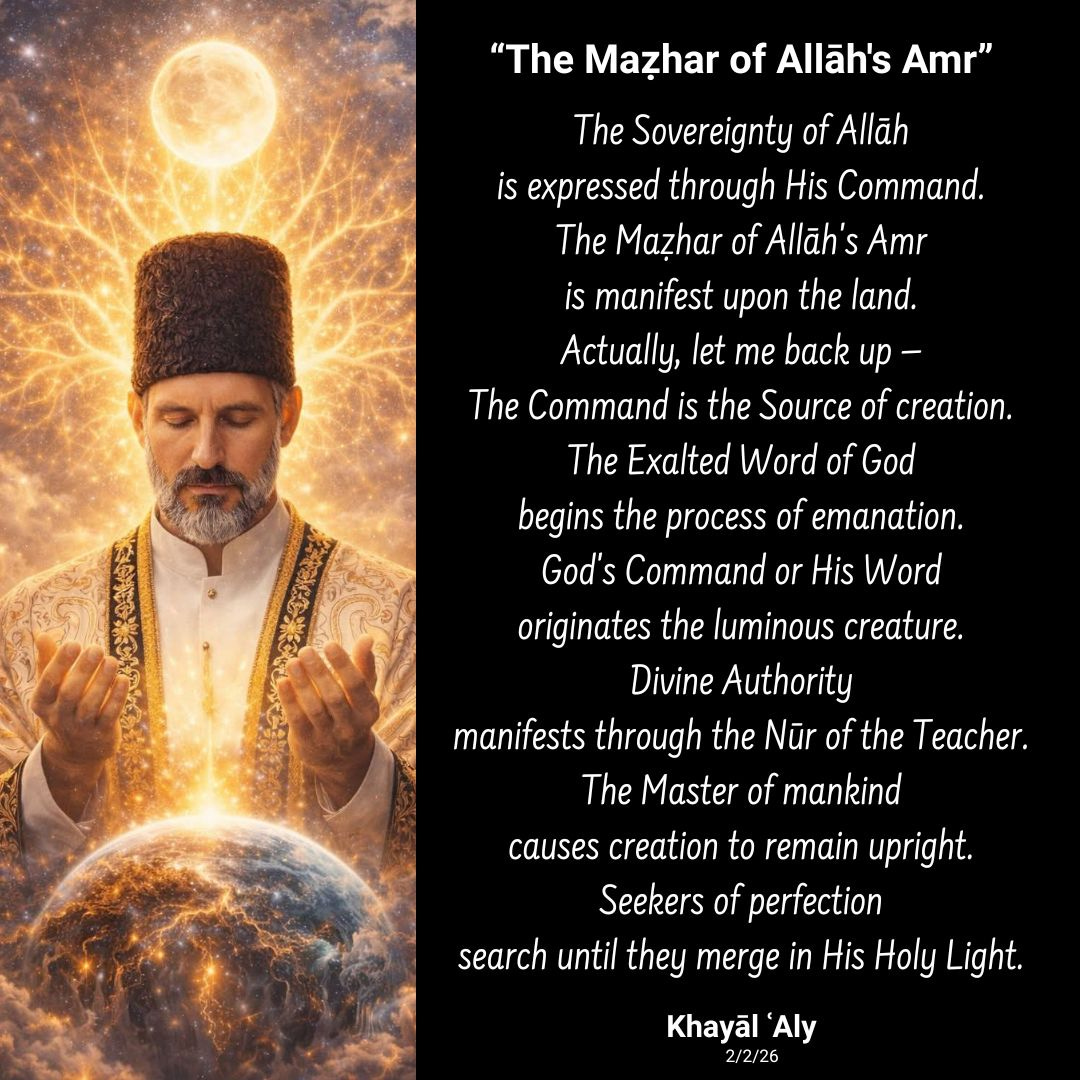
“The Mazhar of Allah’s Amr”
By: Khayal ‘Aly
(2/2/26)
The Sovereignty of Allāh
is expressed through His Command.
The Maẓhar of Allāh’s Amr
is manifest upon the land.
Actually, let me back up —
The Command is the Source of creation.
The Exalted Word of God
begins the process of emanation.
God’s Command or His Word
originates the luminous creature.
Divine Authority
manifests through the Nūr of the Teacher.
The Master of mankind
causes creation to remain upright.
Seekers of perfection
search until they merge in His Holy Light.
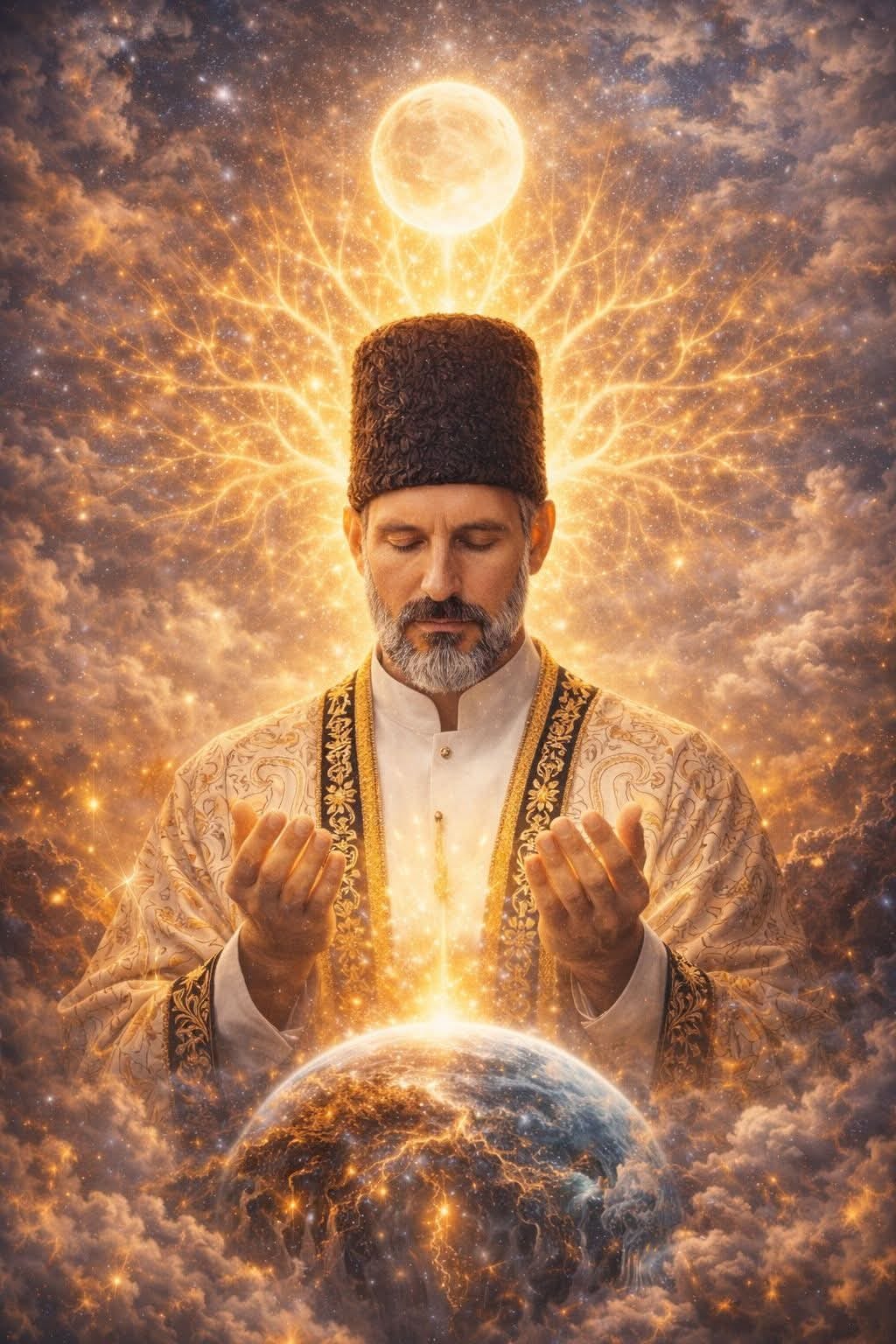
Imamat Day Mubārak to all readers and seekers of Ismaili Gnosis!
We hope you found the above poem a meaningful offering — written in reverence and awe for the Ḥujjat al-Amr (Proof of the Divine Command), Ṣāḥib al-Zamān wa’l-‘Aṣr (Master of physical and spiritual time), Nūr Mawlānā Shāh Rahīm al-Ḥusaynī Aga Khan V, ṣalawātu’llāhi ‘alayhi — and in gratitude for the divine reality he manifests as the maẓhar (locus of manifestation) of Allāh.
The selected passages that follow are intended to deepen our understanding of the key concepts invoked—explicitly and implicitly—in the poem. They remind us, and for some may newly illuminate:
the function of the Divine Command (Amr-i Ilāhī) or Exalted Word (Kalima-i A‘lā) as the Source (Mabda’) of emanation and creation;
the reality of the Manifest Imām, who, as God’s Maẓhar, makes His sovereignty and authority present in the world of humanity;
the Imām’s role as the Perfect and Universal Teacher (Mu‘allim-i Kull), through whom humanity is preserved and guided morally, spiritually, and intellectually;
and the significance of our own esoteric mission as sincere believers (mu’mins)—to elevate and complete our souls by uniting with the Sacred Light (Nūr-i Muqaddas) of the Maẓhar of Allāh’s Amr, the Imām of the Time.
All of the excerpts presented below are drawn from two major works of the renowned 13th-century Muslim polymath and Ismā‘īlī dā‘ī, Naṣīr al-Dīn Ṭūsī. The first selections come from Sayr wa Sulūk, translated by S. J. Badakhchani as Contemplation and Action: The Spiritual Autobiography of a Muslim Scholar. The second are taken from Rawḍa-yi Taslīm, a collaborative work to which Sayyidna Ṭūsī contributed, translated by S. J. Badakhchani as Paradise of Submission: A Medieval Treatise on Ismaili Thought.
By sharing these carefully chosen passages, we hope not only to enrich the reader’s appreciation of the poem offered on this blessed occasion, but also — through a deeper recognition of the bāṭinī ḥaqīqa of our Imām-i Zamān — to inspire a return to these original texts. Without them, neither the poem nor the reflections in this post would have been possible.
Ya ‘Aly Madad,
Khayāl ‘Aly
2/3/2026
khayal.aly@gmail.com
Follow on Instagram:
khayal.aly | ismaili.rhyme.minders
ismailignosis | ismailignosis.blog
“Verily, His Command,
when He desires a thing,
is to say to it
‘Be’ and it is.”
Innamā amruhu
idhā arāda shay’an
an yaqūla lahu
kun fayakūn
« Holy Qur’an 36:82 »
The Ta‘līmiyān [i.e. Ismā‘īlīs] believe that all beings issue forth from God, the exalted, Who is the First Origin (mabda’-i awwal), through the mediation of something which…is called His Command (amr) or His Word (kalima).
[T]he First Cause of the Universal Intellect (‘aql-i kull), which is the First Effect, is God’s Command (amr), because God is altogether beyond (munazzah) cause or effect.
[…] This verse [“Verily, His Command, when He desires a thing, is to say to it ‘Be’ and it is” (36:82)] makes it clear that the issuing forth of existents from God depends on the expression ‘Be’ (kun), and…the Command (amr) is an expression for that Word (kalima).
[…] There is no doubt that this aspect, the Command (amr) or the Word [of God] is not something additional to His [i.e. God’s] sacred essence, in so far as He is He, the exalted…but from the point of view where [the Command] is the cause of an effect, it is something additional.
This additional entity, in reality, is the cause of the First Effect [that is, it is the cause of the Universal Intellect], because…there can be no cause without a corresponding effect, and no effect without a corresponding cause.
— Naṣīr al-Dīn Ṭūsī, Contemplation and Action, 35-37
It is an error to speak of the First Cause in relation to God, but it is correct to apply it [i.e., the term “First Cause”] to His Command (amr), which is the source of all existents.
In fact, whatever attribute has been ascribed to the “First Cause”…is a reference to His Command (amr), one facet of which is directed to the world of pure, eternal unity, [and] the other to the world of multiplicity and contingency; but God as such is free from, and exalted above, both these facets.
As has been expressed in the words of [one of] the Leaders of the truthful… “Whatever pertains to God, pertains to us [the Imāms].”
— Naṣīr al-Dīn Ṭūsī, Contemplation and Action, 38
In the sciences of the truth (‘ulūm-i ḥaqīqī), it has been perceived that beyond the world of the senses there is another world — that of the Intellect — which is related to the former in the same way as the soul is to the body. This is why it is called the spiritual world and the other the physical world.
Corresponding to each sensible thing in this [physical] world is an intelligible entity in that [spiritual] world, and corresponding to each person here is a spirit there, and corresponding to every manifest thing (ẓāhir) here, is a hidden one (bāṭin) there.
Similarly, corresponding to every intelligible entity there is a sensible one here, and corresponding to each spirit there is a person here, and corresponding to each hidden entity there is a manifest one here.
That intelligible entity is the source (maṣdar) of this sensible one, and this sensible thing is the manifestation (maẓhar) of that intelligible one.
— Naṣīr al-Dīn Ṭūsī, Contemplation and Action, 40

As for the Word (kalima) of the exalted Creator — which is the sustainer of existents in the world and that by which each of them reaches its perfection, originating from it and returning to it — if it [i.e. the Word] had no connection (ta‘lluq) to the sensible world, the latter would have never come into existence.
Since there is such a connection, which is of the same kind and therefore has to be perceptible to the senses, the Command (amr) and the Word (kalima) must inevitably be manifest in this world, and the locus of its manifestation (maẓhar) must be in the form of an individual human being who appears to be like other humans, [one who] is born, grows old and succeeds to the one before him in a continuous line, so that it [i.e., the Command or the Word of God] will be preserved in perpetuity [among mankind]:
“And had We made him [the Prophet] an angel, We would have certainly made him a man, and disguised [him] before them in garments like their own” (6:9).
— Naṣīr al-Dīn Ṭūsī, Contemplation and Action, 40-41
In the world of pure spirituality, it [i.e. the Command of God] is the possessor of infinite knowledge and power; all forms of knowledge and perfections pour forth from it upon the intellects and souls....
This being is the Command (amr) or the Word (kalima) of God; its rank is higher than that of possible things and effects, both of which are obedient and subservient to His Command: “None is there in the heavens and the earth but he comes to the All-merciful as a servant’ (19:93).
As for God as such, He is above both the worlds; He is free and absolved from [the oppositions of] unity and multiplicity, similarity and differentiation, reality and relativity: “Glory be to thy Lord, the Lord of majesty. [He is] above what they describe” (37:180).
Any perfection that exists potentially in souls and individuals in the two realms is brought from potentiality to actuality by [His Command], by the light (nūr) of its instruction (ta‘līm) and the illumination of its guidance (hidāyat): “[Our lord is He] who gave everything its existence, then guided it” (20:50).
Since in the beginning the existents came forth from the Command (amr) and by it they attain their perfection, it is their origin (mabda’) and to it is their return (ma‘ād); it is the first (awwal) and the last (ākhir), and in it the circle of existence is completed: “He is the first and the last, the manifest and the hidden; He has knowledge of all things” (57:3).
[The Command], therefore, has necessarily three aspects: first, it is a person like any other; second, it is the cause, the instructor, the perfect one, and the others are its effects, the instructed, those who are lacking in perfection; and third, it [the Command] is itself, and nothing other than it is worthy of being the cause of existence.
— Naṣīr al-Dīn Ṭūsī, Contemplation and Action, 41-42
The followers of ta‘līm [Ismā‘īlīs]…believe in the principle that everyone, whatever his degree may be, knows his own instructor, who in turn knows his own instructor [and so on] to the First Instructor [mu‘allim-i awwal], who knows God through God. As a result, everyone also comes to know God through God.
In the Fuṣūl-i Muqaddas [Sacred Chapters of Imām Ḥasan ‘alā dhikrihi al-Salām] it is written: “Everyone must know [God] through knowing me, since a person becomes a knower (‘ārif) through my knowledge and becomes a monotheist (muwaḥḥid) through my monotheism. Then the reality of knowledge (ma‘rifat), union (ittiḥād) and oneness (waḥdat) comes completely into existence, and the reality of worship becomes evident”.
The evidence for such a judgment in the revealed law and the exoteric aspect of revelation is the text of the Qur’ān: “Those are they whom God has guided, so follow their guidance” (6:90).
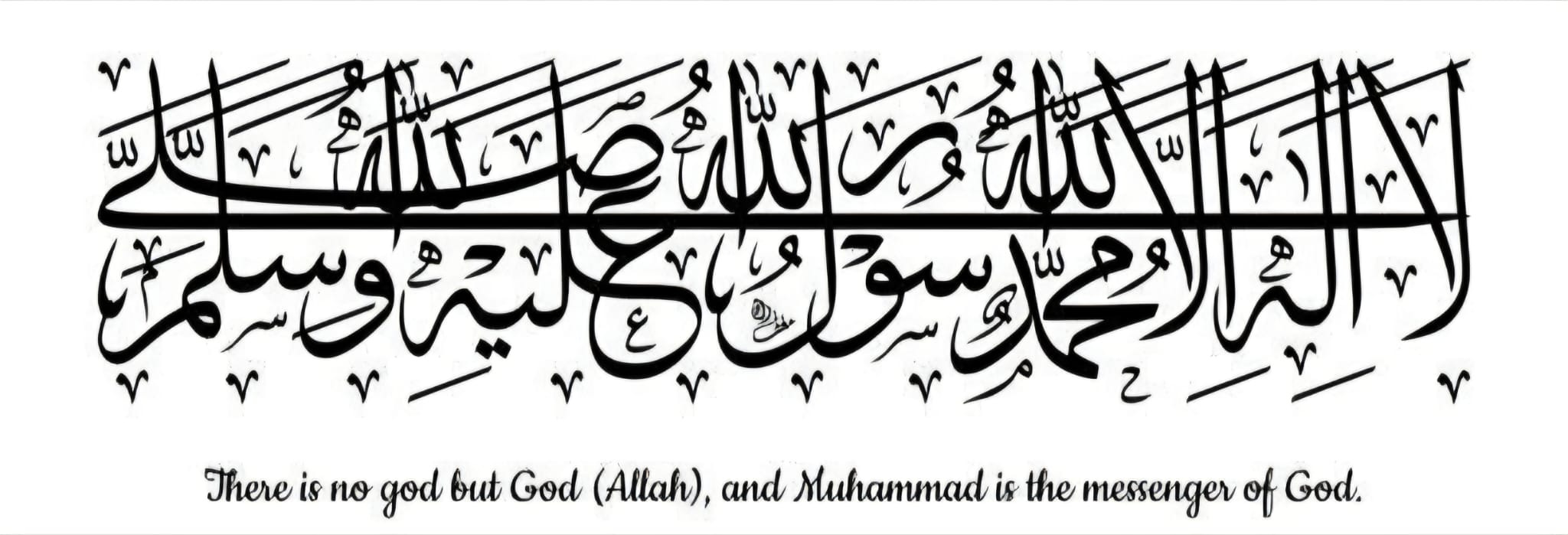
And there is also the fact that in the realm of religious law, knowledge of God is not judged by the mere profession of the formula ‘There is no god but God’, unless the confession of ‘Muḥammad is His Messenger’ is added to it.
— Naṣīr al-Dīn Ṭūsī, Contemplation and Action, 44-45

Souls, despite their various ranks, emanate from one origin and share in the same essence (māhiyyat), but they are perpetuated [individually] by virtue of the forms they acquire, which is the cause of their coming into this world.
So if the form which is represented in the soul of the disciple is identical to that which is represented in his instructor’s soul, and if his position is such that he knows through the knowledge of his instructor, and the instructor is in agreement with his return, there will be no differentiation and multiplicity between their souls; and when the veil is removed, he will reach his instructor and be united with his oneness, and then he [the disciple] will have reached [his place of] return.
— Naṣīr al-Dīn Ṭūsī, Contemplation and Action, 45-46
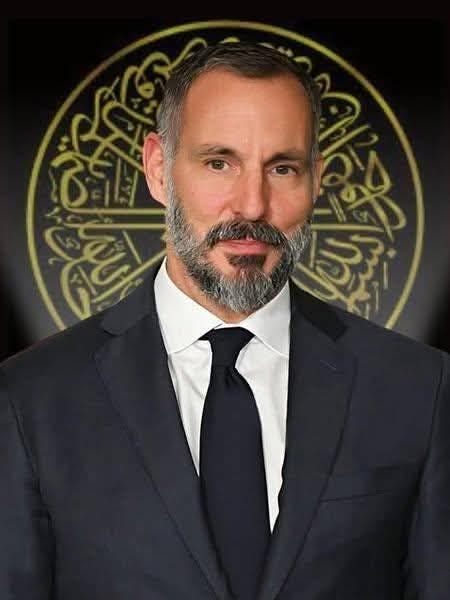
To sum up, from the above premises and the testimonies of intellect and religious law (‘aqlī wa shar‘ī), it became evident to me that the final step on the path of the seekers after truth is to be blessed with success in knowing their instructor and to become knowledgeable through his knowledge, as it is expressed in the Fuṣūl-i Muqaddas: “Knowledge of God is [through] knowledge of the Imam.”
— Naṣīr al-Dīn Ṭūsī, Contemplation and Action, 47
I conceive the source (mabda’) of existence to be one, and that one [is] His Almighty and Holy Command (amr-i ū ta‘ālā wa taqaddas), which is also called the Word (kalima).
The first being, which came into existence through absolute origination (ibdā‘-i maḥḍ) from the Command without any mediation, was the First Intellect (‘aql-i awwal) [i.e., Universal Intellect].
Other things came into existence through intermediaries from the Command, such as the [Universal] Soul (nafs) through the mediation of the [Universal] Intellect, and Matter (hayūlā), Nature (tabī‘at) and Body (jism) through the mediation of the [Universal] Soul.
[…] The Divine Command (amr-i ilāhī)...is one pure light (nūr-i mahḍ), one uncontaminated emanation, one bounty and one generosity which, in the primordial past was the cause for the existence of the 18,000 worlds, and, in the subsequent future will be the cause for the perfection (kamāl) of their essences.
— Naṣīr al-Dīn Ṭūsī, Paradise of Submission, 19-20
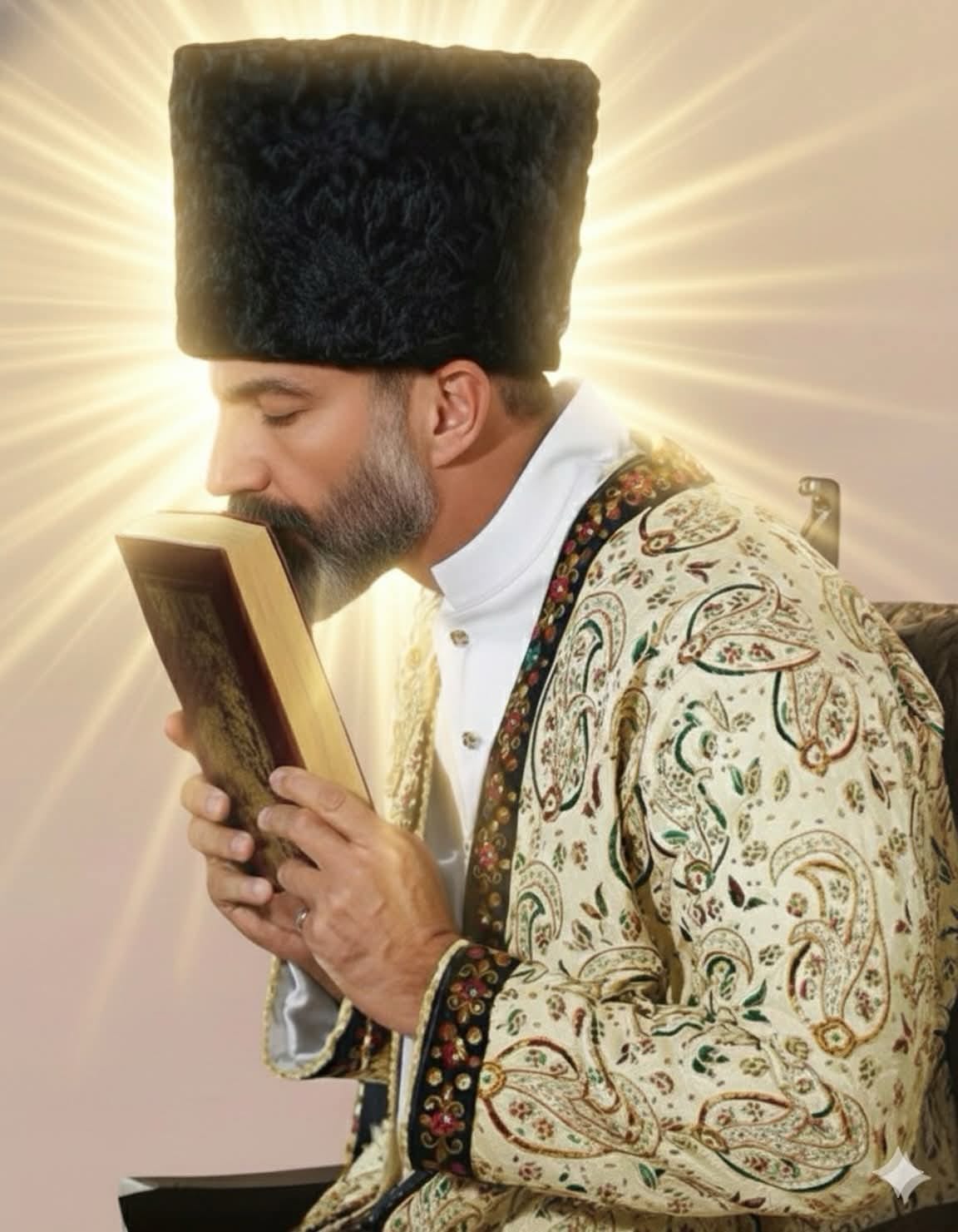
The Prophet — peace be upon him — appears at the beginning of the cycle of origin (dawr-i mabda‘). He encompasses it so that through him the lights of the Almighty’s Command (anwār-i amr-i ū ta‘ālā), in the form of acts of obedience and worship, collectively prescribed to the generality of humankind, may reach them.
As the majority of people in this world are, in the first instance, veiled from accepting and responding to the Divine Command in good faith, and can only perceive what is connected with the senses, fanciful estimation and imagination, the divine providence has decreed that these divine lights — which are absolute intelligible realities (ma‘qūlāt-i muṭlaq) and pure divine graces (ta’yīdāt-i maḥḍ) — should become apprehended through the Prophets, their family and offspring, and by the senses, estimation and imagination, according to the principle that revelation (tanzīl) is [given in proportion to] the degree corresponding to that stage.
Human beings accepted these things as a result of [their] affinity to the senses, estimation and imagination, and applied themselves to them…while the souls of the elect within the community became capable of acquiring [spiritual] perfection by such ways and means, thus [enabling them to] progress from religious practices (‘amaliyyāt) to religious knowledges (‘ilmiyyāt), and from that on to purely intelligible realities (‘aqliyyāt).
The Imām — may salutations ensue upon mention of him — is situated at the commencement of the cycle of perfection (dawr-i kamāl), encompassing both the origin and the perfect fulfilment. The lights of the divine creative volition (anwār-i amr-i ibdā‘ī), by his command, shine upon those souls who harbour an aptitude to apprehend the perfection of the Divine Command, taking the form of distinctive and true gnosis (ma‘rifat), love (maḥabbat), obedience and devotion.
And by the grace of the Imām — may salutations ensue upon mention of him and his family and offspring — in accordance with [the saying], “Spiritual exegesis (ta’wīl) is the restoration [or returning] of things to their origin” (al-ta'wīl radd al-shay’ilā awwalihi) — these sensible, estimative and imaginal realities become one and the same with the absolute intelligible realities and sheer divine supports (ta’yidāt-i maḥḍ).
— Naṣīr al-Dīn Ṭūsī, Paradise of Submission, 111
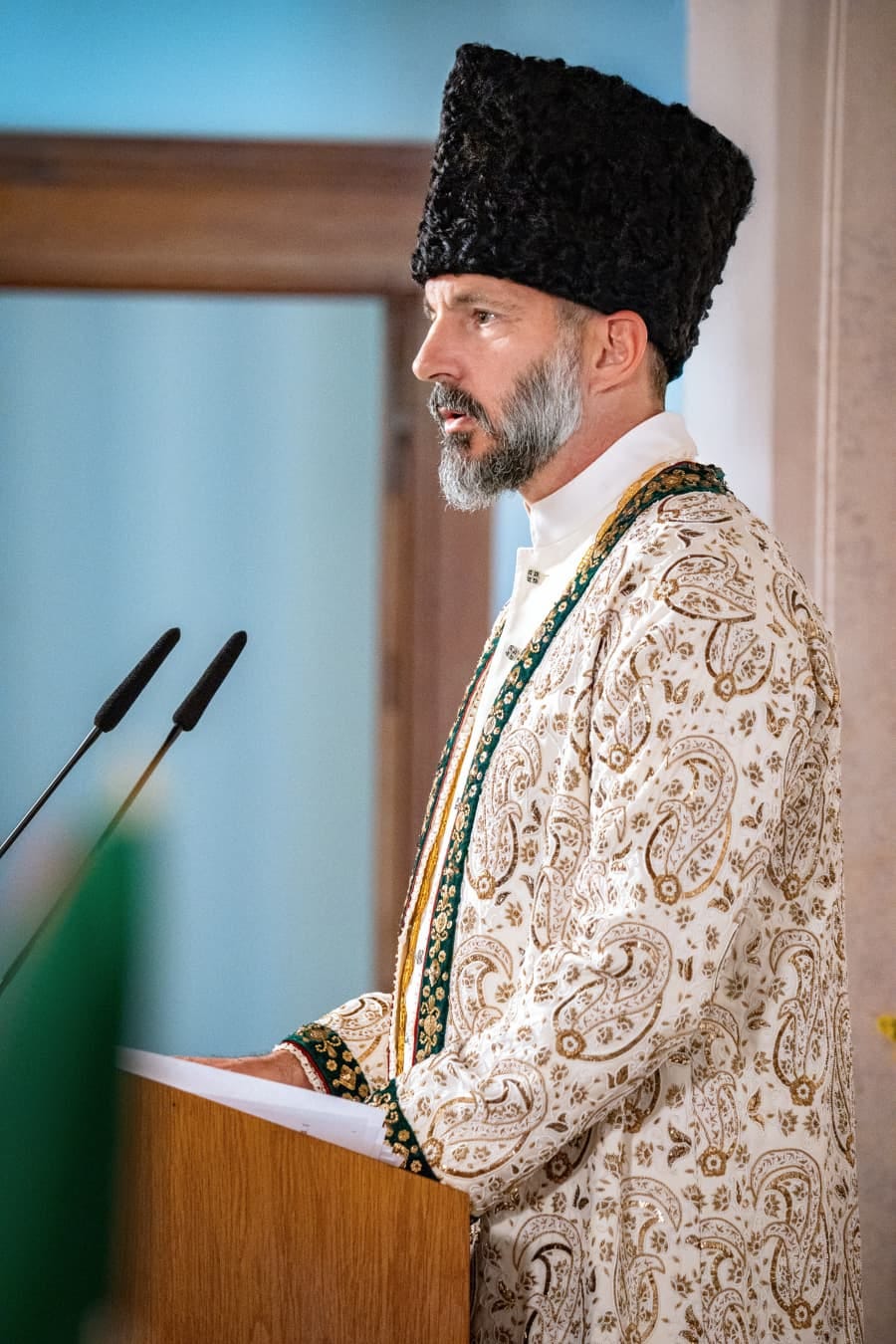
There is one who is beyond both learning and unlearning, who is the lord of all these (khudāwand-i īn hama) and the bestower of that knowledge (ma‘rifat) through which the perfection of reason is obtained.
Such a one [i.e. person] is the manifestation of the sublime Word (maẓhar-i kalima-yi a‘lā), who bestows that knowledge which is the perfection of the intellect.
The whole purpose of his work is that people should come to know and love him and so become members of his party, company and community (jamā‘at). He is the Imām — may salutations ensue upon mention of him.
— Naṣīr al-Dīn Ṭūsī, Paradise of Submission, 131
It has been said: “just as the gnosis of God in reality depends on the man of God (mard-i khudā), so the recognition of the Imām in reality depends on the man of the Imām (mard-i imām)” and so on...everyone possesses a different degree in gnosis, as is stated in the Qur’ān: “And none of us is there, but has a known station” (37:164).
The highest station [of gnosis] is that one knows God through God (khudā rā bi-khudā shināsand): “God bears witness that there is no God but He” (3:18). This station can only be that of the “man of God” [i.e. the Imām], who is the manifestation (maẓhar) of the Divine Command (amr) and the Word (kalima) of God and the mediator (mutawwasiṭ) between God and creation — such that, with the face that he has towards God, he can recognise God, and with the face that he has towards people, he can cause people to reach God, so that through his gnosis they become cognisant of God.
Since the Divine Command and the Word are from the realm of Unity — “And Our command is but one” (54:50) — the “man of God” [i.e. the Imām] will always be that unique truthful master who does not and cannot have any partner or like in the world: “He is one without a partner” (6:163).
After this, the next station is to know God through the “man of God” [i.e. the Imām]. This may be the rank and degree of the bābs (gates) and the supreme ḥujjats (proofs), who are manifestations of the First Intellect and First Effect. They are also the first receivers, so that whatever they accept from the “first man” (mard-i awwal) [i.e. the Imām], they cause to reach other human beings.
Since there is only one mediator between them and God, they know God through that mediator [i.e. the Imām]. And because multiplicity (kathrat) is potentially embedded in the First Effect, the number of people who hold this class in every age can be more than one….
[…] Beneath this station, there are stations of multiple degrees which pertain to the ranks within the community (maqāmhā-yi jamā‘ati). Between them and God there are several mediators.
The spiritual knowledge (ma‘rifat) of this community lies in the fact that each person, according to the station he possesses, is cognisant of the spiritual knowledge of his own teacher in such a manner that the form of his soul is identical with that which is in his teacher’s soul.
So, ultimately all acts of cognition are united by the cognition of the one who is truly cognisant (‘ārif-i bi-ḥaqīqat), that is, the “man of God” [i.e. the Imām of the time]: “And to Him are returned all affairs” (11:123).
— Imām ‘Alā’ al-Dīn Muḥammad⁽ᶜ⁾, as quoted in Naṣīr al-Dīn Ṭūsī, Paradise of Submission, 176-7

Now, you may call the Imām — may salutations ensue upon mention of him —either ‘Imām’, or the ‘eternal Face of God’ (wajh Allāh al-bāqī), or the ‘Supreme Attribute’ (ṣifat-i a‘zam), or the ‘Great Name of God’ (nām-i buzurg-i khudāy), or the ‘Manifestation of the Supreme Logos’ (maẓhar-i kalima-yi a‘lā), or the ‘Truthful Master of the Age’ (muḥiqq-i waqt). For he is all things even without creation, whereas all creation devoid of him is but nothing. All these titles have one and the same meaning.
— Naṣīr al-Dīn Ṭūsī, Paradise of Submission, 133
Support Ismaili Gnosis
in Publishing Articles
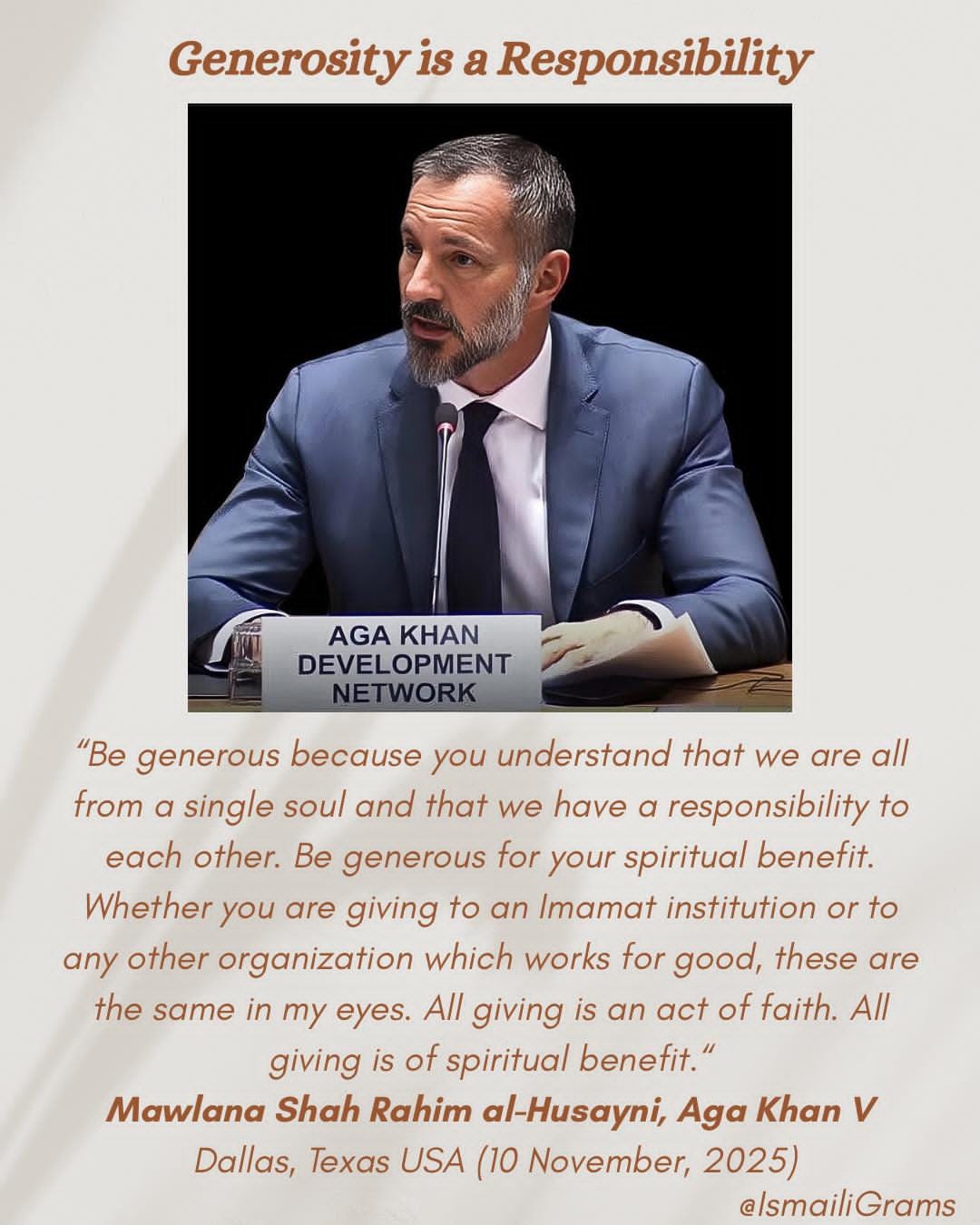
“Whether you are giving to an Imamat institution or to any other organization which works for good, these are the same in my eyes. All giving is an act of faith. All giving is of spiritual benefit.”
— Imām Shāh Raḥīm al-Ḥusaynī⁽ᶜ⁾
(Dallas, Texas, November 10, 2025)

The article looks really interesting and I will do it justice by reading it later today insha'Allah
Mashallah it's a great poem! GBY and ya Aly madad!