


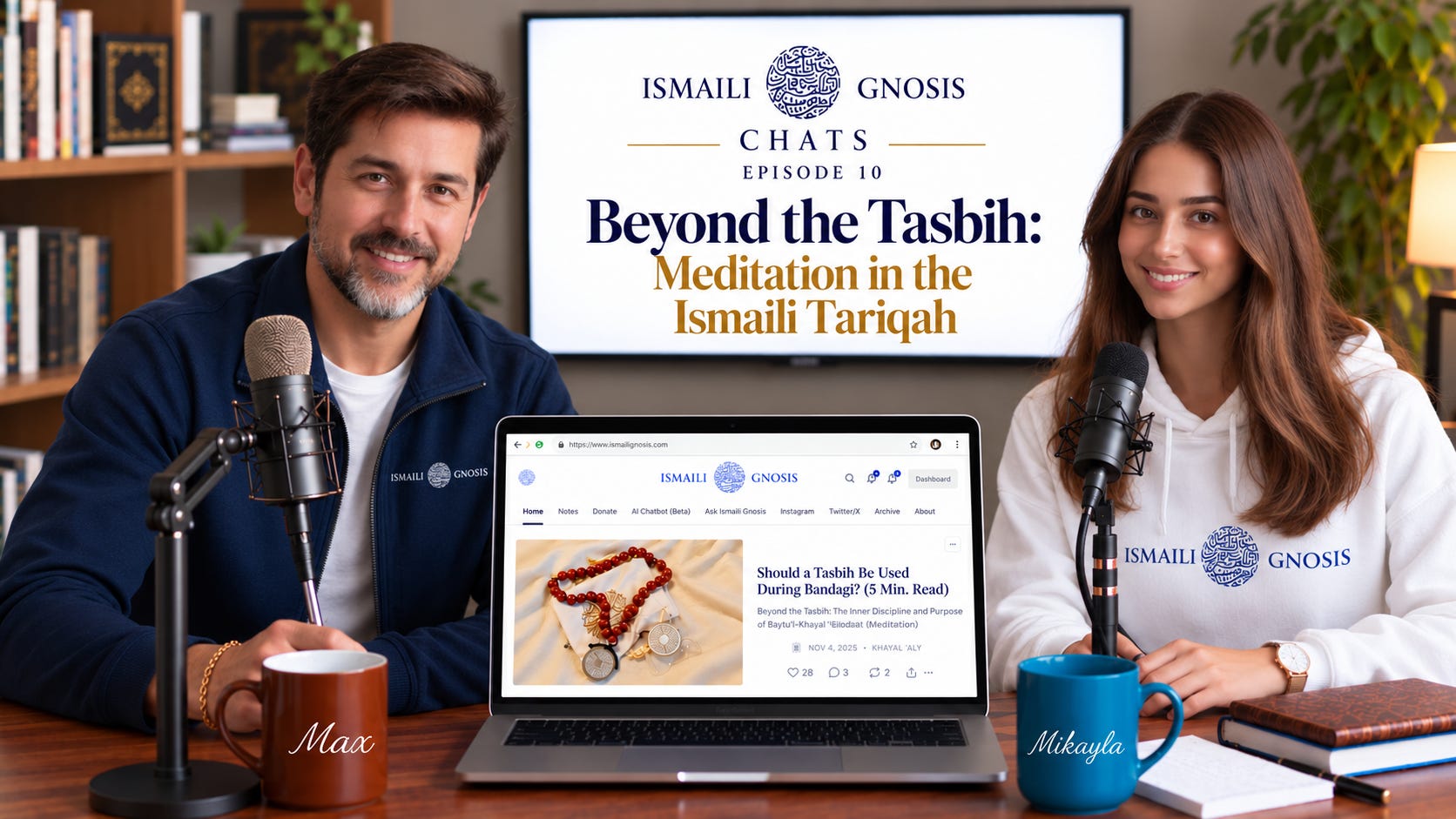
Welcome to Episode 10 of Ismaili Gnosis Chats with Max and Mikayla. Each episode draws on original research from Ismaili Gnosis articles.
Scroll down to play the podcast. After listening, you’ll find:
Questions & Answers
Video Overview
Ways to Support Ismaili Gnosis
Link to the Original Article
Podcast Summary
Beyond the Tasbih: Meditation in the Ismaili Tariqah
Join Max and Mikayla for Episode 10 of Ismaili Gnosis Chats as they explore a key question in Ismaili spiritual practice: Should a physical tasbih (prayer beads) be used during bandagi, the meditative worship performed in the Bayt al-Khayal? Drawing on evidence from the Imams, the conversation examines why physical prayer beads should not be used during this practice and explores the deeper purpose of bandagi: cultivating inner stillness through concentration on the ism-i a‘zam (Supreme Name), or Bol; nurturing the soul’s connection with the Divine; and transforming earthly consciousness toward the Eternal.
The episode also explores spiritual empathy—showing consideration for fellow seekers and preserving the stillness and silence essential to collective spiritual practice. It will appeal to Ismailis seeking a deeper understanding of their Tariqah and anyone interested in esoteric Islam, Sufi thought, and contemplative spirituality.
Ismaili Gnosis Chats
Episode 10:
“Beyond the Tasbih:
Meditation in the Ismaili Tariqah”
(click the ▶ button above to listen)

Questions & Answers
(Drawn from the Ismaili Gnosi article)
1. Why was the tasbih (prayer beads) discontinued during bandagi?
The discontinuation of the tasbih during bandagi was explicitly directed by the 48th Ismaili Imam, Mawlana Sultan Muhammad Shah⁽ᶜ⁾, in a 1908 farman delivered in Poona.
According to the source, the Imam set aside the tasbih during bandagi for several specific reasons:
Focus Shifts to Counting: Using beads naturally draws the practitioner’s mental attention toward the physical beads and keeping count, which breaks the pure, uninterrupted concentration (dhyan) required for deep meditation.
Distraction to Others: The physical movement and clicking sounds of handling prayer beads disrupt the quiet, reflective environment of the Baytu’l-Khayal, interfering with the concentration of nearby worshipers.
The Nature of Inner Meditation: Bandagi is an esoteric practice meant to transcend outward physical aids. It demands absolute physical stillness, a silent tongue, and single-minded focus (ek dhyan) on the Ism-i A‘zam (Supreme Name) or bol.
Distinction from Daily Dhikr : The Imam clarified that setting aside the tasbih applies specifically to the silent hour of bandagi. Outside of bandagi, carrying a tasbih and using it for daily dhikr (remembrance of Allah, the Prophet, and the Imams) remains a deeply meaningful and encouraged practice
2. What is the purpose of bandagi and how does concentration work?
Purpose of Bandagi
The core purpose of bandagi (the silent meditation practiced in Baytu’l-Khayal) is to turn the heart and mind completely toward the remembrance of Allah through the Ism-i A‘zam (the Supreme Name bestowed by the Imam) or another Divine Name.
Its purpose encompasses several interconnected spiritual dimensions:
Attaining Divine Proximity: Enabling the believer’s soul to ascend spiritually and draw close to “He who is above all else” through the Light of the Imam and contemplation of the bol (sacred word).
Achieving Inner Stillness and Absorption: Reaching a state where the body is calm, the tongue is silent, and the heart calls wholly upon God, ultimately allowing the worshiper’s soul to be absorbed in the Light of the Imam and merge with the spiritual reality (haqiqat) of the Name.
Transcending the Earthly Self: Liberating the individual from the constraining bonds of the subjective self through rapt meditation, whereby temporal and earthly consciousness is swallowed up in eternity and itself becomes eternal.
How Concentration Works
Concentration (dhyan) in bandagi is a discipline of pure, single-minded focus (ek dhyan) that requires turning away from all external physical aids and internal mental wanderings. It functions through the following key practices:
Eliminating Outer Aids and Physical Movement: Physical items such as the tasbih are set aside because counting or handling beads diverts focus to outward actions. Concentration requires total physical stillness, keeping the body calm, and ensuring the tongue does not move.
Clearing Worldly Thoughts: Concentration works by intentionally eliminating material considerations, worldly matters, and thoughts of “here” and “there” from the mind.
Focusing on the Bol and Its Meaning: The practitioner focuses symbolically on the bol (the sacred word or invocation) and deeply contemplates its meaning as the path to approach the Divine, or He Who is Above All Else.
Internal Visualization through the Inner Eye: By holding the sacred invocation (pavitra jap) firmly in memory, its spiritual form (surat) or written form (nakhsh) manifests to the inner eye. Just as thinking of the sun brings its image into the mind’s eye, contemplating the form of the Name allows one to behold the Divine Form.
Avoiding Distraction to Attain Peace: When attention is pulled away by external surroundings or physical objects, concentration breaks, preventing the heart from experiencing the true spiritual benefit, peace, and inner joy of meditation.
4. Explain ‘spiritual empathy’ in the context of Bayt al-Khayal bandagi.
In the context of Baytu’l-Khayal and bandagi, spiritual empathy refers to the conscious mindfulness, consideration, and care a believer maintains toward fellow seekers sharing the sacred space of meditation].
While bandagi is a deeply personal, inward journey toward Divine proximity, it takes place within a shared environment where every individual is striving for pure, uninterrupted focus (dhyan). Spiritual empathy manifests in several key ways:
Mindfulness of Physical Disturbances: It involves recognizing that even small outward actions — such as the clicking sound or physical movement of prayer beads (tasbih), fidgeting, or making unnecessary noise—can disrupt the delicate concentration of nearby worshipers who are trying to free their minds from external distractions.
Protecting Collective Silence: Spiritual empathy means actively contributing to a quiet, serene sanctuary. By keeping the body motionless, the tongue silent, and setting aside outward physical aids, the practitioner helps safeguard an atmosphere where everyone can maintain single-minded focus (ek dhyan) on the Ism-i A‘zam or bol.
Transcending the Ego: In his Memoirs, Imam Sultan Muhammad Shah⁽ᶜ⁾ reflects that true contentment comes from “forgetting self” and merging subject with object in spiritual harmony. Caring for the spiritual well-being and quietude of others is a practical application of letting go of the self-centered, “subjective self” during prayer and meditation.
5. According to Mawlana Shah Karim⁽ᶜ⁾, how should the seeker come closer to He Who is Above All Else?
According to Mawlana Shah Karim⁽ᶜ⁾, a seeker comes closer to “He Who is Above All Else” during bandagi through specific inner steps during meditation:
Eliminating Worldly Considerations: Sitting in meditation while actively freeing the mind of material considerations and worldly matters.
Concentrating on the Meaning of the Bol : Symbolically focusing on the sacred word (bol) and concentrating deeply on its meaning, as seeking proximity to the Divine is the true purpose and meaning of the bol.
Searching for the Light of Hazrat ‘Ali⁽ᶜ⁾: Seeking to draw spiritually close through the Light of Hazrat ‘Ali⁽ᶜ⁾ (the Light of the Imam) — searching out that Light during meditation.
Progressive Ascent Through the Word: Concentrating on the sacred word as a symbolic path to draw continuously nearer — moving “close, and closer, and closer to ‘He who is above all else’”
Video Overview
Ya ‘Ali Madad,
Khayal ‘Aly
khayal.aly@gmail.com
October 20, 2026
Follow on Instagram:
khayal.aly | ismaili.rhyme.minders
ismailignosis | ismailignosis.blog
Access Full Content
on Ismaili Gnosis
Know someone who would enjoy
full access to Ismaili Gnosis?
Support Our Mission
“Whether you are giving to an Imamat institution or to any other organization which works for good, these are the same in my eyes. All giving is an act of faith. All giving is of spiritual benefit.”
— Imam Shah Rahim al-Husayni⁽ᶜ⁾
(Dallas, Texas, November 10, 2025)

Ismaili Gnosis is a U.S.-registered 501(c)(3) nonprofit. Your voluntary donation supports research and educational content and is separate from paid Ismaili Gnosis subscriptions offered through Substack.
