


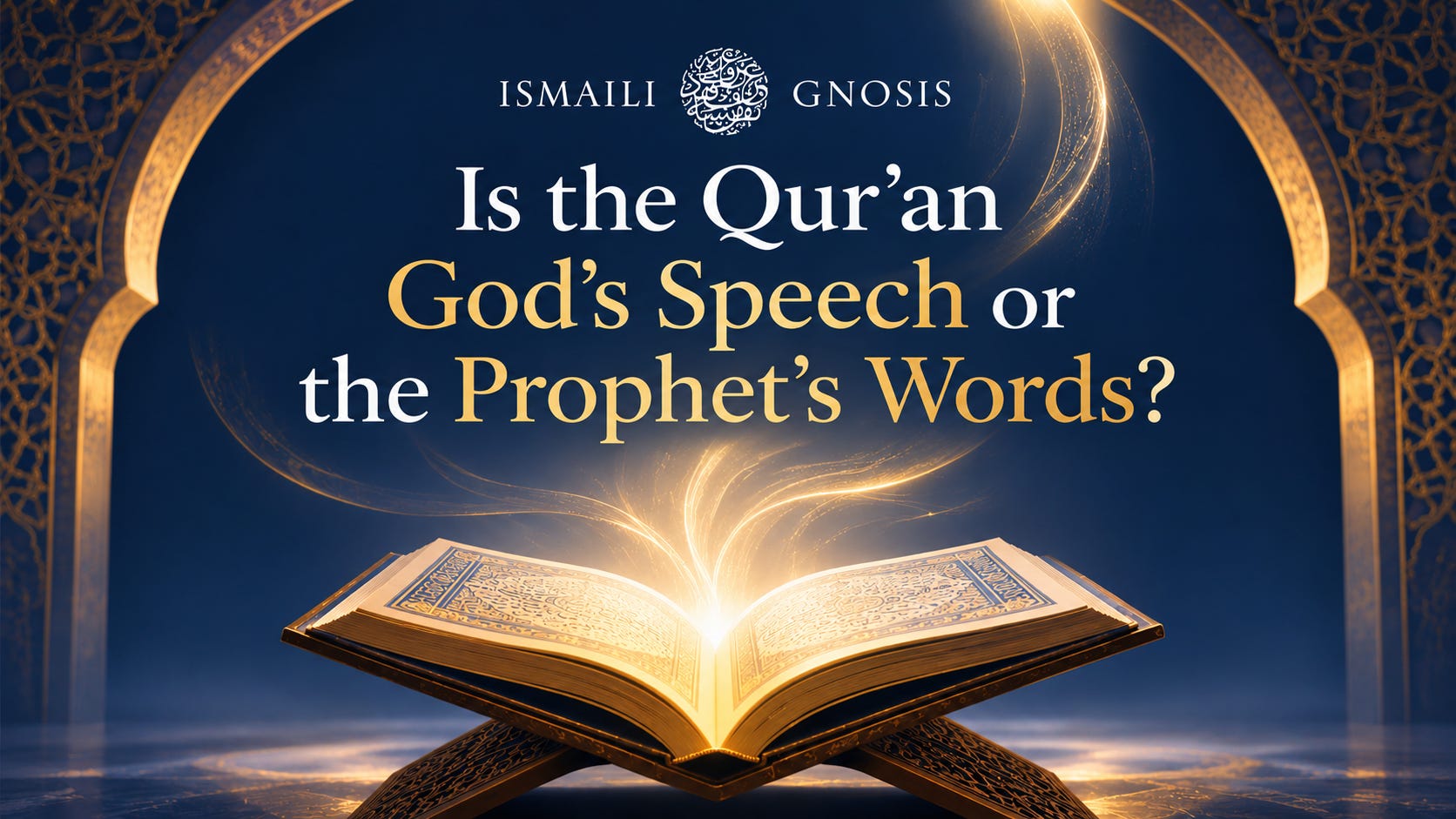
Question: Is the Qur’an God’s Speech or the Prophet’s Words?
Ya Ali Madad, readers and seekers of Ismaili Gnosis.
The other day, an Ismaili seeker asked us:
“Can you please share the passage by a Fatimid Imam explaining that the Qur’an is the Prophet’s expression of revelation in the Arabic language?”
This request suggests that the seeker was already aware of a distinctive Ismaili perspective on Qur’anic revelation: that the Prophet Muhammad⁽ˢ⁾ received divine revelation and expressed it in the Arabic language.
In other words, did the Prophet simply recite the exact Arabic words given to him, or did he play a role in expressing the divine message he received?
For the benefit of our readers, we are sharing the relevant passage from Dr. Khalil Andani’s PhD dissertation, Revelation in Islam: Qur’ānic, Sunni, and Shiʿi Ismaili Perspectives. It contains the requested statement by the Fatimid Ismaili Imam al-Muʿizz⁽ᶜ⁾, along with Dr. Andani’s further explanations.
The Speech of God and the Word of His Messenger
Khalil Andani, Revelation in Islam: Qur’ānic, Sunni, and Shiʿi Ismaili Perspectives (PhD diss., Harvard University, 2019), 568–571.
In one section of Ta’wīl al-sharīʿa, [al-Qāḍī] al-Nuʿmān reported that Imam al-Muʿizz was asked about a qur’ānic verse referring to the Qur’ān as “the light (nūr) that We sent down”. The questioner stated that “light contains neither audible letters nor connected expressions, so in what modality was the state of the Qur’an?”. The Imam responded as follows:
“God only sent down the Qur’ān upon His servant and His Messenger, Muhammad, as a light (nūr) that the faculty of prophecy bore and that the perfect and purified soul accepted. When the Prophet wished to convey the light to the ranks of human beings (ṭabaqāt al-nās), he realized that their dense natures and their turbid souls do not perceive that subtlety (al-laṭāfa). So he [i.e., the Prophet] molded (kayyafa) that subtle light (al-nūr al-laṭīf) with connected utterances (bi-alfāẓ majmūʿa), coined parables (amthāl maḍrūba), and understandable allusions (ishārāt mafhūma) in order establish them in their souls according to the intention of the revealed wisdoms, since the ranks [of the people] do not possess pure souls receptive to that lordly universal light.”
The above remarks contain the most authoritative exposition on the Ismaili view of Qur’ānic Revelation as far as the Fatimid Ismailis are concerned, because these are the words of an Ismaili Imam considered to be infallible in his religious teachings.
The Imam’s explanation … of Qur’ānic Revelation portrays divine inspiration (waḥy) as “subtle light” (al-nūr al-laṭīf), which means that waḥy is non-verbal and non-material. He then affirmed that Muhammad “molded” (kayyafa) the light of waḥy into “connected utterances (bi-alfāẓ majmūʿa), coined parables (amthāl maḍrūba), and understandable allusions (ishārāt mafhūma)”, which together constitute the Arabic Qur’ān. This was necessary because the Prophet’s audience was incapable of perceiving waḥy with their souls.
In sum, the Ismaili Imam identified the “lordly universal light” as the Revelatory Principle and the Arabic Qur’ān as the Revelatory Product, while depicting a two-level Revelatory Process consisting of a non-verbal divine inspiration to Muhammad and the latter’s composition of Arabic letters and words.
Recognizing the agency of Muhammad in producing the Qur’ān may seem to call into question the status of the Qur’ān as the Speech of God. Accordingly, a second statement from the same Imam reported in the Ta’wīl al-sharīʿa leaves no doubt that the Ismaili Imamate recognized the Arabic Qur’ān both as the “word of the Messenger” (qawl al-rasūl) and the “Speech of God” (kalām Allāh).
In this report, the Imam al-Muʿizz was asked about the meaning of the qur’ānic verses that say, “Verily, it is the word of an honorable messenger” (Q. 81:19, 69:40). After quoting this verse, the questioner observed that “according to the majority, [the Qur’ān] is the Speech (qawl) of God, while according to the mention of this verse, the Qur’ān is the Speech (kalām) of the Messenger.”
The Imam responded by saying:
“Verily, God sent down the light (nūr) which He mentioned in the Qur’ān upon the heart of Muhammad. The Prophet did not send down that divine lordly light upon the hearts of the believers because they lacked the capacity to bear it, due to the disparity between the Prophet and the believers among the common people. He only conveyed the meanings of the inspiration (waḥy) and the light – its obligations, rulings and allusions — by means of utterances composed with arranged, combined, intelligible, and audible letters (bi-alfāz mu’allafa bi-ḥurūf muḥarrafa murakkaba mafhūma masmūʿa).
When [the] Prophet combined (rakkaba) these utterances and letters and enclosed the meanings that the inspiration contained within them, the Recitation (al-qur’ān) constructed according to the light — which is the inspiration (al-waḥy) sent down [to him] — became the word of the Messenger (qawl al-rasūl).
Thus, the construction (al-tarkīb), the expressions (al-alfāẓ), and the composition (al-ta’līf) belong to the Prophet (li l-nabī). So it [the Qur’ān] is the Speech of God (kalām Allāh) as well as the word of the Messenger of God (qawl rasūl Allāh).”
This statement certainly overlaps with the same Imam’s remarks as discussed above. God sent down a “divine lordly light” upon Muhammad, who expressed this light in the form of “utterances composed with arranged, combined, intelligible, and audible letters (bi-alfāz mu’allafa bi-ḥurūf muḥarrafa murakkaba mafhūma masmūʿa). But here, the Imam is much more explicit that the Arabic Qur’ān was authored by Muhammad because he enclosed the spiritual contents of waḥy within Arabic utterances and letters: “The construction (al-tarkīb), the expressions (al-alfāẓ), and the composition (al-ta’līf) belong to the Prophet (li l-nabī).” In this respect, the Imam concluded that the Arabic Qur’ān is simultaneously the Speech of God (kalām Allāh) and the word of the Messenger of God (qawl rasūl Allāh).
The implication of this Ismaili formula is that God’s Speech is a spiritual light (nūr) transcending sounds and letters; this being the Revelatory Principle. The Arabic Qur’ān qua sounds, letters, and words is a Revelatory Product composed by the Prophet in which the Speech of God is manifest.
[…] The Ismaili Imam’s position directly opposes contemporary Sunni understandings of Qur’anic Revelation in tafsīr and kalam: he rejects the pre-existence of the Arabic Qur’ān in a heavenly tablet as well as its verbatim dictation to Muhammad by Gabriel. His description that God inspired Muhammad with a spiritual light contradicts…claims that God’s Speech is essentially sounds and letters.
[…] The Ismaili Imam did not frame God’s Speech as an uncreated divine attribute; he also accorded real agency to Muhammad as the author (mu’allif) of the Arabic Qur’ān. Despite the absence of Neoplatonic concepts, the Ismaili Imamate’s position on Qur’ānic Revelation accords with the general views of the Ismaili Neoplatonic philosophers in asserting the non-verbal, spiritual, and luminous nature of waḥy and emphasizing Muhammad’s role as the actual “author” of the Arabic Qur’ān.
Download the Full Dissertation

A Poetic Reflection (Reflecting the Above Section)
Inspired by the same section of Khalil Andani’s PhD dissertation, this short poem, written by Khayal ‘Aly in 2021 and slightly revised for this publication, offers a personal reflection on the spiritual reality of Revelation and the Prophet’s role in expressing it through human language.
“The Prophetic Revelation”
By Khayal ‘Aly
(July 1, 2021)
The Revelation of Scripture
is beyond conventional human speech;
it’s not like Angel Gabriel
needed to use sounds and letters to teach.
In fact, it was actually the Prophet
— who had a magnificent nature 1 —
that expressed the effect of the Spirit 2
using Arabic nomenclature.
That doesn’t diminish the stature
of the inimitable Revealed Book;
it simply does justice to the Prophet —
at least for those who know how to look.
Look with the inner eye of the heart
to witness the luminous manifestation.
The Book and its sagacious Teacher
need to be seen in the Light of Revelation.
1. A poetic allusion to Surah al-Qalam (68:4), in which God describes the Prophet as possessing khuluqin ʿaẓīm, commonly translated as “a great moral character.”
2. That is, the Prophet gave verbal form to the nonverbal spiritual reality of Revelation, expressing it through the Arabic language.
Ya ‘Ali Madad,
Khayal ‘Aly
ismailignosis.com
November 23, 2026
Access Full Content
on Ismaili Gnosis
Know someone who would enjoy
full access to Ismaili Gnosis?
Support Our Mission
“Whether you are giving to an Imamat institution or to any other organization which works for good, these are the same in my eyes. All giving is an act of faith. All giving is of spiritual benefit.”
— Imam Shah Rahim al-Husayni⁽ᶜ⁾
(Dallas, Texas, November 10, 2025)
Ismaili Gnosis is a U.S.-registered 501(c)(3) nonprofit. Your voluntary donation supports research and educational content and is separate from paid Ismaili Gnosis subscriptions offered through Substack.
Enjoyed This Post?
Follow Us on Instagram
«inspired.rhyme.minders»
«ismaili.rhyme.minders»
«ismailignosis.blog»
«khana_yi_khayr»
«ismailignosis»
