


Are You Ismaili or Are You

The 48th Ismaili Imām, Mawlānā Sulṭān Muḥammad Shāh⁽ᶜ⁾, in one of his most widely known and spiritually resonant addresses to the Ismaili Jamat—often referred to as the “Uṣūl-i Dīn Farmān” (the Farmān on the Principles of Faith)—issued a powerful call to his followers: to move beyond surface identity and strive for a deeper, more conscious understanding of their Ismaili dīn (faith). He warned against being Ismaili in name only and emphasized the importance of seeking the inner truth, purpose, and transformative potential of the faith:
“There are those among you who know next to nothing about their faith (dīn).
[…] One who does not understand with intellect and has no desire of rising higher is like a rain-drop which has evaporated from the surface of the earth. One who has the aspiration to a higher realm practices more and more worship (bandagī) and also cultivates love in their heart.
Many of you are unaware. You do not know the true essence or real value (aṣlī khubī) of your faith (dīn), nor do you understand its deeper meaning. You remain unaware of the profound hope and transformative promise that your faith (dīn) holds. Among you are those who have taken on the name of the Ismaili religion (madhhab) and call themselves Ismailis, but they have no knowledge of what the Ismaili religion (madhhab) truly is, nor of its real value. They are ignorant.
[…] You do not understand the true meaning of the Ismaili faith. It is essential that you clearly and precisely recognize your true status—your spiritual rank (daraja)—as Ismailis.”
— Mawlānā Sulṭān Muḥammad Shāh⁽ᶜ⁾, Kalām-i Imām-i Mubīn (Part One), Farmān No. 160, Dar es Salaam, September 29, 1899.

Those murīds (loyal followers) of the Imām who seek to be more than Ismails in name alone—who aspire to understand and embody the inner truths and higher purpose of their dīn—may find profound guidance in the following section. It features excerpts from a concise treatise that reflects deeply on what it means to be a true believer (muʾmin) in the Ismāʿīlī tradition, authored by the eminent 13th-century Muslim polymath and chief Ismaili dāʿī, Naṣīr al-Dīn Ṭūsī.
What Does it Mean to Be an Ismaili Muʾmin?
In this concise yet spiritually rich excerpt from his work Maṭlūb al-Muʾminīn (Desideratum of the Faithful), Sayyidnā al-Ṭūsī outlines the essential conditions for genuine Ismaili belief and conduct—describing what it means to be a faithful Ismaili muʾmin: one whose faith is expressed not merely in outer identity, but in inner realization, devotion, and ethical transformation.
Description of the Faithful Ismaili:
Those who seek the true religion (dīn-i ḥaqq) and name themselves Ismailis should be aware of the conditions for faithfulness (muʾminī) and being an Ismaili. To be an Ismaili means that the claimant should possess three signs.
First, he should have obtained the recognition of the Imām of the time, abide by the commands of the truthful teacher, and never abandon, even for a moment, thought and remembrance of God the Exalted (fikr wa dhikr-i ḥaqq taʿālā).
The second [sign] is contentment (riḍā), meaning that whatever befalls upon him, be it good or evil, benefit or loss, he should not change his attitude.
The third [sign] is submission (taslīm), the meaning of which is to surrender. This means that all things that one cannot carry with himself to the Hereafter should be considered borrowed things (ʿāriyat), that is, something that one should get rid of.
One should devote worldly possessions, family attachments and all other worldly things to the path of truth (rāh-i ḥaqq), so as to reach the rank of faithfulness (muʾminī), in compliance with [the words of the Qurʾān]:
“But no, by their Lord, they will not really believe [as mu’mins, yu‘minūna] until they make you [i.e., the Prophet] the judge in all disputes between them, and find no resistance against your verdict, but accept it [submit, yusallimū] with the fullest conviction [submission, taslīm]” [4:65].1
Thereafter, one must arrive at certitude (mūqin bāyad shudan). This requires ‘believing in the unseen’ (2:3) and ‘being certain of the Hereafter’ (2:4). […]
[…] The rank of unity [waḥdat] can only be achieved when men of faith completely discard their own existence, desiring neither Paradise nor reward or perfection for themselves. They should surpass this world and the Hereafter. The Prophet [Muḥammad], peace be upon him, said:
‘This world is forbidden to the people of the Hereafter, and the Hereafter is forbidden to the people of this world, and both of them are forbidden to the people of God the Exalted.’
These are, as narrated above, the provisions for being a faithful Ismaili.2
On Solidarity and Dissociation:
For anyone claiming religiosity [as an Ismaili], two things are indispensable. The first is solidarity (tawallā) and the second is dissociation (tabarrā), as narrated from [the Prophet]: ‘Religion is love and hate for the sake of God.’ The reality of solidarity is facing someone and the reality of dissociation is discarding everyone apart from him. Both solidarity and dissociation have their respective exoteric and esoteric [aspects].
The exoteric aspect of solidarity is facing good people and its esoteric is facing the man of God (mard-i khudā), that is, the Imām of the time. The exoteric meaning of dissociation is discarding and abandoning bad people and its esoteric meaning is to dislike everything apart from God.
The fulfilment of solidarity and dissociation depends on four things: first, gnosis (maʿrifat); second, love (maḥabbat); third, emigration (hijrat); and fourth endeavour (jihād), each of which having its own exoteric and esoteric [aspects].
The exoteric aspect of gnosis (maʿrifat) is to recognize God through the man of God, that is, the Imam of the time who is God’s vicegerent. Its esoteric aspect is to recognize no one apart from him. The exoteric aspect of love (maḥabbat) is to have affection for him, and its esoteric aspect is to love no one apart from him. The exoteric aspect of emigration (hijrat) is to despise and detach oneself from the enemies of the Imām, and its esoteric aspect is to cut oneself off from everything which is apart from him like wealth, family dependents (ʿiyāl), and body and soul. The exoteric aspect of endeavour (jihād) is to hate the enemies of Truth (ḥaqq), and its esoteric aspect is to try to abandon [worldly] lusts and pleasures and sacrifice them in the path of Truth (rāh-i ḥaqq).
Once these objectives are fulfilled, the true solidarity and dissociation will be realized, and these are the conditions for solidarity and dissociation.
On the Seven Pillars of Religious Law and Their Esoteric Interpretation:
[…] Having performed the external aspects of the fundamentals (arkān-i ẓāhirī) and wishing to know its esoteric meaning, and with knowledge return from this world to the realm of the esoteric and reach one’s original abode (maqām-i aṣlī), one should perform the seven pillars of the truth (haft arkān-i ḥaqīqat) in order to be considered as a man of truth (mard-i ḥaqīqat).
The first is attestation to faith (shahādat), which implies knowing God through the Imām of the time, in compliance with: ‘I will appoint a vicegerent on earth’ (2:30).3
The second is ritual cleanliness (ṭahārat), which means dissociating oneself from previous religious customs and traditions, considering the command of the Imām of the time as truth (ḥaqq) and abiding by his command, in compliance with the words of God, the Exalted: ‘Obey God and obey the Apostle and those charged with authority among you’ (4:59).4
The third is ritual prayer (namāz), meaning that even for a single breath, one should not be negligent of obedience to God and God’s vicegerent so that one might be perpetually in the state of prayer, in compliance with: ‘Those who remain steadfast to their prayer’ (70:23).5
The fourth is ritual fasting (rūza), meaning that one has to surrender his seven exoteric and esoteric faculties to the commandment of God, [as in the words of Mary]: ‘I have vowed a fast to God’ (9:26).
The fifth is almsgiving (zakāt), which means donating to the brother in faith [a portion] of what God has bestowed upon you and to avoid depriving the needy and poor from their right, in compliance with God’s words: ‘Practice regular charity, which is the right religion’ (98:5).
The sixth is endeavour (jihād), which means fighting one’s own [carnal] soul (nafs) and desires, cutting yourself from everything else apart from God and devoting one’s life to the path of the truth, in compliance with: ‘Those who strive in God’s path with their wealth and life’ (9:20).
The seventh is pilgrimage (ḥajj), which implies abandoning this perishable world for the sake of the eternal abode (sarā-yi baqā), in compliance with: ‘What is the life of this world but amusement and play? It is the abode of the Hereafter which is life indeed, if they only knew’ (29:64). And such is the path for the followers of the esoteric aspects (ṭarīqat-i ahl-i bāṭin).
One should abide by the esoteric interpretation of the seven pillars of the religious law, as described here, to be a man of truth (mard-i ḥaqīqat). One should be certain that the commandments and prohibitions of the religious law (sharīʿat) are far easier to perform then the real duties (takālīf-i ḥaqīqī), because all of that which is prescribed for a day and night for the man of religious law (sharīʿat) can be performed in two hours. As for the rest [of day and night], one can engage in whatever is considered important among the worldly tasks, including according to religious law, worshipping God and seeking salvation.
The commandments and prohibitions of the truth are more difficult, in the sense that if the man of truth, even for a twinkling of an eye, forgets the real [esoteric aspects of] prayer, fasting and obedience, and becomes negligent, in that period of time, whatever he does or sees will not be for God’s sake…and he will not be considered a man of truth and esoteric meaning (mard-i ḥaqīqat wa ahl-i bāṭin).6
You Are All Dāʿīs Today: Inspired by and Representing the Ismaili Imām
Having reflected on the spiritual counsel of our 48th Imām regarding the importance of truly understanding and embodying our Ismaili identity—and having gained further insight through the teachings of the esteemed dāʿī Naṣīr al-Dīn Ṭūsī—readers and seekers of Ismaili Gnosis may more deeply appreciate the following words of encouragement from our 49th Imām, Mawlānā Shāh Karīm⁽ᶜ⁾. In this address, the Imām invites his murīds to find inspiration by engaging with the spiritual and intellectual heritage of their faith and by recognizing their active role in continuing the legacy of the dāʿīs.
“Those who served the Imam historically, were given the title of daʿi. You are all daʿis today—all of you. So you are all representing the Imam in your lives, in your work, in your practice. And I give you special blessings for success.
Those of you who are interested in history, read up upon the daʿis of our history! There is much to learn—the way the Jamat practised centuries ago. There is much to learn. It is a source of knowledge, it is a source of understanding of our tradition. So if you have the time and you are interested, read up on the history of the daʿis of our Jamat around the world.
And I think you will find inspiration, you will find ideas that are worth keeping alive today. So this historic continuity is a part of our faith, to which I attach the greatest importance.”
— Mawlānā Shāh Karīm al-Ḥusaynī⁽ᶜ⁾ (Baitu’l-Khayal Mulaqat, Lisbon, Portugal, July 7, 2018).

It is noteworthy that while Mawlānā Shāh Karīm⁽ᶜ⁾ generously refers to all his murīds as dāʿīs—reminding them that they represent the Imām—his words also contain a subtle ishāra (indication): while all may be the Imām’s dāʿīs in a general sense, some may be in a position to serve as dāʿīs with deeper knowledge—those who take interest and initiative to learn more about this profound dimension of the faith “to which [the Imam] attach[es] “the greatest importance.”
A Code of Conduct: A Dāʿī Ought To…
Heeding the wise words of our blessed 49th Imām, we present in this section an important—albeit extremely brief—example of the type of material the Imām may have had in mind when he guided his spiritual children to “read up on the history of the daʿis.” The passages selected are especially relevant, as they are excerpted from an Ismaili work titled A Brief and Concise Treatise on the Code of Conduct for the Dāʿīs, authored by the illustrious 11th-century Ismaili dāʿī Aḥmad b. Ibrāhīm al-Naysābūrī. In this important work, spiritual seekers interested in the refinement of their souls can learn about the qualifications of the Ismaili dāʿī.
The dāʿī firstly requires governance of the individual, which means to govern his own self. Thus he provides for the welfare of his own soul, governing and controlling it, preventing it from having any of the vices and any bad habits of character, keeping it from reprehensible desire for things that are illicit, bearing itself in conformity with the virtuous, and fulfilling required duties and established regulations.
He will censure himself sincerely if he behaves badly, accompanying that with condemnation, regret, reproach and repentance; and he will reward himself if he is good with delight, praise and the urging of more fine actions, and drawing on knowledge in order to direct the novice to it so as to have him adopt his own fine character, follow his words, actions and wise lead.
It is as our master Jaʿfar b. Muḥammad al-Ṣādiq, may the blessings of God be upon him, said: ‘Be for us silent dāʿīs’. They asked: ‘How can we summon if we are silent?’ He answered: ‘Act in accord with what actions we commanded of you and in obedience to God. Make illicit those acts of disobedience that we ordered you to prohibit.’
He who succeeds in governing his own self is fit and able to govern others. It is said: Do what is beneficial to yourself and the people will follow you. God said: ‘O you who believe, guard your own souls; the one who goes astray cannot hurt you if you are guided aright’ [Qurʾān, 5:105] (A Code of Conduct, 53-54).
A dāʿī ought to possess a refinement of soul in addition to knowledge. Knowledge in the absence of refinement of the soul means that it lacks lustre, is unwelcome, its owner deficient in decorum, and his knowledge is of no benefit to him (A Code of Conduct, p. 55).
— Aḥmad b. Ibrāhīm al-Naysābūrī’, A Brief and Concise Treatise on the Code of Conduct for the Dāʿīs.7
The Ismailis: A Radiant Example to the World
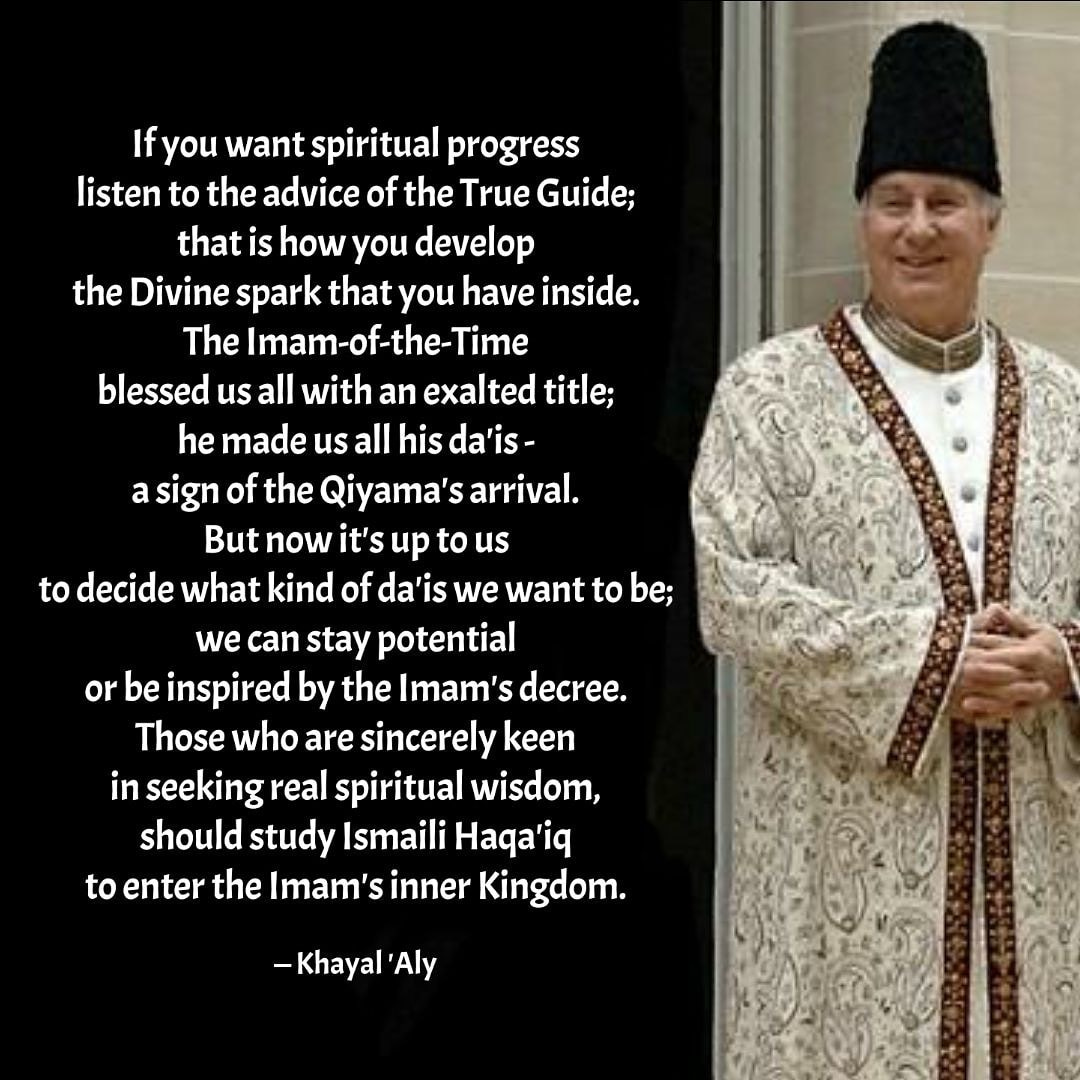
As we bring this humble reflection to a close, we turn once more toward the luminous guidance of our beloved 48th Imām, Mawlānā Sulṭān Muḥammad Shāh⁽ᶜ⁾, who shared with the Jamat a vision that remains deeply relevant—a vision of what he hoped his Ismaili spiritual children would become, and the meaningful role they are called to fulfill in the world:
“In these 70 years of my Imamat men’s material condition has totally changed. There has been an immense increase in power over nature but, as we see, with strifes everywhere, spiritual power has not increased.
It is my hope that my Spiritual Children, the Ismailis, will, by the example of their own higher enlightenment and helpful co-operative movements amongst themselves, set to the world an example of better fraternity and brotherhood which alone can free men from the fear and dangers of moral and mental discord which leads to disaster for all.”
— Mawlānā Sulṭān Muḥammad Shāh⁽ᶜ⁾, Platinum Jubilee Message, “Ismaili Souvenir”, December 12, 1953.
The Imām’s words call us to something far greater than passive identity or surface-level affiliation—something deeper than simply being “Ismaili-ish”, or Ismailis in name only. They urge us to fully embody the ethics, spiritual purpose, and inner principles our tradition. To be truly Ismaili, the Imām suggests, is to cultivate refinement of the soul, to be a source of light and integrity in a world often overshadowed by moral darkness.
This calling is not only ethical, but deeply spiritual and religious. In another address marking his Platinum Jubilee, the Imām offered a gentle yet urgent reminder:
“The world of spiritual enlightenment is fundamentally different from the world of material intellectualism, and it is the pride of Ismailis that we firmly believe that the world of spiritual enlightenment has come as a truth from the inception of Islam to this day with the Imamat and carries with it as one of its necessary consequences love, tenderness, kindliness and gentleness towards first, our brother and sister Muslims of all sects and secondly, to those who live in righteousness, conscience and justice towards their fellow men.”
“These religious principles of Ismailism are well known to you; for you have heard them from me and through your fathers and grandfathers and from my father and grandfathers until I fear that by long familiarity with these teachings some of you forget the necessity of re-examination of your heart and religious experience.”
— Mawlānā Sulṭān Muḥammad Shāh⁽ᶜ⁾ (Extracts of an Address at the Platinum Jubilee Ceremony, Cairo, February 20, 1955).
These religious principles—uṣūl-i dīn—are rooted in the central spiritual reality of Ismailism: the continuing presence of the Imām, and the recognition of the Imāmat as the living link to spiritual enlightenment. When the Imām speaks of the “world of spiritual enlightenment” that “has come as a truth…with the Imamat,” he is not merely making a historical observation. He is reminding us that the Imām of the Time is the gateway to that world. To truly recognize the Imām is not merely to acknowledge a leader, but to orient one’s life around a living spiritual reality (ḥaqīqat). With deep faith (īmān) and certitude (īqān) in this foundational truth, qualities such as love, gentleness, and righteousness are not just moral aspirations, but consequences of spiritual understanding.
From the guidance of the 48th Imām quoted above—and the spiritual insights reflected throughout this article—it becomes clear that the spiritual life of an Ismaili muʾmin is neither static nor automatic. It requires not only outward affirmation of belief and collective action, but also a lifelong inner journey: a continual re-examination of the heart and a deepening of religious consciousness.

Yā ‘Alī Madad,
Khayāl ‘Aly
July 19, 2025
khayal.aly@gmail.com
Follow on Instagram:
khayal.aly | ismaili.poetry
Support Ismaili Gnosis in Publishing New Articles


Footnotes
Sayyidnā al-Kirmānī: Dispositions differ, desires are disparate, events are not predictable or determined, and arrogance, transgression, love of conquest and domination are natural. The course of wisdom thus requires that among people there be a ruler who decides for them about what happens and from whom or from his rule they have no escape nor can they flee his decree. This was the case with the Prophet in his time. God said about him in His statement: ‘Indeed, by your Lord, they will not believe until they make you judge their disputes and find no reservation in their souls about what you have determined but accept them fully’ [4:65]. The ruler [after the Prophet] is the Imām. Therefore, the Imamate is necessary (Ḥamīd al-Dīn al-Kirmānī, al-Maṣābīḥ fī Ithbāt al-Imāma (Lights to Illuminate the Proof of the Imamate), translated by Paul E. Walker as Master of the Age: An Islamic Treatise on the Necessity of the Imamate [London: I.B. Tauris in association with the Institute of Ismaili Studies, 2007], 73-74.
‘Allāmah Hunzai: As for the answer to…the question, “What does it mean to be an Ismā‘īlī in a general sense?”, is that an Ismā‘īlī is such a muslim and a mu’min who acts upon the Qur’ān and Islam according to the commands of God, the Prophet and the ulu’l-amr i.e., the pure Imāms (4:59). The mu’min is convinced that the vicegerent of the Prophet, i.e., the Imām of the time, who is the light of guidance, is always present and existent in this world, and without his blessed existence the affairs of religion cannot be managed (57:28). The mu’min absolutely believes that the position of the Imām of the time is not only as the light (5:15) and the Teacher (mu‘allim) of the Qur'an (2:150-151) but is also the speaking Qur’ān (45:29) (‘Allāmah Naṣīr al-Dīn Naṣīr Hunzai, Saw Su’āl, translated by Faquir Muhammad Hunzai and Rashida Noormohamed-Hunzai as Hundred Questions, 142-143).
Ismaili Gnosis: In verse 2:124, God says to Hazrat Ibrahim⁽ᶜ⁾: ‘Certainly, I am appointing [ja‘il] you an Imām for humankind.’ The Arabic word jā‘il is an ‘active participle’ (ism fa‘il) of the verb “to appoint” (ja‘ala). This verbal form — literally meaning “the appointer” — indicates “a continuous action, a habitual state of being, or a permanent quality...as a verbal adjective for an on-going action” (Gadalla, 2017, 63). In other words, the Qur’anic verb usage indicates that God always appoints Imams for humankind. In that sense, Hazrat Ibrahim⁽ᶜ⁾’s appointment as Imam is not a singular and isolated event; rather, it reflects God’s established way, or habit (sunnah) to continuously appoint Imams age after age.
The Qur’an uses the same agentive verb jā‘il in verse 2:30 when referring to God appointing Adam as His vicegerent or representative on earth: When your Lord said to the angels: ‘I am appointing (jā‘ilun) a vicegerent (khalifah) in the earth.’ In other words, the Qur’anic worldview dictates that the appointment of the Imām or God’s Vicegerent is always executed by God, not by the community: Your Lord creates and chooses whatever He wills — they have no choice in the matter. Glorified and Exalted is Allah above what they associate [with Him]! (28:68) (Ismaili Gnosis, Where is Imamat Found in the Qur’an?, Section 2: “Hazrat Ibrahim: Imām of Humankind [Qur’an 2:124]”).
‘Allāmah Hunzai: Amongst the countless beauties of the wise Qur’ān is that one verse in it is explained by another verse or verses. One such example is verse 4:59 which is related to the subject of obedience, the greatest subject of religion. It is verse 4:80: “He who obeys the Messenger, surely obeys Allāh.” This Divine teaching makes it evident that to obey the holy Prophet is of very great importance. However, for the wise people, the question arises whether this obedience is direct or indirect. The explanatory verse which answers this question is as under:
“O you who believe! Obey Allāh and obey the Messenger and those vested with authority from amongst you” (4:59).
It becomes clear from this luminous guidance that obedience to Allāh's Messenger is possible through the pure Imāms who are those vested with authority because other than them there is no such chain which continues and lasts as long as the world lasts. The proofs for this are in the Qur’ān and the Ḥadīth. It is they whom God has considered His light and He has considered the chain of Imāmat His light (5:15; 7:157; 24:35; 4:174; 57:28; 9:32; 61:8) (‘Allāmah Naṣīr al-Dīn Naṣīr Hunzai, Qur’ānī Minār, trans. Faquir Muhammad Hunzai and Rashida Noomohamed-Hunzai, Qur’anic Minarets [London: Institute for Spiritual Wisdom and Luminous Science, 2024], 138).
Sayyidnā al-Ṭūsī: The summary explanation…[of] ritual prayer (namāz) means to be always speaking with the knowledge of God [in mind] (Naṣīr al-Dīn Ṭūsī, Rawḍa-yi Taslīm, translated by S.J. Badakhchani as Paradise of Submission: A Medieval Treatise on Ismaili Thought [London: I.B. Tauris in association with The Institute of Ismaili Studies, 2005], 142).
Naṣīr al-Dīn Ṭūsī, Maṭlūb al-Muʾminīn (Desideratum of the Faithful), translated by Jalal Badakhchani, in Shiʿi Interpretations of Islam: Three Treatises on Theology and Eschatology by S. J. Badakhchani (London: I.B. Tauris in association with The Institute of Ismaili Studies, 2010), 38-42.
Aḥmad b. Ibrāhīm al-Naysābūrī, al-Risāla al-Mūjaza al-Kāfiya fī Ādāb al-Duʿāt, translated by Verena Klemm and Paul E. Walker with Susanne Karam as A Code of Conduct: A Treatise on the Etiquette of the Fatimid Ismaili Mission (London: I.B. Tauris in association with The Institute of Ismaili Studies, 2011), 53-54, 55.