


Earlier this month, on June 3, 2026, the Ismaili Jamat commemorated Eid-i Ghadir. To mark this blessed occasion, we present — albeit somewhat belatedly — an edited and expanded version of a 2005 handout by Khayal ‘Aly entitled Understanding Our Holy Du‘a: Part III.
For ease of reading, the original has been divided into two parts. This first installment reflects on the event of Ghadir Khumm as alluded to in Qur’an 5:67, a verse recited in Part III of the Ismaili Du‘a. Drawing upon other Qur’anic verses, Prophetic traditions, and even the poetry of the thirteenth-century Ismaili poet Nizari Quhistani, it explores the deeper significance of the Prophet’s proclamation at Ghadir Khumm and its connection to the covenant of Imamat, Divine Favour, and salvific guidance.
A forthcoming second installment will continue to explore Part III of the Ismaili Du‘a, offering further reflections and connections drawn from the Qur’an, Hadith, and the Ismaili intellectual tradition.
The Ismaili Du‘a, Part III: Reflections and Connections — Part 1
We begin Part III of our Holy Du‘a, like all other parts of the Du‘a, in the Name of Allah, the Most Beneficent, the Most Merciful (bismi’llahi’r-rahmani’r-rahim). In doing so, we fulfill a command given by Allah in the first sura of the Qur’an revealed to Prophet Muhammad⁽ˢ⁾. In Surat al-‘Alaq, God proclaims:
“Read in the Name of your Lord Who created.”
iqra’ bi-smi rabbika alladhi khalaq
— Qur’an 96:1
Following the recitation of the Basmala, we recite a verse from Surat al-Ma’ida that holds profound significance for all Shi‘i Muslims. Allah Most High commands the Prophet:
“O Messenger! Convey what has been revealed to you from your Lord. If you do not do so, then you have not conveyed His message. And Allah will protect you from the people.”
ya ayyuha’r-rasulu balligh ma unzila ilayka mir-rabbika; wa-i’l-lam taf‘al fa-ma ballaghta risalatahu wa’llahu ya‘ṣimuka mina’n-nas
— Qur’an 5:67
Several important points emerge from this verse:
The Messenger is commanded to proclaim a matter of exceptional importance.
The significance of this matter is such that failing to convey it would be tantamount to failing to convey the divine message itself.
The completion and fulfillment of the Prophet’s mission are made contingent upon the delivery of this message.
The verse indicates that the Prophet had concerns regarding how some people might react to its proclamation.
According to our fourth Imam, Mawlana Muhammad al-Baqir⁽ᶜ⁾, the Prophet's concern arose because the message he was commanded to proclaim involved the clear and public designation of his cousin and son-in-law, Hazrat ‘Ali⁽ᶜ⁾, as the mawla of the Muslim community. The Prophet feared that some people might interpret this appointment as an act of familial favoritism. Yet Allah would not allow this crucial declaration to remain unspoken, and He reassured the Prophet with His promise of divine protection.
For this reason, according to the Shi‘i understanding, the famous event of Ghadir Khumm represents the Prophet’s response to the command contained in Qur’an 5:67.1 After receiving this revelation, the Prophet halted the caravan at Ghadir Khumm and publicly proclaimed the authority of Hazrat ‘Ali⁽ᶜ⁾ as the mawla of the believers before the assembled community.
That the event of Ghadir Khumm itself took place is accepted by both Shi‘i and Sunni historians and is recorded by even the most authoritative Sunni sources.2 The two traditions differ, however, in their interpretation of what the Prophet intended by the term mawla.
Drawing upon early Shi‘i sources, Arzina R. Lalani summarizes the Prophet’s declaration at Ghadir Khumm as follows:3
After completing the congregational prayer, the Prophet asked:
“Who has the greatest claim over you?” (man awla bikum).
The people replied that God and His Messenger knew best. The Prophet then said:
“Do I not have a greater claim upon you than you have upon yourselves, according to what God, the Exalted, has said: ‘The Prophet has a greater claim (awla) upon the believers than their own selves’” (Qur’an 33:6)?
They replied:
“Yes, O Messenger of God.”
After repeating this question three times and making God a witness to their agreement, the Prophet took the hand of Hazrat ‘Ali⁽ᶜ⁾, raised it before the people, and declared:
“Whomsoever I am his mawla, ‘Ali is his mawla” (man kuntu mawlahu fa-‘Ali mawlahu).
Two important points emerge from this celebrated Hadith of Ghadir:
The Prophet first established his own authority over the believers by invoking Qur’an 33:6, which teaches that he possesses a greater claim upon them than they have upon themselves.
Having established this authority, the Prophet then singled out and honored Hazrat ‘Ali⁽ᶜ⁾ by raising his hand before the people and teaching that whoever recognizes the Prophet as his mawla should also recognize Hazrat ‘Ali⁽ᶜ⁾ as his mawla.
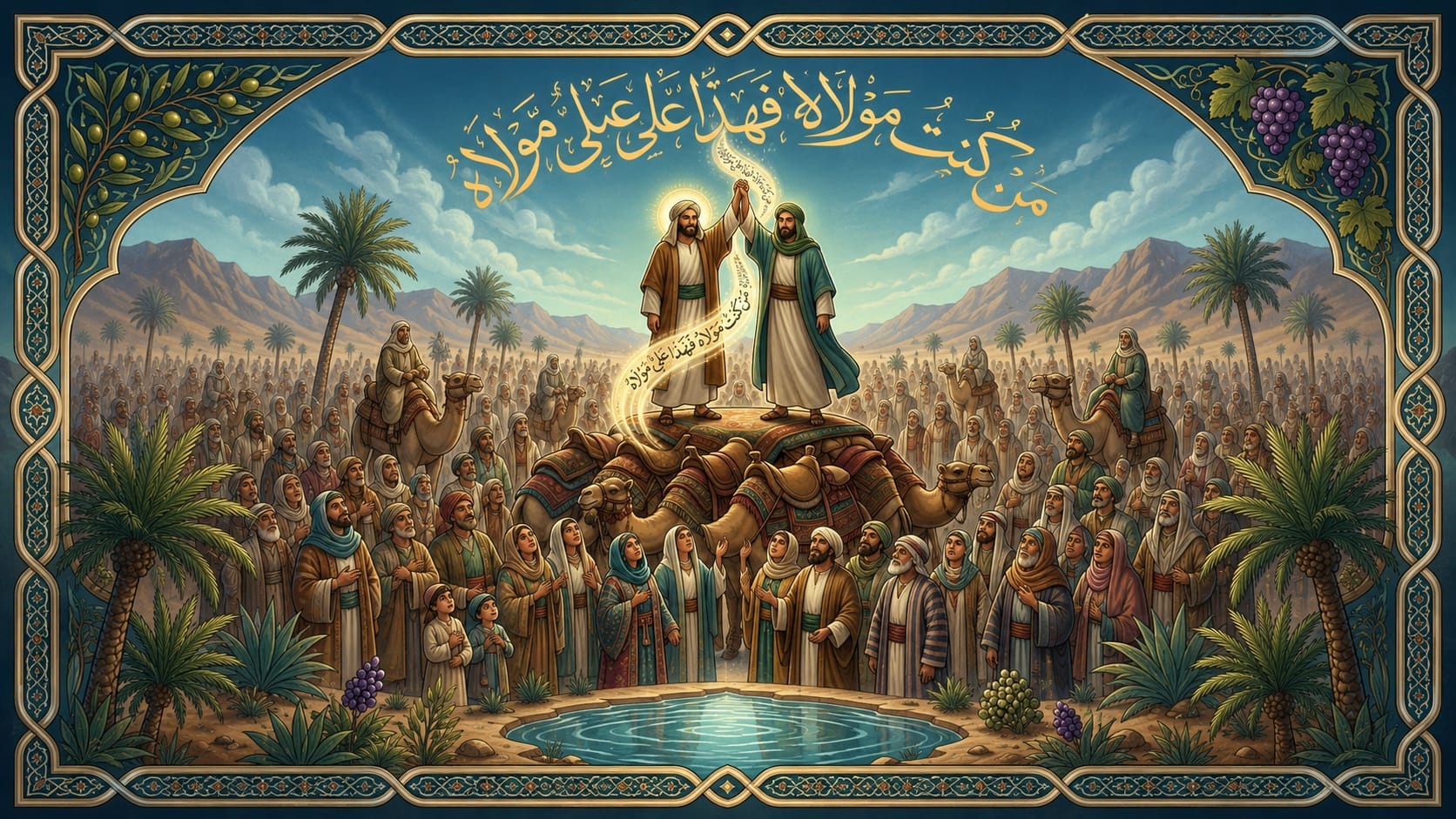
The Hadith of Ghadir continues. After proclaiming Hazrat ‘Ali⁽ᶜ⁾ as the mawla, the Prophet declared:
“O God, help whoever helps him, oppose whoever opposes him, support whoever supports him, forsake whoever forsakes him, and turn the Light wherever he turns.”
Upon hearing this declaration, ‘Umar ibn al-Khattab said:
“Congratulations to you, O ‘Ali! You have become the mawla of every believing man and woman.”4
Two additional observations may be drawn from this narration:
The Prophet's prayer highlights the unique station of Hazrat ‘Ali⁽ᶜ⁾. Particularly striking is the supplication that God should “turn the Light wherever he turns,” suggesting a profound connection between Hazrat ‘Ali⁽ᶜ⁾ and divine guidance. From an Ismaili perspective, this prayer may also be understood as alluding to the continuing presence of divine light and guidance through the institution of Imamat.
We also see that ‘Umar ibn al-Khattab, who would later become the second Caliph of Islam, acknowledged the significance of the Prophet's declaration and congratulated Hazrat ‘Ali⁽ᶜ⁾ upon becoming the mawla of all believing men and women.
As noted above, Shi‘i and Sunni Muslims differ in their understanding of what the Prophet intended by calling Hazrat ‘Ali⁽ᶜ⁾ the mawla. The term possesses a wide range of meanings and can be understood in several ways, including:5
• Friend
• Companion
• Supporter
• Beloved
• Protector
• Master
• Lord
Generally speaking, the Sunni interpretation maintains that the Prophet’s declaration at Ghadir Khumm identified Hazrat ‘Ali⁽ᶜ⁾ as a beloved companion, friend, and supporter of the Muslim community. The Shi‘i interpretation does not deny these qualities. Rather, it maintains that, in the context of Ghadir Khumm, the term mawla carries a deeper significance, particularly its meanings of master, protector, and one invested with walaya (spiritual authority). This understanding is further strengthened by the fact that mawla and walaya derive from the same Arabic root.6
Shi‘i Muslims base this interpretation upon two principal considerations:
1. The Context in Which the Word Mawla Was Used
In the Hadith of Ghadir, the Prophet employed the term mawla immediately after citing Qur’an 33:6:
“The Prophet has a greater claim (awla) upon the believers than their own selves.”
The words awla, mawla, and walaya all derive from the same Arabic root. According to the Shi‘i interpretation, this linguistic connection is highly significant. By invoking the concept of awla, the Prophet first established his own authority and prior claim over the believers. His subsequent declaration that “‘Ali is his mawla” is therefore understood to indicate that Hazrat ‘Ali⁽ᶜ⁾ inherited a corresponding position of authority and guardianship within the community.7
2. The Position and Status of the Prophet
The Prophet described Hazrat ‘Ali⁽ᶜ⁾ as the mawla only after first affirming, three times, his own authority over the believers. This sequence is of great significance.
The Prophet was certainly a friend to the believers, but his relationship to them was not limited to friendship. He was also God’s Messenger, guide, teacher, judge, and the divinely appointed authority over the Muslim community. Concerning the Prophet’s authority, Allah says:
“But no, by your Lord! They can have no faith until they make you judge in all disputes between them, and find in themselves no resistance to your decisions, but submit with full acceptance.”
— Qur’an 4:65
From the Shi‘i perspective, therefore, the Prophet’s declaration at Ghadir Khumm cannot be reduced to a statement of friendship alone. Rather, it points to a continuing authority that would remain present within the Muslim community after the Prophet’s departure from this world.
For this reason, Shi‘i Muslims believe that Hazrat ‘Ali⁽ᶜ⁾ and the Imams from his progeny inherited the Prophet’s spiritual authority. While the Imams were not prophets and did not bring a new revelation, they possessed the divinely ordained authority of walaya and served as the rightful guides of the community. It is in this sense that they are understood to be the mawla of the believers.
This understanding is further reinforced by the famous Hadith al-Thaqalayn (“The Two Weighty Things”), a tradition transmitted in both Shi‘i and Sunni collections of hadith. Shortly before his death, the Prophet declared:
“Verily, I am leaving with you two precious things, the Book of God and my progeny, my ahl al-bayt; for as long as you cling to these two, you will never go astray; and truly they will not be parted from each other until they join me at the Hawd [a pool of Paradise, identified with al-Kawthar].”8
According to the Hadith al-Thaqalayn:
After the Prophet, there remain two authoritative sources of guidance:
The Holy Qur’an
The Imam of the Time from the ahl al-bayt
Although they may appear to be two distinct sources, in reality they are inseparable. The Prophet teaches that the Qur’an and the Imam are joined together and can never be separated from one another. This same principle is expressed in another tradition, found in both Shi‘i and Sunni sources, in which the Prophet said:
“‘Ali is with the Qur’an and the Qur’an is with ‘Ali. They shall never separate until they come to me at the [paradisal] Pond (al-hawd).”9
The Prophet’s statement in the Hadith al-Thaqalayn — “for as long as you cling to these two, you will never go astray” — also brings to mind another well-known tradition found in both Shi‘i and Sunni sources: the Hadith al-Safina (Tradition of the Ark). Speaking about the ahl al-bayt, the Prophet said:
“Indeed, their likeness is that of Noah’s Ark. Whoever boarded it was saved, and whoever remained behind was drowned.”10
Together, these traditions emphasize a central theme: right guidance and salvation are attained through adherence to both the Qur’an and the divinely appointed guide from the ahl al-bayt.
We have seen that Qur’an 5:67, which we recite in Part III of our Du‘a, alludes directly to the event of Ghadir Khumm. Yet it also calls to mind a wider body of Qur’anic verses and Prophetic traditions concerning the authority and guidance of the Imam.
Imam Muhammad al-Baqir⁽ᶜ⁾ teaches that after the declaration at Ghadir Khumm, the following verse was revealed:
“This day I have perfected your religion for you, completed My favour (ni‘mat) upon you, and chosen for you Islam as your religion.”11
— Qur’an 5:3
According to the Shi‘i interpretation of this verse:
It was only after the designation of Hazrat ‘Ali⁽ᶜ⁾ as the mawla that the religion was perfected. This further demonstrates the immense significance of the proclamation commanded by Allah in Qur’an 5:67.
The declaration of Hazrat ‘Ali⁽ᶜ⁾ as mawla is understood to be a ni‘mat — a Divine Favour bestowed upon the believers.
After this Divine Favour was manifested, Allah chose Islam as the name of the religion. In this interpretation, Islam signifies both peace and submission, because in every age one must submit to the mawla, or Imam of the Time, through whom believers are guided in the practice of their faith and enabled to live in spiritual peace (salam).
The word “completed” in Qur’an 5:3 — “completed My favour upon you” — should not be understood in the sense of something that has ended or ceased. One should not imagine that the Divine Favour bestowed at Ghadir belonged only to that historical moment.
Rather, the Divine Favour is complete because it remains continuous, uninterrupted, and ever-present. It is a favour that endures throughout the ages, sustained by Allah, the Ever-Living and Self-Subsisting One (al-Hayy al-Qayyum).
For this reason, there must always be a present and living Imam in every age through whom God’s favour is manifested and made complete.
The institution of Imamat is a Divine Favour bestowed upon humanity because, according to the Holy Qur’an, the Imams themselves are among those upon whom God bestows His favour, authority, and inheritance:
“And We desired to bestow favour upon those who were oppressed in the earth, and to make them Imams and to make them the heirs, and to establish them in the land….”
— Qur’an 28:5–6
Several themes emerge from this verse:
Throughout history, enemies of the faith have sought to oppress the Imams and their family. One need only recall the tragedy of Karbala, where the Prophet's grandson, Imam Husayn⁽ᶜ⁾, together with members of his family and companions, was martyred.
The Imams are the heirs of the Prophet and of one another. This demonstrates the continuity of the Imamat within the lineage of the ahl al-bayt.
It is the Imam of the Time who is granted Divine Favour and true authority, whether this reality is recognized by many or only by a few who acknowledge the Imam as their spiritual guide and father.
The Holy Qur’an, which serves as guidance for believers in every age, frequently speaks of Allah’s favour (ni‘mat). The following verse warns of those who exchanged this Divine Favour for ingratitude:
“Have you not seen those who exchanged Allah’s favour for ingratitude and caused their people to descend into the Abode of Loss?”
— Qur’an 14:28
Two reflections follow from this verse:
Those who followed such ungrateful leaders deprived themselves of the benefit of Allah’s favour, entering the “Abode of Loss” rather than the “Abode of Peace” (Dar al-Salam).
From an Ismaili perspective, those who disregarded the Prophet’s declaration at Ghadir Khumm — man kuntu mawlahu fa-‘Ali mawlahu (“Whomsoever I am his mawla, ‘Ali is his mawla”) — cut themselves off from the guidance of the Imams who, according to Qur’an 21:73, are divinely appointed to guide by God’s command (amr).12
Therefore, the same sura in which Allah declares that He has completed His favour (5:3) also reminds believers:
“And remember Allah’s favour upon you and His covenant (mithaq) by which He bound you firmly, when you said: ‘We hear and we obey’; and be conscious of Allah. Surely Allah knows what is within the hearts.”
— Qur’an 5:7
This verse invites us to reflect on three related themes:
It is possible to forget or become unmindful of Allah’s favour. This warning may apply both to those who reject the institution of Imamat altogether and to those who acknowledge the Imam as their mawla but fail to live according to his guidance and farmans (decrees).
God’s ni‘mat (favour) is linked to His mithaq (covenant), suggesting that the Divine Favour is inseparable from the Imam, to whom the believer pledges allegiance (bay‘a) and through whom one enters into the sacred covenant with God.
The Ismaili da‘is, who invited others to recognize the Imam of the Time, used the term mithaq to designate the oath taken by an Ismaili. Through this oath, the believer promises obedience to God, the Messenger, and the Ulu al-Amr (“those vested with authority”; Qur’an 4:59), while also undertaking to preserve the trust placed in him or her by safeguarding the inner meanings (batin) of the faith. Such discretion was especially important during periods when the Imams and their followers faced persecution.13
Verse 5:7 speaks of the covenant (mithaq) as that “by which He bound you firmly.” This same image of being firmly bound to Allah appears in Qur’an 3:103, which refers to the “Rope of Allah” as a source of Divine favour, grace, and guidance:
“And hold fast, all together, to the Rope of Allah, and do not be divided. Remember Allah’s favour upon you: you were enemies and He joined your hearts together in love, so that by His grace you became brothers. You were on the brink of a pit of fire and He saved you from it. Thus does Allah make His signs clear to you, that you may be guided.”
— Qur’an 3:103
This verse sheds light on several important themes:
According to the Shi‘i interpretation, the “Rope of Allah” refers to the institution of Imamat. It is the Imam of the Time who keeps his murids (covenanted followers) connected to Allah through his love, hidaya (guidance), ta‘lim (teaching), ta’wil (esoteric interpretation), and baraka (blessings). The “Rope of Allah” is therefore understood as a symbol of the continuous Light of Imamat and the living bond between God and humanity. Otherwise, there is no physical rope descending from the heavens by which humanity is bound to God.
Shi‘i Muslims may also agree with Sunni Muslims that the “Rope of Allah” refers to the Holy Qur’an. There is no contradiction between these interpretations, for according to the Hadith al-Thaqalayn, the Prophet left behind both the Holy Qur’an and his progeny, the Imams. Since the two are inseparably joined, they constitute a single reality of divine guidance.
According to this verse, it is by means of the “Rope of Allah” that one is saved from the brink of the “pit of fire,” just as it is through Noah’s Ark that one is saved from the flood. In the Ismaili interpretation, both the Ark and the Rope symbolize the Light and Guidance of Imamat.
The thirteenth-century Persian Ismaili poet Nizari Quhistani beautifully expresses this symbolism:14
Finally, the Noah of the time
led me to the Ark of Guidance
and I found myself saved
from the billowing deluge.
When I firmly held the Rope of God
with willing submission,
I found deliverance
from the pit of disappointment.
...
Salvation is in the Imam of the time;
I found the root of faith
in obedience to his commands
and prohibitions.
I gave up everything except
‘offspring, one from the other’15
when I found the
permanent Imamate in them.
The “Rope of Allah” is also the means by which the community remains united. When believers hold firmly to the Rope of Allah, they are bound not only to God but also to one another in a bond of brotherhood and sisterhood. For this reason, all Muslims, regardless of sect, should regard one another as brothers and sisters, united by their reverence for the Holy Qur’an.
Ismaili Muslims, however, recognize both the Holy Qur’an and the living Imamat. As spiritual children of the same Imam, they share a unique bond of brotherhood and sisterhood rooted in a common spiritual lineage.
The Shi‘i Ismaili Imams have frequently reminded the Jamat of the importance of unity among brothers and sisters in faith. In a farman delivered in Karachi on December 13, 1964, the 49th Imam, Mawlana Shah Karim al-Husayni⁽ᶜ⁾ Aga Khan IV, explicitly referred to the “Rope of Imamat” and explained its role in guiding the community:
“For hundreds of years, My spiritual children have been guided by the Rope of Imamat. You have looked to the Imam of the Age for advice and help in all matters, and through your Imam’s immense love and affection for his spiritual children, his Noor has indicated to you where and in which direction you must turn, so as to obtain spiritual and worldly satisfaction.”16
We have seen that Qur’an 5:67 is far more than a reference to a single historical event. Beginning with the proclamation of Mawlana ‘Ali⁽ᶜ⁾’s walaya (authority) at Ghadir Khumm, it leads us to a deeper understanding of the institution of Imamat and of the themes of Divine Favour, covenant, and guidance that are woven throughout the Qur’an and the Prophetic tradition. Together, these teachings reveal the profound significance of the message that Allah commanded His Messenger to proclaim and the enduring role of the Imam in guiding the faithful through every age.
As we conclude, let us recall the blessed words of Qur’an 5:67 recited at the beginning of Part III of our Holy Du‘a:
ya ayyuha’r-rasulu balligh ma unzila ilayka mir-rabbika; wa-i’l-lam taf‘al fa-ma ballaghta risalatahu wa’llahu ya‘simuka mina’n-nas
“O Messenger! Convey what has been revealed to you from your Lord. If you do not do so, then you have not conveyed His message. And Allah will protect you from the people.”
The next time we recite or listen to Part III of our Holy Du‘a, beginning with these divinely revealed words, may we do so with a deeper sense of gratitude, conviction, and understanding, mindful of the great Divine Favour bestowed upon the ummah at Ghadir Khumm and perpetuated through the living institution of Imamat.
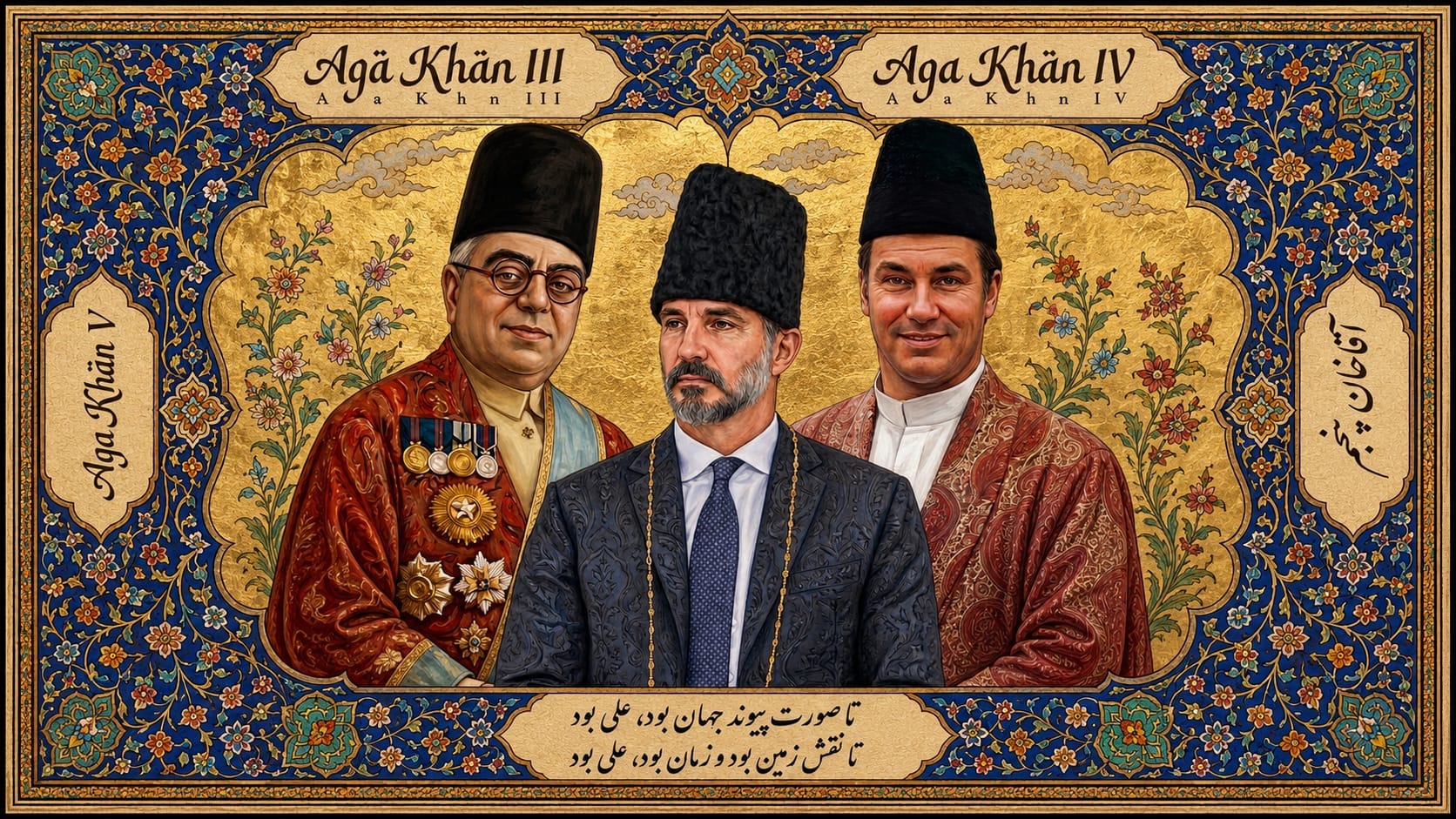
As Ismaili Muslims, we continue to recognize and follow a present, living Imam, Mawlana Imam Shah Rahim al-Husayni⁽ᶜ⁾ Aga Khan V, through whom the light of Imamat continues to guide, nurture, and unite the Jamat in every age. By holding fast to the Rope of Allah and boarding the Ark of Salvation, we reaffirm our allegiance to the Imam of the Time and our commitment to the spiritual path illuminated by our Mawla for his murids.
Ya ‘Aly Madad,
Khayal ‘Aly
June 12, 2026
Follow on Instagram:
khayal.aly | ismaili.rhyme.minders
ismailignosis | ismailignosis.blog
Access Full Content
on Ismaili Gnosis
Know someone who would enjoy
full access to Ismaili Gnosis?
Support Our Mission
“Whether you are giving to an Imamat institution or to any other organization which works for good, these are the same in my eyes. All giving is an act of faith. All giving is of spiritual benefit.”
— Imam Shah Rahim al-Husayni⁽ᶜ⁾
(Dallas, Texas, November 10, 2025)

Ismaili Gnosis is a U.S.-registered 501(c)(3) nonprofit. Your voluntary donation supports research and educational content and is separate from paid Ismaili Gnosis subscriptions offered through Substack.
Enjoyed This Post?
In Case You Missed It

NOTES
For Imam Muhammad al-Baqir’s⁽ᶜ⁾ interpretation of Qur’an 5:67 and its connection to the designation of Hazrat ‘Ali⁽ᶜ⁾ at Ghadir Khumm, see al-Qadi al-Nu‘man, Da‘a’im al-Islam, trans. A. A. A. Fyzee, rev. Ismail K. Poonawala as The Pillars of Islam (New Delhi: Oxford University Press, 2002), 19–20.
S. H. M. Jafri, The Origins and Early Development of Shi‘a Islam (London: Longman, 1979), 19–21. See also Lalani, 147 n. 53.
Arzina R. Lalani, Early Shi‘i Thought: The Teachings of Imam Muhammad al-Baqir (London: I.B. Tauris in association with The Institute of Ismaili Studies, 2000), 70-71. For a reading guide to this work, see here.
Lalani, Early Shi‘i Thought, 71.
Lalani, Early Shi‘i Thought, 71-72.
Mawla, wali, walaya (or wilaya), tawalli, and awla all derive from the Arabic root w-l-y, which conveys the ideas of nearness, guardianship, authority, and allegiance. Shi‘i scholars often note this linguistic connection when relating Qur’an 33:6 (awla) to the Prophet’s declaration at Ghadir Khumm, man kuntu mawlahu fa-‘Ali mawlahu.
Lalani, Early Shiʿi Thought, 73.
Ayatollah Ja‘far Sobhani, Doctrines of Shi‘i Islam: A Compendium of Imami Beliefs and Practices (London: I.B. Tauris in association with The Institute of Ismaili Studies, 2001), 103.
Faquir Muhammad Hunzai and Rashida Noormohamed-Hunzai, The Holy Ahl-i Bayt in the Prophetic Traditions (Karachi: Institute for Spiritual Wisdom and Luminous Science, 2020), 15.
Al-Qadi al-Nu‘man, The Pillars of Islam, 37.
Al-Qadi al-Nu‘man, The Pillars of Islam, 20.
Qur’an 21:73: “And We appointed them Imams guiding by Our command (amr). And We inspired them ...” See also Qur’an 32:24: “And We appointed from among them Imams guiding by Our command when they were patient and had certainty in Our signs.”
On the significance of the mithaq (and the related term ‘ahd) and its use by the Ismaili da‘is, see Heinz Halm, “The Isma‘ili Oath of Allegiance (‘Ahd) and the ‘Sessions of Wisdom’ (Majalis al-Hikma) in Fatimid Times,” in Farhad Daftary (ed.), Mediaeval Isma‘ili History and Thought (Cambridge: Cambridge University Press, 1996), 91, 94. See also Heinz Halm, The Fatimids and Their Traditions of Learning (London: I.B. Tauris in association with The Institute of Ismaili Studies, 1997), 18, 21, 26, 48, 66.
Nizari Quhistani, “I Found the Treasure,” in Shimmering Light: An Anthology of Ismaili Poetry, translated by Faquir Muhammad Hunzai and edited with an introduction by Kutub Kassam (London: I.B. Tauris in association with The Institute of Ismaili Studies, 1997), 89, 91.
Qur’an 3:33-34: “Verily, Allah chose Adam and Noah and the descendents of Abraham and the descendents of ‘Imran above all creatures, offspring one of the other.”
Mawlana Shah Karim al-Husayni, Precious Gems: Volume 1 (His Highness Prince Aga Khan Shia Imami Ismailia Association for Canada), 9.
I appreciate the detailed explanation. Absolutely great and increased my understandings of this ayat of Quran e Sharif
Very informative. Articles like this is important for raising awareness and understanding. Very much appreciated this article. Thank you