


Editor’s Note: The following material is an edited and updated excerpt of Section 12 from the premium Ismaili Gnosis article, “Where Is Imamat Found in the Qurʾan?” (15 sections).
As this article continues the discussion begun in Part 1, readers who have not yet read it are strongly encouraged to click here to read Part 1 first. Like the original study, this standalone article — including its annotation — offers both exoteric and esoteric insights into Qurʾanic verses and concepts relating to the Imamat. For a more comprehensive treatment of the subject, please refer to the original article via the link provided at the end of this post.
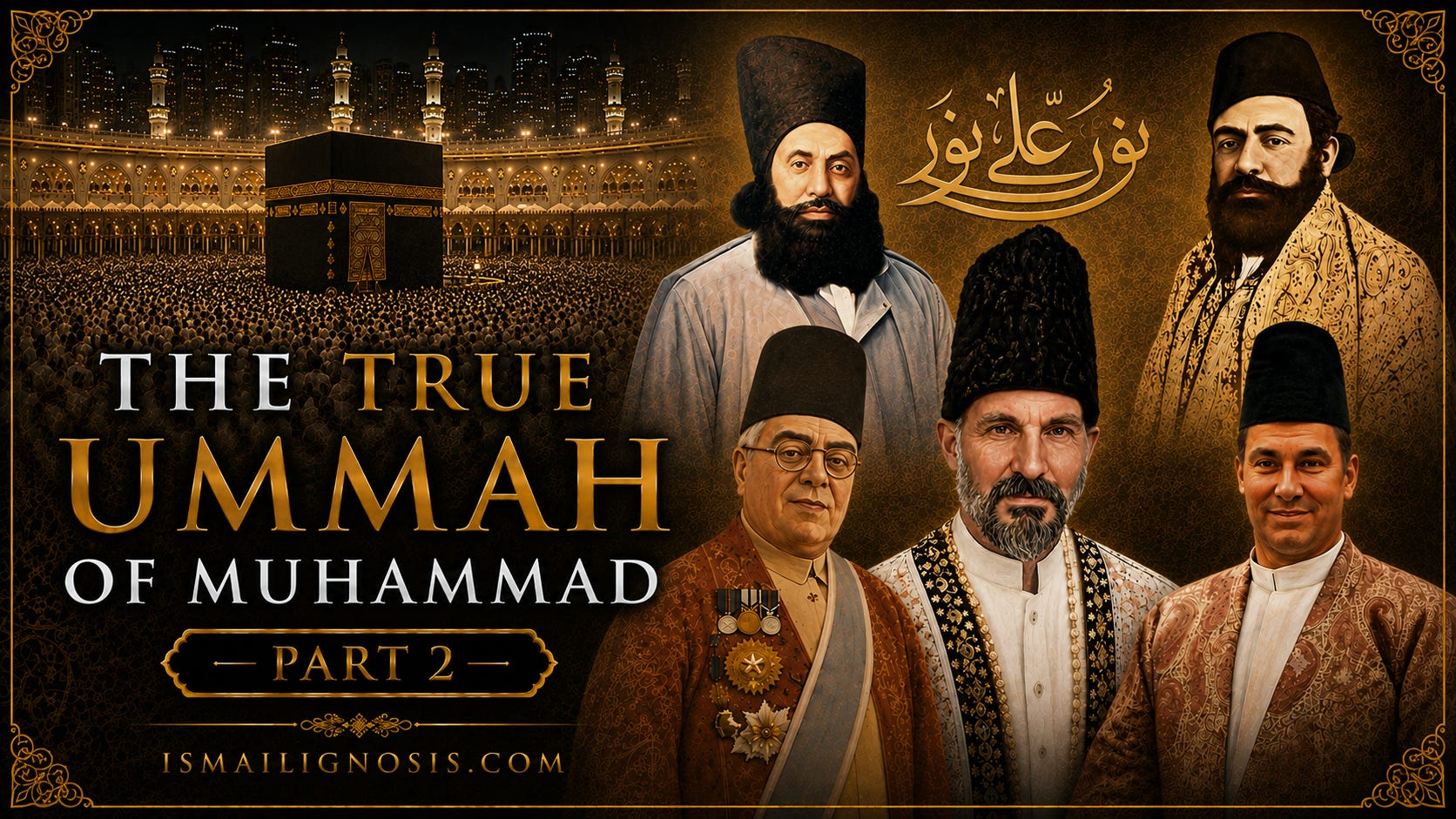
12. The Imams as the Ummah Wasat (Mediating Nation): Summoning to the Good and Serving as God’s Witnesses over Humankind
(Qurʾan 2:128, 2:143, 22:78, 3:104, 3:110, 7:181)
“Our Lord! Make us
[Abraham and Ishmael]
submitters (muslimayn) to You,
and from our progeny
a submitting community
(ummatan muslimatan) to You.”
— Holy Qur’an 2:128
Apart from Qurʾan 2:128,1 discussed in section 11 (Part 1), Imam al-Sadiq⁽ᶜ⁾ highlights other Qurʾanic verses that, according to the Imam, refer to the same specific ummah (community or nation) submitted to God, distinct from the broader Muslim Ummah. For example:
“Thus We have appointed you an ummatan wasatan (moderate community, or mediating nation), that you will be witnesses (shuhadaʾa) over humankind, and that the Messenger will be a witness (shahid) over you” (2:143).
“He selected you, and He did not impose on you any hardship in the religion which was the religion of your forefather, Abraham. He named you al-muslimin (‘those who submit’) before and in this [Scripture], that the Messenger be a witness (shahid) over you, and that you be witnesses (shuhadaʾa) over humankind” (22:78).
“And let there be among you a community (ummah) who summon to the good and enjoin right conduct and forbid indecency. Such are they who are successful” (3:104).
“You are the best ummah (khayra ummatin) that has been raised up for humanity (li’l-nas), enjoining what is right, forbidding what is wrong, and believing in Allah” (3:110).
Thus, referring to Qurʾan 2:143, Imam Jaʿfar al-Sadiq⁽ᶜ⁾ affirms:
“We [Imams] are the ‘mediating nation’ and the ‘witnesses’ of God over His creation and His ‘proofs’ in His earth.”
— Imam Jaʿfar al-Sadiq⁽ᶜ⁾, in Qadi al-Nuʿman, Disagreements of the Jurists, 113 (translation modified).
In identifying the divinely established ‘witnesses’ of the ‘mediating ummah’ (2:143) with the Imams from the progeny of Abraham⁽ᶜ⁾ — the submitting ummah (2:128) discussed in Part 1 — the Imams find support in other verses that, like 2:143, mention witnesses who will testify before their Lord on behalf of the rest of humanity. For example:
“And strive for God in the way He deserves. He selected you, and He did not impose on you any hardship in the religion (al-din), which was the religion (millat) of your forefather, Abraham. He named you al-muslimin (‘those who submit’) before and in this [Scripture], that the Messenger be a witness (shahid) over you, and that you be witnesses (shuhada’a) over humankind” (22:78).
When asked about Qurʾan 22:78, Imam Jaʿfar al-Sadiq⁽ᶜ⁾ replied:
“God meant us [Imams] by this. We are the ones selected for the religion of our forefather Abraham. God called us al-muslimin (‘those who submit’) in the earlier Scriptures and in this Scripture, and He stated, ‘that the Messenger might be a witness over you.’
The Messenger of God is the witness over us concerning what he conveyed to us from God, and we are witnesses (shuhada’a) over the people.
Whoever believes in the Day of Resurrection, we believe in him, and whoever denies it, we reject him.”
— Imam Jaʿfar al-Sadiq⁽ᶜ⁾, quoted in Qadi al-Nuʿman, Disagreements of the Jurists, 113 (translation modified).
Before commenting further on Imam al-Sadiq⁽ᶜ⁾’s words, it is worth citing a similar commentary on this verse by his father, Imam al-Baqir⁽ᶜ⁾, whose concluding statement underscores even more emphatically the role of the Imams as witnesses on the Day of Judgment. The Imam said:
“It is to us (the Imams) that this [verse 22:78] refers. We are ‘the chosen ones’, from the community of our ancestor Abraham, and God has designated us as al-muslimin (‘those who submit’) before this in the former Books and in this Qurʾan, so that the Messenger of God might be a witness over us.
The Messenger of God, therefore, will hold us to account in respect of what he conveyed to us from God, and we [Imams] are the witnesses (shuhada’a) who will hold people to account.
Thus, on the Day of Judgment, we shall testify to the veracity of him who speaks the truth, and whoever does not speak the truth we shall denounce as a liar.”
— Imam Muhammad al-Baqir⁽ᶜ⁾, quoted in The Pillars of Islam: Daʿaʾim al-Islam of al-Qadi al-Nuʿman, vol. 1, 29–30 (translation modified).
See also the Twelver Shiʿi source Usul min al-Kafi, Kitab al-Hujjah, ch. 9.
In their interpretation of Qurʾan 22:78 — which refers to a specific and select group of submitters following the religion of their forefather Abraham⁽ᶜ⁾, called al-muslimin both in the earlier Scriptures and in the Revelation brought by Muhammad⁽ˢ⁾ — the Imams identify themselves as that very group, designated by God as al-muslimin and entrusted to serve as witnesses (shuhadaʾa) over humanity. This interpretation aligns with the Imams’ understanding of the witnesses from the ummah wasat (mediating nation) mentioned in 2:1432 and builds upon what was clarified in Part 1 concerning Abraham⁽ᶜ⁾, Ismaʿil⁽ᶜ⁾, and the progeny (dhurriyyah) from which God established the ummah muslimah (submitting nation) of Qurʾan 2:128. As Qadi al-Nuʿman explains, reiterating what was discussed in Section 11 of Part 1:
[Abraham and Ishmael prayed:] “Our Lord! Make us muslimayn (submitters), that is, devoted exclusively to You, and make of our progeny (dhurriyyah) an ummah muslimah (submitting nation), that is, devoted exclusively to You” [2:128].
When God informed Abraham that there would be wrongdoers among his progeny, he asked God to save his nation [ummah] from that fate and to have the nation include his progeny, then the progeny of Ishmael, and no others of his descendants. This is the nation (ummah) that God described as enjoying favor, which He selected, approved, and made witnesses, and whom He spared all hardship in religion.
He informed them [i.e. the selected progeny of Abraham, the Imams] that it was the religion of their forefather Abraham, who named them al-muslimin aforetime [22:78], because of the statement of Abraham and Ishmael here: “Make us muslimayn (submitters), that is, devoted exclusively to You, and make of our progeny an ummah muslimah (submitting nation), that is, devoted exclusively to You” [2:128].
— Qadi al-Nu‘man, Disagreements of the Jurists, 103-105 (translation modified).
See also the Twelver source Usul min al-Kafi, Kitab al-Hujjah, Ch. 9.
Therefore, the individuals qualified to serve as God’s witnesses over the rest of humankind are those specific individuals whom God explicitly designates as al-muslimin (22:78)3 from the progeny of Abraham⁽ᶜ⁾ and Ismaʿil⁽ᶜ⁾. Together with their chosen and rightly guided descendants (3:33–34; 6:87),4 they are true muslimin, perfectly submitted to God and belonging to the ummah muslimah (2:128). As the divinely appointed Messengers and Imams, they guide by God’s command (amr) (21:73; 32:24).5 They are, therefore, the divinely authorized guides to whom believers must refer and whom they must obey as the Ulu’l-Amr — the Holders of Authority (4:59;6 4:837).
These divinely selected khalifahs (vicegerents) of God (2:30;8 38:269) and His righteous servants on the earth (21:105) are pure monotheists (14:35),10 thoroughly purified by God (33:33),11 and divinely inspired to perform good deeds and establish acts of worship (21:73). As true guides for every people (13:7),12 they serve as exemplars (imams) for the righteous (muttaqin) (25:74)13 and judge with justice (4:58; 7:181; 38:26), making them uniquely qualified to serve as God’s witnesses over humankind as the ‘mediating nation’ (2:143).
By virtue of their inheritance of the Book (kitab), the Wisdom (hikmah), and the Great Kingdom (4:54),14 as well as their covenant (‘ahd) with God, they are distinguished as the perpetual bearers of the Throne of Imamat (2:124). This ensures the continuous presence of a living, ‘manifest Imam’ (Imam-i Mubin) — in whom God encompasses the knowledge and authority of all things (36:12)15 and through whom the people of every era are summoned before God (17:71)16 to be judged fairly in the presence of the just witness.17 As Imam al-Baqir⁽ᶜ⁾ affirms, the Imams are indeed “the witnesses (shuhadaʾa) who will hold people to account” and who, on the Day of Judgment, “shall testify to the veracity of him who speaks the truth” (The Pillars of Islam, vol. 1, 29–30).
This identification of the Imams as the witnesses mentioned in Qurʾan 2:143 is further illuminated by Qurʾan 17:71, according to which every people will be summoned on the Day of Judgment with their Imam. To recall, God states in 2:143:
“We have appointed you a ‘mediating nation’ so that you may be witnesses over humankind (shuhadaʾa ʿala al-nas) and that the Messenger may be a witness over you.”
In Qurʾan 17:71, the people of every era are summoned with their Imam. Read alongside Qurʾan 2:143, this provides further support for identifying the ‘witnesses over humankind’ with the Imams, who, as discussed earlier in Section 6 of the original article, must be present among the people in every era:
“On the Day [of Judgment] when We summon all peoples (kullu unas) with their Imam (bi-imamihim). Then he who is given his record (kitabahu) [of deeds] in his right hand will read it [with pleasure], and no one will be wronged in the least” (17:71).18
With the identity of these witnesses thus clarified, a further profound Qurʾanic insight concerning the Imamat emerges when Qurʾan 17:71–72 are read together:
“On the Day [of Judgment] when We summon all peoples with their Imam. Then he who is given his record in his right hand will read it [with pleasure], and no one will be wronged in the least. And he who is blind in this [world] will also be blind in the Hereafter and further astray from the [right] way” (17:71–72).
This raises an important question: What is it that people may be blind to in this world that causes them to be blind in the Hereafter and further astray from the right way? Within the context of these verses, the answer is the Imam of the time.
Some followers of the Prophet may thus be spiritually blind by failing to acknowledge or accept the Imamat of the divinely appointed Imams, through whom God summons all people to return to Him. By rejecting the Ulu’l-Amr (4:59; 4:83), they render themselves spiritually blind to the light of God’s guidance, which manifests through the Imams who guide by His command (amr) (21:73; 32:24). Others may be blind to the Imams in a different sense: although accepting them nominally, they may fail to recognize their true status or inner reality (haqiqah), thereby depriving themselves of the spiritual and intellectual light imparted by “those who are deeply rooted in knowledge” (3:7)19 — the rasikhun fi’l-ʿilm — who possess true knowledge of the Kitab (13:43)20, which is present in the form of “clear ayat in the hearts of those who have been given knowledge [by God]” (29:49).21
In either case, spiritual blindness stems from a failure to truly recognize the Imam. Interestingly, as mentioned in Section 6, according to Qadi al-Nu’man’s Daʿaʾim al-Islam, when Imam Jaʿfar al-Sadiq⁽ᶜ⁾ was asked about Qurʾan 17:71, he listed the names of the Imams and then quoted the following hadith of the Prophet⁽ˢ⁾, which has also been narrated in variant versions by Sunni traditionalists and cited by Sunni legal scholars in their discussions of the Imamat: “He who dies without recognizing the Imam of his time dies the death of ignorance” (The Pillars of Islam, vol. 1, 36. See also Usul min al-Kafi, vol. 2, Kitab al-Iman wa l-Kufr, ch. 13).22
Returning to the question of identifying the ummah wasat, not all Muslims have accepted the interpretations of the Shi‘i Imams. Consequently, both historically and in the present day, Sunni scholars have generally maintained that all Muslims collectively constitute the ummah wasat — the mediating nation appointed by God to serve as witnesses over humankind (2:143). Responding directly to this understanding, Imam Jaʿfar al-Sadiq⁽ᶜ⁾ asks:
“If you think that by this verse God means all the Muslims…, would you then allow [i.e., believe and say] that God requires one whose testimony is unacceptable in this world — even in the matter of a [small] measure of dates [i.e., relatively trivial worldly matters] — to act as a witness for humankind on the Day of Judgment and that He accepts him as such for the communities of former times? Certainly not,” [continued the Imam]. “God surely never intended the like of him [i.e., one whose testimony is not accepted even in this world].”
— Imam Jaʿfar al-Sadiq⁽ᶜ⁾, quoted in The Pillars of Islam: Daʿaʾim al-Islam of al-Qadi al-Nuʿman, vol. 1, 45.
See also the Twelver Shiʿi source Usul min al-Kafi, Kitab al-Hujjah, ch. 9.
In the above, Imam al-Sadiq⁽ᶜ⁾ argues that those whom God accepts as witnesses over humankind cannot be simply anyone belonging to the broader Muslim community, since many individuals within it are not even qualified to serve as witnesses in legal matters in this world, let alone as witnesses over humankind on the Day of Judgment. Rather, according to this interpretation, the ‘mediating nation’ (ummah wasat) of Qurʾan 2:143 is the same distinct community as the ‘submitting nation’ (ummah muslimah) of Qurʾan 2:128: the specific ummah of Imams whom God established from the righteous descendants of Abraham⁽ᶜ⁾ and Ishmael⁽ᶜ⁾.
Qadi al-Nuʿman, who upheld the authority of the Ulu’l-Amr, makes a similar point in his Ikhtilaf. He observes that most individuals from the broader Muslim ummah “cannot permissibly serve as official witnesses in juridical cases” and that those who “might serve as the witnesses of God over His worshippers are even fewer in number and more difficult to find” (Disagreements of the Jurists, 99). He then cites numerous Qurʾanic verses as evidence:
“Except those who believe and do good works, and few they are” (38:24);
“But most of them are ignorant” (6:111);
“But most of them do not know” (6:37);
“But most of them do not comprehend” (5:103);
“But they do not perceive” (2:9);
“But most of the people, even though you strive hard, will not believe” (12:103);
“Most of them do not believe in God without attributing partners to Him” (12:106).
Qadi al-Nuʿman then concludes:
“These are among the many verses of the Book of God that attest to what we have stated [about the majority of Muslims not being fit to serve as witnesses], not to mention that both direct observation and experience confirm what we have declared.”
— Qadi al-Nu‘man, Disagreements of the Jurists, 99.
Accordingly, in interpreting Qurʾan 2:143 — “Thus We made you a ‘mediating nation’...” — Qadi al-Nuʿman upholds Imam Jaʿfar al-Sadiq⁽ᶜ⁾’s interpretation that the ‘mediating nation’ refers to the Imams of the Ahl al-Bayt. He also calls upon his readers to consider the broader Qurʾanic context in which this verse appears. As he observes:
“The narrative focus of this passage, in its entire sequence from beginning to end [2:124–143], is the nation, or ummah, that God chose and selected from the progeny of Abraham and Ishmael, as you see, and which He made a mediating nation [ummah wasat], meaning a nation endowed with moral probity…meaning ‘the most morally upright of them’…. God set them [the Imams] up as witnesses over the people, and made the Messenger, who is Muhammad, a witness to the divine knowledge that he conveyed to them from God and the divine wisdom that he entrusted to them, and they are the Imams from the people of his House, all of them.”
— Qadi al-Nuʿman, Disagreements of the Jurists, 107 (translation modified).
Like Qadi al-Nuʿman, al-Shahrastani (d. 1153) — the revered Sunni theologian whose writings have led a number of scholars to identify him with the Ismaili tradition, possibly as a secret Ismaili daʿi acting on its behalf — also offers an illuminating commentary on Qurʾan 2:143. Using rational and intra-Qurʾanic arguments, he maintains that the ‘mediating ummah’ refers not to the general Muslim community but to a particular community whose members are qualified to bear witness over humankind on the Day of Judgment:
His saying, “And thus We have made you a Mediating Nation” (2:143), means that — “just as We have favored you with primordial monotheism (al-hanifiyyah) and absolute islam, likewise We have made you a Mediating Nation (ummatan wasatan).”
There is no doubt that what is meant by it [i.e., ‘a Mediating Nation’ / ummatan wasatan] is not the general community with its disagreements and divisions; rather, it is a special community that is meant by His saying, “And from our descendants a submitted community [ummatan muslimatan] to You” (2:128), and by the Most High’s saying, “And among those We created is a community (ummatun) which guides by the truth and thereby establishes justice” (7:181). And “We divided them throughout the earth into communities” refers to the general communities, while “among them are the righteous ones” (7:168) refers to the special community.
Then He described the special community as ‘mediating’ (wasat), and it is said in the tafsir: the just choice is that which is entirely good… Justice is that which entirely upholds what is just. Because the Lord, the Exalted, reports about His appointment of them exclusively therein. And He connected to this ruling a perfect actuality in order that they would be overseeing witnesses over humankind.
Thus, the just overseeing witness requires that he be cognizant of whatever he oversees over humankind. Thus, they are God’s overseeing witnesses in His earth and His trustees over His creation and His proofs over His worshippers and the intermediaries to Him and the gates of His mercy. There is no judgment of theirs in the world which contradicts their judgment in the Hereafter.
— ʿAbd al-Karim al-Shahrastani, Mafatih al-Asrar wa-Masabih al-Abrar, vol. 2, 653; translated by Khalil Andani.
As Sayyidna al-Shahrastani points out, the divinely favored, special ummah of Prophets, Messengers, and Imams are not only God’s witnesses, trustees, and proofs over His worshippers but also the “intermediaries” through whom they are connected to Him and the “gates of His mercy.” This understanding of their exalted status also helps explain why the Imams interpret the following verses — Qurʾan 3:104 and 3:110, already mentioned at the beginning of this section — as referring to the same distinct ummah of righteous guides who “guide by the truth and thereby establish justice” (7:181):
“And let there be among you a nation (ummah) who summon (yadʿuna) to the good (al-khayr) and enjoin (yaʾmuruna) right conduct and forbid what is evil. Such are they who are successful” (3:104).
“You are the best nation (khayra ummatin) that has been raised up for humankind (li’l-nas), enjoining (taʾmuruna) what is right, forbidding what is wrong, and believing in God” (3:110).
Concerning Qurʾan 3:104, Imam al-Baqir⁽ᶜ⁾ stated:
“This verse is for the Progeny of Muhammad (Aal Muhammad), peace be upon him and his progeny, and those who follow them, commanding to the good and forbidding from evil.”
— Imam Muhammad al-Baqir⁽ᶜ⁾, quoted in ʿAli b. Ibrahim al-Qummi, Tafsir al-Qummi (Altafsir.com).
As part of his response to those who maintained that all who profess Islam should, by that fact alone, be considered the ummah of Muhammad⁽ˢ⁾, Imam Jaʿfar al-Sadiq⁽ᶜ⁾ refers to Qurʾan 3:104 and states:
“This verse lays the charge of unbelief on sinful Muslims, because he who does not commend what is approved and prohibit what is disapproved is not part of the community that God describes. They [the non-Shiʿi masses] allege that all Muslims are the community [ummah] of Muhammad. You can see, however, that this verse [3:104] characterizes the community of Muhammad as one which invites [people] to goodness, enjoins what is approved, and forbids the opposite. Thus, how can he in whom these characteristics are not found be counted as part of the community which God describes, while he, in reality, represents the contrary of what God has stipulated for the community and depicted it as representing?”
— Imam Jaʿfar al-Sadiq⁽ᶜ⁾, quoted in The Pillars of Islam: Daʿaʾim al-Islam of al-Qadi al-Nuʿman, vol. 1, 45.
As for Qurʾan 3:110, when Imam al-Sadiq⁽ᶜ⁾ was asked about the khayra ummah mentioned in the verse and the claim that it refers to the Muslim ummah in general, the Imam replied incredulously:
“‘The best nation?’ These are the people who killed the Commander of the Faithful [ʿAli⁽ᶜ⁾], al-Hasan⁽ᶜ⁾, and al-Husayn⁽ᶜ⁾!”
So the reciter asked him: “Then how was it revealed?”
The Imam said: “You are the best Imams raised up for humankind. Do you not see God’s praise of them? You command the good, forbid evil, and believe in God.”
— Imam Jaʿfar al-Sadiq⁽ᶜ⁾, quoted in ʿAli b. Ibrahim al-Qummi, Tafsir al-Qummi (Altafsir.com).
To conclude this discussion of the identity of the ummah addressed and praised by God in the Qurʾan, we turn once again to Qadi al-Nuʿman’s analysis. After citing the various Qurʾanic verses concerning the ummah—nation or community—that we have reviewed in this section, he responds to those who reject the Imams’ interpretation of these verses with the following pointed assessment:
“Their citation of the word of God as proof of the doctrine they espouse…along with their contention that what is meant by ‘the nation’ [ummah] in these verses is the entire Islamic nation and all the believers, is an opinion which does not stand up to scrutiny and does not bear rigorous examination.
This is because God does not ascribe such merit or attribute such excellence to the entire nation or to all those who have embraced Islam and adopted faith in God and the Messenger, for among them are uncouth louts, ignoramuses, sinners, and miscreants.
He who espouses this opinion should be asked about the existence of such people, and if he denies that there are such people in the nation, then he has denied what is plain to see and has resorted to blatant falsehood. If he admits this, then he is forced to state that God has favored and selected uncouth louts, rowdies, morons, sinners, scofflaws, evildoers, and miscreants.”
— Qadi al-Nu‘man, The Disagreements of the Jurists, 93-95.
Ya ‘Ali Madad,
Ismaili Gnosis
August 21, 2026
ismailignosis.com
Follow on Instagram:
ismailignosis | ismailignosis.blog
Scroll Down for
Ismaili Tafsir and Taʾwil
Access Full Content
on Ismaili Gnosis
Know someone who would enjoy
full access to Ismaili Gnosis?
Support Our Mission
“Whether you are giving to an Imamat institution or to any other organization which works for good, these are the same in my eyes. All giving is an act of faith. All giving is of spiritual benefit.”
— Imam Shah Rahim al-Husayni⁽ᶜ⁾
(Dallas, Texas, November 10, 2025)
Ismaili Gnosis is a U.S.-registered 501(c)(3) nonprofit. Your voluntary donation supports research and educational content and is separate from paid Ismaili Gnosis subscriptions offered through Substack.
Enjoyed This Post?
Link to the Original Article

Ismaili Tafsir and Ta’wil
for Deeper Understanding
Qur’an 2:128–129: “Our Lord! Make us both submissive to You, and of our progeny (min dhurriyyatina) [make] a submitting community (ummatan muslimah) unto You. Our Lord! Raise up among them a messenger from among themselves who shall recite to them Your revelations (ayat), teach them the Book and wisdom, and purify them.”
‘Allamah Hunzai: The above-mentioned group, which is truly submissive to God, is the holy Imams from the progeny of Hazrat Ibrahim, whose chain will continue until the Day of Resurrection. By the word “messenger,” in general, are meant all the Prophets from their progeny and, in particular, the Holy Prophet, because the Prophets are from the same genus as the Imams. In reality, the Holy Prophet recited the verses of God to them both exoterically and esoterically, taught them the heavenly Book and wisdom, and purified them, so that, through this special and miraculous teaching of the Qur’an and wisdom, and through the attributes of purity, they might become worthy of the light of Imamat and impart the grace of guidance from the spirit of the ta’wil of the Qur’an to the servants of God according to their struggle and capacity.
This fact can be further substantiated and corroborated by the following verse: “And thus We have made you a just group [ummatan wasatan], so that you may be witnesses over mankind, and the Messenger may be a witness over you” (2:143).
‘Allamah Nasir al-Din Nasir Hunzai, Qur’an awr Nur-i Imamat, translated by Faquir Muhammad Hunzai and Rashida Noormohamed-Hunzai as The Holy Qur’an and the Light of Imamat, p. 24 (translation modified).
‘Allamah Hunzai: Question 958: God says in Surah-yi Baqarah (2:143): “Wa kadhalika ja‘alnakum ummatan wasatan li-takunu shuhada’a ‘ala’n-nasi wa yakuna’r-rasulu ‘alaykum shahidan.” Please tell us the translation and ta’wil of this noble verse according to Imam Baqir. Answer:
It is written in Da‘a’im al-Islam (Poonawala edition, vol. 1, p. 29): “And We have made you [the Imams] such a community (ummat) that is exceedingly just.”
“So that you may be witnesses over the people and the Prophet may be a witness over you.”
Imam Baqir told the questioner: “We, the Imams from the ahl-i bayt, are the intermediary community (ummatan wasatan), and we are God’s witnesses over the people. We have been appointed by Him as hujjats [proofs] on this earth.”
‘Allamah Nasir al-Din Nasir Hunzai, Sanadiq-i Jawahir, translated by Faquir Muhammad Hunzai and Rashida Noormohamed-Hunzai as Caskets of Pearls (Volume 2), pp. 155–156 (translation modified).
‘Allamah Hunzai: Who are the Chosen Ones (mujtabas) (22:78)? The Imams are the selected believers (9:105), and they are also the Chosen Ones (22:78). Study verses 22:77–78 carefully: whatever is said there is about the Imams from the progeny of the holy Prophet, who are the progeny of Hazrat Ibrahim (4:54), such as: “He has chosen you”; “And has not laid upon you in religion any impediment” — that is, He has given you abundant knowledge to interpret and perform ta’wil in the explanation and elucidation of the rules (ahkam); “The religion of your father Ibrahim” — that is, Islam is the religion of your father Ibrahim, and you are the heirs to this religion; “He named you Muslims” — that is, the obedient ones; “not only before” [i.e., in previous scriptures] “but also in this” [Qur’an]; “so that the Messenger” — i.e., the light of the Prophet — “may be [present and] witness over you, and you” — i.e., the light of Imamat — “may be [present and] witnesses over [all] humankind” (22:78).
The key wisdom of this verse should be well understood: the light of Prophethood is the permanent witness over the light of Imamat, and the light of Imamat is the permanent witness over the people. Such a witness is always present, even though the people may be unaware of this bright fact.
‘Allamah Nasir al-Din Nasir Hunzai, Qur’ani Minar, translated by Faquir Muhammad Hunzai and Rashida Noormohamed-Hunzai as Qur’anic Minarets, pp. 43–44 (translation modified).
Qur’an 3:33–34: “Verily, Allah chose Adam and Noah and the descendants of Abraham and the descendants of ‘Imran above all creatures, direct descendants one of the other.”
In a Persian poem, the Ismaili da‘i Nizari Quhistani writes (in translation):
Salvation is in the Imam of the Time; I found the root
of faith in obedience to his commands and prohibitions.I gave up everything except “offspring, one from the other”
when I found the permanent Imamate in them.
Nizari Quhistani, excerpt from “I Found the Treasure,” trans. Faquir M. Hunzai, in Shimmering Light: An Anthology of Ismaili Poetry (London: I.B. Tauris in association with The Institute of Ismaili Studies, 1996), p. 91.
‘Allamah Hunzai: According to the custom of God, the Wise, we should note the principle that He always chooses, for the task of guidance, from the family of Prophethood, just as He chose Hazrat Adam, Hazrat Nuh, the progeny of Hazrat Ibrahim, and the progeny of Hazrat ‘Imran above all the people of the world (3:33); as He granted the progeny of Hazrat Ibrahim the Book, wisdom, and the great kingdom (4:54); and as, in accordance with this Divine law, Hazrat Ibrahim prayed for this special mercy—that the Imamat may remain in his progeny until the Resurrection (2:124).
‘Allamah Nasir al-Din Nasir Hunzai, Miwah-yi Bihisht, translated by Faquir Muhammad Hunzai and Rashida Noormohamed-Hunzai as Fruit of Paradise, p. 58 (translation modified).
‘Allamah Hunzai: In verse 21:73, God says: “And We made them the Imams [of the people] who guide by Our Command.”
The wisdom of this verse shows that the true Imams are appointed by God Himself, and they guide the people according to His will and command. Furthermore, this verse shows that, in order to command and guide the people, He always speaks to the Imam. Whether we call this Divine Speech the special favour (tawfiq-i khass) or the luminous guidance (nurani hidayat), it is received from God continually and afresh by the Imams according to the requirements and needs of their time and place. Since the Divine command (amr-i bari) is their prerogative—that is, on the one hand they receive it, and on the other they convey it to the people—it is in this sense that they are called ulu’l-amr (those who possess the Divine command; 4:59).
Every wise person who believes in God’s existence can, upon reflection, understand that, in view of the law of the mercy of God, the Compassionate, the Merciful, it is absolutely impossible for Him to remove His means of command and guidance—that is, the Imam of the time—from among the people of the world at any time. Likewise, it is absolutely impossible for the people of the world to dispense with the source of His guidance at any time. Thus, it is necessary and indispensable that the Imam should always be alive and present among the people, in human attire, in every age, whether it is the cycle of Prophethood or the cycle of Imamat.
It should be clear that the time which elapsed from Hazrat-i Adam to the Seal of the Prophets, that is, the holy Prophet Muhammad, is called the cycle of Prophethood, while the time continuing from him until the Resurrection is called the cycle of Imamat. The difference between these two cycles is that, during the cycle of Prophethood, by God’s command, some Imams performed the duties of Prophethood in addition to the function of Imamat, whereas in the cycle of Imamat, since it is the cycle of Resurrection, the pure Imams from the progeny of Prophet Muhammad perform only the duties related to the matters of Imamat.
‘Allamah Nasir al-Din Nasir Hunzai, Imam Shinasi, trans. Faquir Muhammad Hunzai and Rashida Noormohamed-Hunzai as Recognition of Imam, pp. 22–23 (translation modified).
Sayyidna al-Kirmani: God imposed obedience to the Imam by means of His declaration: ‘O, you who believe, obey God and obey the Messenger and those in authority among you’ [4:59]. Thus, He [i.e. God] connected it [i.e. obeying the Imam] to obeying Him and obeying His Messenger. Wisdom precludes the linking of a pearl with dung, or the noble with the base, or the pure with the unclean. For that reason, it is necessary that the linking of obedience to the Imam with obedience to the Messenger who is infallible happens because the one is like the other. If the linking of obedience to the Imam with obedience to the infallible Messenger happens because of the one being like the other, and obedience to the Messenger and its being an obligation is because of his being infallible, it is necessary that obedience to the Imam is obligatory because of his own infallibility. Therefore, the Imam is infallible.
Hamid al-Din al-Kirmani, al-Masabih fi Ithbat al-Imama (Lights to Illuminate the Proof of the Imamate), translated by Paul E. Walker as Master of the Age: An Islamic Treatise on the Necessity of the Imamate (London: I.B. Tauris in association with The Institute of Ismaili Studies, 2007), pp. 80–81.
‘Allamah Hunzai: The word “istinbat” is mentioned in only one holy verse (4:83), but due to its link with the ulu’l-amr (the custodians of the Divine command), its meaning extends from the beginning to the end of the Holy Qur’an. For it means to verify, establish, or substantiate something; to reflect properly; or it denotes the wisdom and ta’wil, or the batin (esoteric aspect) of a verse. In this sense, istinbat is found throughout the Noble Qur’an.
[…] The translation of the verse under discussion is: “And when there comes to them news of security or fear, they spread it abroad; and if they had referred it to the Messenger and to those in authority (ulu’l-amr) among them, those among them who can search out the knowledge of it [yastanbitunahu] (i.e., the hudud-i din) would have known it” (4:83).
The wisdom-filled allusion of this verse is that mu’mins should have faith and certainty in their hearts about the Prophet and the ulu’l-amr, so that they may attain the grace of istinbat from the Imam of the time and the physical and spiritual hudud. In this verse, the words “min-hum” (from among them) are mentioned twice, of which the first is used for the ulu’l-amr and the second for the hudud under them. As you know, Divine knowledge was revealed to the Holy Prophet, who granted it to the ulu’l-amr (i.e., the Imams), and they open the door of knowledge and wisdom to their representatives.
These two verses (4:59 and 4:83), namely, the “verse of obedience” and the “verse of deduction,” respectively, become one subject because they are about the ulu’l-amr and are the exegesis of one another. Verse 4:59 says: “O you who believe! Obey God and obey the Prophet and the ulu’l-amr from among you (who are with you throughout history and in all the cycles); then, if you quarrel about anything, refer it to God and the Prophet, if you believe in God and the Last Day; this is better (for you) and very good with respect to ta’wil.”
An extremely important point that should be remembered forever is that, just as obedience to the ulu’l-amr (Imams) is enjoined upon mu’mins after obedience to God and the Prophet, similarly, mu’mins are also enjoined to have recourse to them with their problems and disputes. But obedience comes first, and having recourse to them follows. Therefore, if someone has recourse to God, the Prophet, and the ulu’l-amr for a solution to a question of knowledge without first being obedient, the door to knowledge and wisdom does not open. For the first and foremost requisite is obedience.
In verse 4:59, the command to refer ideological disputes to the ulu’l-amr is not apparent, but in verse 4:83, this command is very clear, because the latter verse is the exegesis of the former verse. Further, obedience is prior to having recourse, and having recourse follows it. If a fortunate mu’min truly obeys God, the Prophet, and the Imam, he automatically has recourse and, without formal questioning, receives answers to all his questions. And this is perfect guidance.
‘Allamah Nasir al-Din Nasir Hunzai, Qurratu’l-Ayn, translated by Faquir Muhammad Hunzai and Rashida Noormohamed-Hunzai as Coolness of the Eye, pp. 8–10 (translation modified).
‘Allamah Hunzai: The wisdom-filled story of Hazrat Adam, the vicegerent of God, peace be upon him, invites the intellect and wisdom to read it again and again, because the masses, as yet, do not duly understand it. For instance, in verse 2:30: “Verily, I am going to appoint a vicegerent in the earth”, by the earth is meant the world of humanity, and the permanent presence of God’s vicegerent in it is His sunnat (law, habit), which continues constantly and consistently (40:85), without any change or alteration (35:43).
Study the subject of the Divine sunnat in the wise Qur’an with great care, so that it may be understood clearly that Hazrat Adam’s vicegerency was according to it. It therefore continues in the world of humanity forever and ever.
‘Allamah Nasir al-Din Nasir Hunzai, The Wise Qur’an and the World of Humanity, Vol. 1, translated from Urdu into English by Faquir Muhammad Hunzai and Rashida Noormohamed-Hunzai, p. 6 (translation modified).
Sayyidna al-Naysaburi: God called Adam a vicegerent (khalifa), and the name “vicegerent” is one of the names of the Imams. God called David, peace be upon him, a “vicegerent” (38:26), whilst he was one of the Imams in the past cycles.
Ahmad b. Ibrahim al-Naysaburi, Kitab Ithbat al-Imama, edited and translated by Arzina R. Lalani as Degrees of Excellence: A Fatimid Treatise on Leadership in Islam (London: I.B. Tauris in association with The Institute of Ismaili Studies, 2009), p. 33.
‘Allamah Hunzai: There is always the physical and spiritual vicegerency of God, may He be exalted, for the sake of people’s guidance and the help and support of right and justice. Therefore, He has said: “O Da’ud! We did indeed appoint you vicegerent in the earth; so judge (fa’hkum) between humankind with the truth” (38:26). From this noble verse, it becomes absolutely clear that the “judgment” (hukm) related to the inhabitants of the earth had been entrusted by God, the Wise, to His chosen vicegerent, with all its meanings. Otherwise, the title of vicegerent would have been meaningless.
According to this teaching of the holy Qur’an, when “judging” (hukm) is not permissible without God’s vicegerency, then how can “commanding” (amr) be permissible without it? Thus, it becomes self-evident that the holy Qur’an calls the holy Imams ulu’l-amr (the custodians of the Divine command), due to the fact that God has conferred upon them the honour of His vicegerency on earth and made them the masters and authorities of His command.
‘Allamah Nasir al-Din Nasir Hunzai, Imam Shinasi, translated as Recognition of Imam, p. 78 (translation modified).
‘Allamah Hunzai: It is mentioned in surah-yi Ibrahim (14:35) that Hazrat Ibrahim prayed to Almighty God to protect him and his progeny (i.e., his present and future children) from idolatry, because it is not only deviation (14:36) but also impurity (22:30). This prayer mentions both external and internal idolatry. In short, in this prayer, Hazrat Ibrahim supplicates to remain pure and innocent by refraining from all types of sins. The holy Prophet said: “I am the fruit of the prayer of my forefather Ibrahim.” Thus, it is evident that all the Prophets and Imams from the progeny of Ibrahim are pure and infallible by birth.
‘Allamah Nasir al-Din Nasir Hunzai, ‘Ilmi Khazana, translated by Azeem Ali Lakhani as Treasure of Knowledge, Part 2, p. 26 (translation modified).
Reza Shah-Kazemi: Hazrat Fatima and Imam ‘Ali are venerated as the forebears of the Prophet’s progeny, the sadat (singular sayyid, literally ‘lord’). The Prophet, ‘Ali, Fatima, al-Hasan and al-Husayn are referred to in Persian as the panj tan (‘five bodies’), and they constitute the immediate referent of the term ahl al-bayt (people of the [Prophet’s] household). The following verse of the Qur’an refers to this group as follows:
‘Truly God only wishes to remove all impurity (al-rijs) from you, O Ahl al-Bayt, and to purify you with utter purification’ (33:33).
It is asserted in a wide range of sources that after the revelation of this the Prophet called for Fatima, ‘Ali and their two sons, al-Hasan and al-Husayn, and declared that his Ahl al-Bayt consisted of these four persons, together with himself as the fifth.
For the Shi‘is, the divine ‘purification’ mentioned in the verse implies that Imam ‘Ali and the other members of the Ahl al-Bayt are impeccable (ma‘sum), rendered incapable of committing any sin or major error.
Reza Shah-Kazemi, Imam ‘Ali: From Concise History to Timeless Mystery (London: The Matheson Trust, 2019), 55–57.
‘Allamah Hunzai: It is said in verse 13:7: “Verily, you are a warner, and for every nation (qawm) there is a guide (hadi).” (See Shi‘i translations and commentaries of the Qur’an and books on the Manaqib of Mawla ‘Ali.) From the time of Adam until the Resurrection of resurrections, the people of every age constitute a nation (qawm), and for every nation God has appointed a guide (hadi), who is the Imam of the time.
‘Allamah Nasir al-Din Nasir Hunzai, Hazar Hikmat, translated by Faquir Muhammad Hunzai and Rashida Noormohamed-Hunzai as A Thousand Wisdoms: An Encyclopaedia of Ta’wil, wisdom 940, p. 490 (translation modified).
‘Allamah Hunzai: Imamu’l-Muttaqin (The Imam of the righteous, 25:74): “And those who pray: O our Lord! Grant us of our wives and our offspring (dhurriyyat) coolness of our eyes, and make us the Imam of the righteous ones.” This prayer is specific to the Imams. In the language of wisdom, it is said therein that the chain of Imamat started from the time of Adam and is going to continue and last until the Resurrection of resurrections. This is because the story of the righteous ones has continued from the inception of religion; read the story of Hazrat-i Habil (5:27). From this, we have to understand the allusion that the word offspring (dhurriyyat) is not only related to the future; in fact, there is also an allusion to how the present Imam was the Imam in the past.
‘Allamah Nasir al-Din Nasir Hunzai, Qur’ani Minar, translated as Qur’anic Minarets, p. 69 (translation modified).
‘Allamah Hunzai: God says in verse 4:54: “Indeed, We gave to Ibrahim’s progeny the Book and wisdom, and We gave them a great kingdom.” The inheritance of the heavenly Book, ta’wili [esoteric] wisdom, and the spiritual kingdom continues in this cycle through the holy chain of Imams from the progeny of Muhammad.
‘Allamah Nasir al-Din Nasir Hunzai, Hazar Hikmat, translated as A Thousand Wisdoms, wisdom 5, p. 21 (translation modified).
‘Allamah Hunzai: God encompasses all the subtle things of the universe, all existents, this world, and the next world in the manifest Imam, because the Imam is the House of His sacred light. Thus, the reviving of the two kinds of the dead, as well as the record of deeds and traces, is also in the Imam, as He says: “Verily, We bring the dead back to life, and We write down what they have sent before them and their traces. And We have encompassed everything in a manifest Imam” (36:12). That is, nothing lies beyond the domain of the subtle body, the Great Soul, and the Perfect Intellect of the pure and holy Imam.
‘Allamah Nasir al-Din Nasir Hunzai, Tajalliyyat-i Hikmat, translated by Faquir Muhammad Hunzai and Rashida Noormohamed-Hunzai as Manifestations of Wisdom, p. 22 (translation modified).
Qur’an: 17:71: “On the Day when We summon all peoples (kullu unas) with/through their Imam (bi-imamihim). Then he who is given his record (kitabahu) in his right hand will read it [with pleasure]. And no one will be wronged in the least.”
Sayyidna al-Kirmani: There is no doubt that the Imam must exist for the worship of God and that God never leaves His earth devoid of an Imam in each and every time, who upholds the rights of God and who, as His proof to His servants, is the guidance to His absolute unity, who represents them to their Lord ‘on the day wherein We summon the people through their Imam’ [17:71].
Hamid al-Din al-Kirmani, al-Masabih fi Ithbat al-Imama, translated as Master of the Age, 118.
‘Allamah Hunzai: The Qur’an says: “My Lord! Vouchsafe me wisdom and unite me to the righteous ones (al-salihin) and make for me a tongue of truth in the later generations” (26:83-84). The greatest secret of monoreality lies in these verses, in which God expresses Hazrat-i Ibrahim⁽ᶜ⁾’s prayer. Its ta’wil is: My Lord, grant me a treasure of the word ‘Be’ and unite me to the righteous ones, i.e., keep me alive forever in the chain of light and make my tongue the Perfect Men’s tongue of truth, the tongue of the Prophets until the final Prophet, and after him the Imams’ tongue.
In verse 19:50 God says: “And We made for them a sublime tongue of truth”. That is, We made them alive forever in the light of Intellect, so that they may explain the sublime realities to their successors, as the Prophet, according to the Divine Command is witness (shahīd or shāhid) over the ‘just ummah’ [ummah-i wasat - ‘mediating nation’] (i.e., the Imams, 2:143).
It is not possible for someone who is absent to be witness, only someone who is present can be a witness. This shows that the Prophet witnesses the Imams and the Imams are witnesses over the people of their respective times and therefore, on the Day of Resurrection, God summons the people of the time with their respective Imām (17:71).
‘Allamah Nasir al-Din Nasir Hunzai, Ganj-i Giran-Mayah, translated by Faquir Muhammad Hunzai and Rashida Noormohamed-Hunzai as Precious Treasure, 62-63.
‘Allamah Hunzai: In verse 17:71, God says: “On the Day when We shall call together all human beings (kulla unasin bi-Imamihim) [of all times] with their [respective] Imam.” It should be borne in mind that, with respect to its literal sense, this verse is like: “Qad alima kullu unasin mashrabahum (i.e., each tribe knew their drinking place)” (2:60).
To understand the wisdom of this noble verse, it is necessary to understand the meaning of unas. Unas is the plural of ins, and another form of it is unasi, which has been used in the Qur’an for the division of small groups. For instance, Hazrat-i Musa’s people are called ummat-i Musa or qawm-i Musa. They can also be called nas without being related to anybody, but they cannot be called unas, because in the Qur’an it is used for small divisions of people. In other words, unas is used for each of Hazrat-i Musa’s twelve tribes. This means that the people are called unas in relation to the Imam of the time, just as they are called ummat or qawm in relation to the Prophet. This is because, in every natiq’s cycle, there are many Imams, and the people of the time of every Imam will be called unas, not ummat or qawm. The above realities reveal that the exalted Imam always exists and is present among the people of the world.
This is why, on the Day of Resurrection, God will summon the people of every age with their respective Imam to His court, because He made him the source of guidance and the means of salvation for them, but they did not recognise him. Further, the Imam is the witness of the people’s deeds, and unless he witnesses their deeds, God will not judge their good and bad deeds.
It is necessary to know the principle that certain of God’s attributes are due to their relation to the Prophet and the Imam. In order to understand such attributes, one should look into God’s one hundred names and then the Prophet’s and Imam’s hundred names. Those attributive names of God which are also mentioned among the names of the Prophet and the Imam are His names in relation to them. For instance, one of God’s attributive names is al-hadi (the Guide), and the same is a name of the Prophet and the pure Imam. Thus, for wise people, it is clear that God is the Guide in the sense that He sent the Prophet for the sake of guidance, and the Prophet is a guide in the sense that he guided people in his own time and, for their future guidance, appointed the Imam from his progeny. In this way, the work of guidance becomes complete with the Imam.
Similarly, another such name among God’s names is ash-shahid (the Witness), which is also the name of the Prophet and the Imam. This means that God has sent the Prophet as a witness, and the Prophet, according to God’s command, has made the Imam a witness over the people in his own place. Thus, the absolute witness over people’s deeds is the exalted Imam. This is the reason that God will call the people of every age with their respective Imam on the Day of Resurrection (17:71).
‘Allamah Nasir al-Din Nasir Hunzai, Imam Shinasi, translated as Recognition of Imam, pp. 20–21 (translation modified).
Qur’an 3:7: “He it is Who has revealed unto you (Muhammad) the Scripture wherein are clear revelations — They are the substance of the Book — and others (which are) allegorical. But those in whose hearts is doubt, pursue, forsooth, that which is allegorical seeking (to cause) dissension by seeking its esoteric interpretation (ta’wil). None knows its ta’wīl except Allah and those who are firmly grounded in knowledge (rasikhun fi'l ‘ilm).”
‘Allamah Hunzai: If understanding the Qur’an had been an easy matter, and it had not been necessary to refer to those who are well-grounded in knowledge (rasikhun fi’l-ilm, 3:7), this would have been the case first for those Muslims who were living in Arabia at the time of the holy Prophet. By virtue of their language, they were not only very close to the Qur’an, but it had also been revealed according to the requirements of their circumstances, providing solutions to their problems and the guidance they needed, etc. Yet it is said to the Prophet: “And We have revealed the Qur’an to you that you may make clear to humankind what has been revealed to them” (16:44). Thus, having a teacher of the Qur’an in all times after the Prophet is indispensable, and that teacher is the Imam of the time.
‘Allamah Nasir al-Din Nasir Hunzai, ‘Ilmi Khazana, translated as Azeem Ali Lakhani as Treasure of Knowledge, Part 1, p. 21 (translation modified).
Qur’an: 13:43: “Those who disbelieve say: ‘You are not a messenger (of Allah)’: Say (O Muhammad): ‘Allāh and he who has knowledge of the book is sufficient as a witness between me (i.e., my Prophethood) and you’”.
‘Allamah Hunzai: According to the gist of verse 13:43, the knowledge of the heavenly Book is with the light of ‘Ali. This means that whoever wants to acquire knowledge and wisdom of the Qur’an must have recourse to the Imam of the time with utmost devotion and willingness, so that the Imam, through his special exoteric and esoteric guidance, may open to him the door of Qur’anic knowledge and wisdom. It follows that the key to the knowledge and wisdom of all Qur’anic verses is Ismailism and the recognition of the Imam.
‘Allamah Nasir al-Din Nasir Hunzai, Pir Nasir-i Khusraw awr Ruhaniyyat, translated as Pir Nasir Khusraw and Spirituality, p. 38 (translation modified).
‘Allamah Hunzai: If it is asked, “In what form does the Wise Qur’an exist in the blessed hearts of the holy Imams?” then, in answer to this important and useful question, God says in verse 29:49:
“Nay, it (the Qur’an) is bright signs of miracles in the hearts of those who have been granted knowledge (by God).”
The purport of this, according to wise people, is that the Perfect Men are first given the knowledge of certainty and then the eye of certainty, through which spiritual and luminous miracles appear in the mirror of their hearts. It is these miracles that are called the “clear signs” mentioned time and again in the Qur’an.
‘Allamah Nasir al-Din Nasir Hunzai, Qur’an awr Nur-i Imamat, translated as as The Holy Qur’an and the Light of Imamat, p. 5 (translation modified).
The well-known Shiʿi hadith, “He who dies without recognizing the Imam of his time, dies the death of ignorance,” has also been narrated in variant versions by Sunni traditionalists, including in Musnad Ahmad, 1986 ed., vol. 4, p, 96, no. 16876; Sahih Muslim, no. 1851; Sahih Ibn Hibban, no. 4573; Mustadrak al-Hakim, no. 259; Musnad Abu Yaʿla, no. 7375; and al-Tabarani’s al-Awsat, nos. 769 and 910. Sunni legal scholars have likewise cited this hadith in their discussions of the Imamat, including Abu Shakur al-Salimi (d. after 460/1066), al-Tamhid fi Bayan al-Tawhid; Abu al-Muʿin al-Nasafī (d. 508/1115), Tabsirat al-Adilla; Ibn Qutlubugha (d. 879/1474), Sharh al-Musayara; Sa‘ad al-Din al-Taftazani (d. 792/1390), Sharh al-ʿAqaʾid.