



Editor’s Note: The following material is an edited and updated excerpt of Section 11 from the premium Ismaili Gnosis article, “Where Is Imamat Found in the Qurʾan?” (15 sections). Like the original study, this standalone article — including its annotation — offers both exoteric and esoteric insights into Qurʾanic verses and concepts relating to the Imamat. For a more comprehensive treatment of the subject, please refer to the original article via the link provided at the end of this post.
11. The Imams as the Chosen Ummah: The Pure Monotheist Community Raised by and Submitted to God (Qurʾan 2:127–129; 14:35–37)
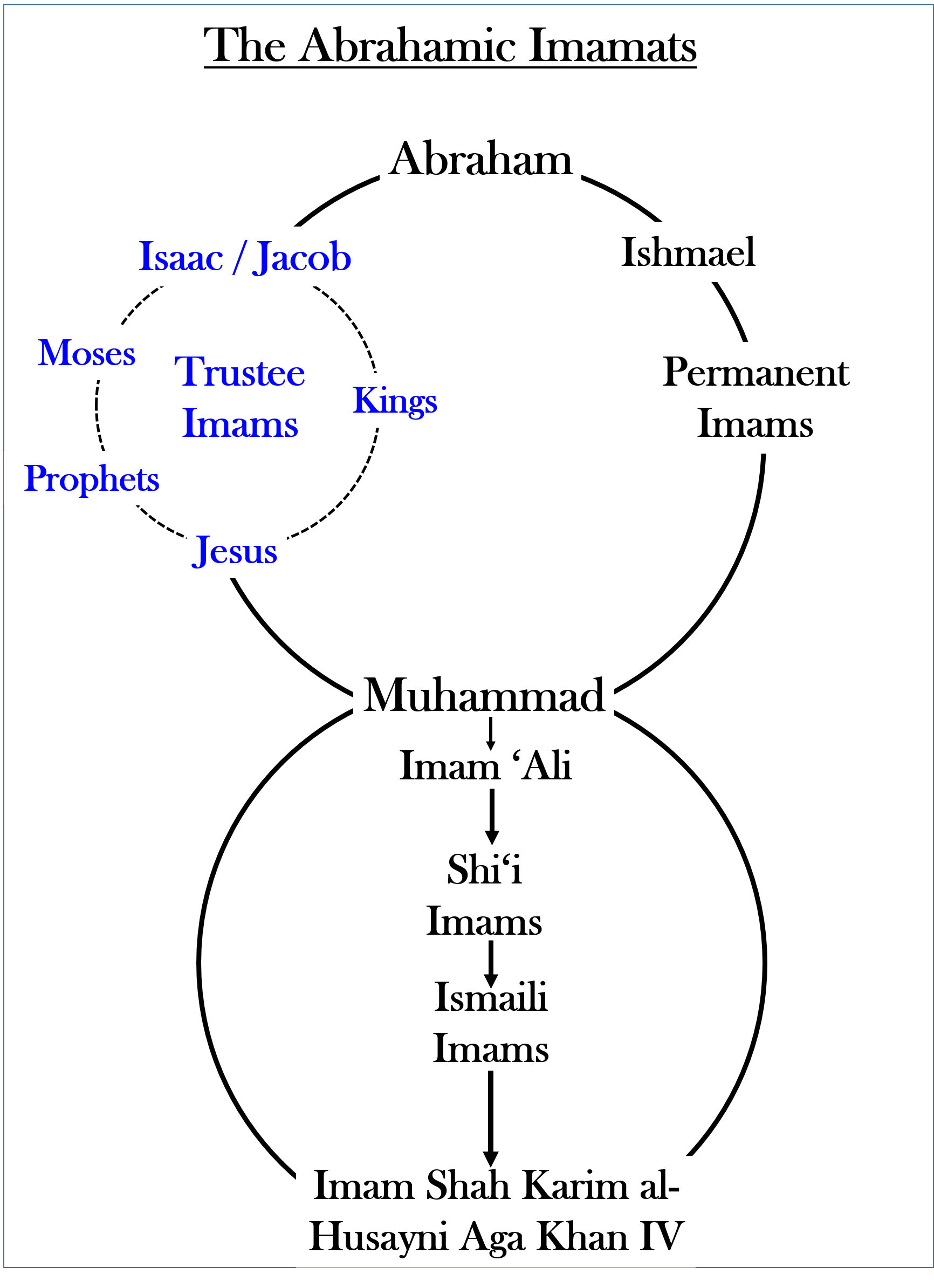
In line with the examples we have seen in previous sections, Abraham⁽ᶜ⁾’s sons and grandson (21:72) were appointed as Imams who guide by God’s Command (21:73).1 The Qur’an also records the prayer of Abraham⁽ᶜ⁾ and Ismaʿil⁽ᶜ⁾ for a distinct community (ummah) from among their progeny (dhurriyyah), characterized by perpetual submission to God (2:128), protection from idol worship (14:35), the hearts of others being inclined toward them (14:37), and the raising of a Messenger from within this community (2:129).
“Remember Abraham said: ‘O my Lord! make this city one of peace and security: and preserve me and my sons from worshipping idols’ (14:35). ‘O my Lord! They [i.e. idols and idol worshipers] have indeed led astray many among mankind. But whoso follows me he verily is of me (fa-man tabiʿani fa-innahu minni). And whoso disobeys me, still You are indeed Oft-Forgiving, Most Merciful’ (14:36).2 ‘Our Lord, I have settled some of my descendants (dhurriyyati) in an uncultivated valley near Your sacred House, our Lord, that they may establish prayer. So make hearts among the people incline toward them and provide for them from the fruits that they might be grateful’” (14:37).3
“And remember Abraham and Ismaʿil raised the foundations of the House (with this prayer): ‘Our Lord! Accept (this service) from us: For Thou art the All-Hearing, the All-Knowing (2:127). Our Lord! Make us submitters (muslimayn) to You and, from our progeny (min dhurriyyatina), a submitting community (ummatan muslimatan)4 to You’ (2:128).5 ‘Our Lord! And raise up within them (fihim) a Messenger from them (minhum) [i.e., a Messenger selected from our descendants] who will recite to them Your ayat (signs), teach them the Kitab (Book) and Hikmah (Wisdom), and purify them. Indeed, You are the Almighty, All-Wise’” (2:129).6
Abraham⁽ᶜ⁾ and Ismaʿil⁽ᶜ⁾ pray for a distinct ummah, described as a “submitting community” (ummatan muslimatan), to arise from their progeny (min dhurriyyatina). They further pray that God raise a Messenger from within this very community (fihim ... minhum) (2:129). In the Ismaili interpretation, this indicates that the ummah muslimah mentioned in Qurʾan 2:128 refers not to the Muslim Ummah in its broad historical sense, but to a particular and distinguished community consisting of a particular group from among the descendants (dhurriyyah) of the Prophets and Imams. This purified community of monotheists wholly submitted to God corresponds to those whom Abraham⁽ᶜ⁾ prayed would be preserved from idol worship (Qurʾan 14:35).
In the Daʿaʾim al-Islam, the Ismaili da‘i and Fatimid jurist al-Qadi al-Nu‘man identifies this ummah muslimah as the “ummah of Muhammad⁽ˢ⁾” when discussing the era of the final divinely revealed religion. In this understanding, the “ummah of Muhammad⁽ˢ⁾” is distinguished from the broader Muslim community, which includes true believers (muʾminin), hypocrites (munafiqin), criminals, and those considered untrustworthy to render testimony under Sharʿiah standards. As we will see below, Imam Jaʿfar al-Sadiq⁽ᶜ⁾ explains that the “ummah of Muhammad⁽ˢ⁾” refers to the Prophet's Ahl al-Bayt (People of the House): Hazrat ʿAli⁽ᶜ⁾, Hazrat Fatimah⁽ᶜ⁾, Hazrat Hasan⁽ᶜ⁾, Hazrat Husayn⁽ᶜ⁾, together with the Prophet himself. According to Qurʾan 33:33, they are the ones whom God thoroughly purified.7
Commenting on Qurʾan 33:33 — “Allah’s wish is but to remove uncleanliness far from you, O People of the House (Ahl al-Bayt), and cleanse you with a thorough cleansing” — Imam Jaʿfar al-Sadiq⁽ᶜ⁾ explained:
“This verse was revealed in respect of five persons attested as being cleansed of associating others [with God], of serving idols, and of worshipping anything other than God. The origin of this was the supplication of Abraham: ‘And preserve me and my sons from serving idols’ (14:35).”
— Imam Jaʿfar al-Sadiq⁽ᶜ⁾, quoted in The Pillars of Islam: Daʿaʾim al-Islam of al-Qadi al-Nuʿman, vol. 1, 48.8
Therefore, it is the Ahl al-Bayt who represent the pure monotheistic ummah muslimah from among the descendants of Abraham⁽ᶜ⁾ and Ismaʿil⁽ᶜ⁾ and, in the fullest sense, the ummah of Muhammad⁽ˢ⁾.
According to Qadi al-Nuʿman and the early Shiʿi Imams, there are two senses in which the term ummah may be understood. Of these, only the first constitutes the ummah muslimah that is truly raised by and submitted to God:
The specific “submitting community” (ummah muslimah), or ummah of Muhammad⁽ˢ⁾—namely, the Imams of the Ahl al-Bayt.
The broader community of potential submitters in general.
Those who belong to the second, broader community become participants in the first by following the Messenger and adhering to his Ahl al-Bayt—the true ummah muslimah of Muhammad. This specific submitting community consists of the purified monotheistic servants of God, the possessors of the Book and the Wisdom, designated by the prayer of Abraham⁽ᶜ⁾ and Ismaʿil⁽ᶜ⁾ and alluded to in the deeper meaning of Qurʾan 2:128–129 and 14:35–37. Thus, in the Daʿaʾim al-Islam, we are told of the following exchange between a questioner and Imam Jaʿfar al-Sadiq⁽ᶜ⁾:
Questioner: “Inform me … about the community (ummah) of Muhammad. Are they the ahl al-bayt of Muhammad?”
The Imam: “Yes!”
Questioner: “But is it not the case that the Muslims as a whole and each individual who believes in Muhammad and affirms his claims constitute his community?”
The Imam: “This issue is like the [previously discussed issue] concerning the family of Muḥammad.9 The Muslims who do not belong to Muhammad’s House, which is a part of Banu Hashim, cannot be held to be part of his ummah. The people at large, the inhabitants of the East and the West, Arabs and non-Arabs, mankind and jinn, those who believe in God and His Messenger and attest him to be truthful and follow him by allegiance and adherence to the [specific] community into which he [the Messenger] was sent, are [part] of the ummah of Muḥammad by reason of their allegiance to that [particular] community [i.e. the ummah of Muhammad⁽ˢ⁾, the Ahl al-Bayt]. Similarly those among the Muslims who profess [their belief] in the unity of God and acknowledge the Prophet are part of the community to which Muḥammad was sent.”
The Imam: “He who denies the excellence of this [chosen] community [i.e., the Ahl al-Bayt] is to be counted among those who say, We believe in some and disbelieve in others, and seek to choose a way in between (4:150). They are the people who upon being asked, ‘Do you believe in God and His Messenger?’ answer, ‘Yes,’ and when they are asked, ‘Do you then acknowledge the excellence of the family of Muhammad in whom you believe, and whom you confirm to be true?’ They respond, ‘No, because they possess no superiority over us.’”
Questioner: “What is the proof that the ummah of Muhammad is [constituted solely by] the members of Muḥammad’s House, whom you mentioned and none other?”
The Imam: “The word of God, … And when Abraham and Ishmael were raising the foundations of the House, (Abraham prayed): ‘Our Lord! Accept from us (this duty). Lo! Thou, only Thou, are the Hearer the Knower. Our Lord! And Make us submitters unto thee, and of our descendants (dhurriya) a submitting community (ummatan muslimatan) unto Thee; and show us our ways of worship, and relent toward us. Lo! Thou only Thou, art the Relenting, the Merciful’” (2:127-8).
The Imam: “God responded to the supplication of Abraham and Ishmael to establish from their descendants an ummah muslimah (community submitting to God) and to send them a messenger from among them — that is from that [very] community — a messenger who would recite His signs to them, and purify them and instruct them in the Book and the wisdom” [2:129].
The Imam: “Then Abraham added to his first supplication on behalf of that [submitting] community — which he had asked to be from his progeny — another supplication seeking [for them] their purification from associating others together with God and from worshiping idols. In this way he sought to make their affairs correct, lest they should follow any other way. Hence, Abraham said, ‘And preserve me and my sons from serving idols (14:35) — that is those on whose behalf I prayed to You [God]. And You [Abraham prayed further] have promised me that You [God] would make them [i.e., my descendants] Imams and an ummatan muslimatan [community rendering submission] and that You would call forth in their midst a messenger from among them and that You would keep them away from idol worship. My Lord! they [the idol worshipers] have led many of mankind astray. But whoso followeth me, he verily is of me. And whoso disobeyeth me—Still Thou art Forgiving, Merciful’” (14:36).
The Imam: “This then constitutes evidence showing that the Imams and [specific] ummah muslimah (submitting community) to which Muḥammad was sent cannot be other than the progeny of Abraham and Ishmael, the dwellers around the sacred precinct (Ka‘ba) and those who never served other than God, as [Abraham] says, And preserve me and my sons from serving idols (14:35). The proof concerning the dwelling place lies in Abraham’s words, Our Lord! Lo! I have settled some of my posterity in an uncultivatable valley near unto Thy holy House, our Lord! that they may establish proper worship; so incline some hearts of men that they may yearn toward them, and provide Thou them with fruits in order than they may be thankful (14:37). But [Abraham] did not say that they should serve idols.”
The Imam: “This Qur’anic verse thus proves that the Imams and the community rendering submission (ummatan muslimatan) on whose behalf Abraham prayed are his progeny, those who served none but God. Then Abraham said, So incline some hearts of men that they may yearn toward them (14:37) [i.e. that some people may incline toward and adhere to Abraham’s progeny, the ummah muslimah]. Abraham’s supplication is specific to the Imams and the community that is from his progeny.
Then, as he had prayed for them [i.e. for his progeny from which the Imams would be appointed], he prayed for their “partisans” (shi‘a) [i.e. Abraham prayed for those people whose hearts would incline towards the Imams and the ummah muslimah of his progeny]. Therefore the people of the supplication of Abraham and Ishmael are surely the Messenger of God, and ‘Ali, Fatima, Hasan and Husayn, and the Imams. He then who bears allegiance to these individuals among the progeny of Abraham and Ishmael belongs to the people intended by their joint prayer, because all of Ishmael’s descendants [at the time the Prophet Muhammad⁽ˢ⁾ began his mission] did in fact serve idols, apart from the Messenger of God, ‘Ali, Fatima, Hasan, and Husayn. Thus the supplication of Abraham and Ishmael was restricted to them.”
The Imam: “The tradition handed down from the Prophet [Muhammad⁽ˢ⁾] is that he said, ‘I am the answer of my ancestor Abraham’s [supplication].’
The Imam: He who adheres in allegiance with true devotion to this [chosen] community [i.e., the Imams of the House of Muhammad⁽ˢ⁾] which God describes in His Book is counted as of it; but he who goes against it [i.e., goes against the Imams from the Ahl al-Bayt], in not accepting its pre-eminence, is of the community to which Muḥammad was sent and which did not accept [him].”
— Al-Qadi al-Nuʿman, The Pillars of Islam, vol. 1, 43-45 (translation modified and reformatted).
The foregoing explanation is largely self-explanatory and requires little further elaboration beyond the commentary already provided. Nevertheless, for a deeper understanding and appreciation of the intellectual (‘aqli) principle underlying this argument, we may also benefit from a commentary (tafsir) on Qurʾan 2:129 by the renowned Muslim scholar ‘Abd al-Karim al-Shahrastani (d. 1153) — revered as a Sunni theologian and also identified as a secret Ismaili da‘i — in which he rationally expounds and supports the above interpretations given by the Imams:
The Muslims say regarding Ibrahim, Isma‘il, and their pure descendants that islam (submission) is of two types: 1) islam as a principle in which both believers and hypocrites participate and 2) islam as perfection, which is the most perfect of the ranks of spiritual wayfaring, as He — the Exalted — said regarding Ibrahim: “Submit (aslim). He [Ibrahim] said: ‘I have submitted (aslamtu) to the Lord of the worlds’” [2:131]. And He said to the Chosen Messenger: “Verily, the religion with God is submission (islam)…” [3:19].
The supplication that flowed upon the tongue of the Friend of God [i.e., Ibrahim] and his son Isma‘il has the meaning of perfection of the ranks of the believers and the Messengers: “Our Lord! Make us submitters (muslimayn) to you” [2:128].
And just as the two of them sought the islam that is perfection for their own souls, the two of them also sought this same islam for some of their descendants from the progeny of Isma‘il… Thus, He said here: “And from our descendants a submitted community (ummatan muslimatan)” [2:128].
This necessitates the particularization of that in the descendants of Isma‘il. Thus, no time period from the beginning to the end is empty of the ‘submitted descendants’ [who embody] the islam of perfection like the islam of Ibrahim and Isma‘il. This is because it is impossible for the islam [that Ibrahim and Isma‘il] sought for themselves — the islam qua perfection — to be neglected and the islam they sought for their descendants — the islam qua principle.
Just as God answered their supplication with respect to themselves such that He provided them with that islam (submission) that is the perfection of the human state, likewise He answered their supplication with respect to their descendants such that He provided them with that islam that is the perfection of the human state perpetually within all time periods and all situations.
— ʿAbd al-Karim al-Shahrastani, Mafatih al-Asrar wa-Masabih al-Abrar, vol. 2, 619–620; translated by Khalil Andani.10
Coming in Part 2: Building on the discussion of Qurʾan 2:128–129, we will examine Qurʾan 2:143, 3:104, 3:110, 7:181, and 22:78 — verses that Imam Jaʿfar al-Sadiq⁽ᶜ⁾ identifies as referring to this same distinct ummah muslimah. Together, they portray the Imams as the “best,” “just,” and “mediating” community, entrusted with calling humanity to the good and bearing witness over it.
Ya ‘Ali Madad,
Ismaili Gnosis
August 4, 2026
ismailignosis.com
Follow on Instagram:
ismailignosis | ismailignosis.blog
Scroll Down for Additional Material with Ismaili Tafsir and Taʾwil
for Deeper and Esoteric Understanding
Access Full Content
on Ismaili Gnosis
Know someone who would enjoy
full access to Ismaili Gnosis?
Support Our Mission
“Whether you are giving to an Imamat institution or to any other organization which works for good, these are the same in my eyes. All giving is an act of faith. All giving is of spiritual benefit.”
— Imam Shah Rahim al-Husayni⁽ᶜ⁾
(Dallas, Texas, November 10, 2025)
Ismaili Gnosis is a U.S.-registered 501(c)(3) nonprofit. Your voluntary donation supports research and educational content and is separate from paid Ismaili Gnosis subscriptions offered through Substack.
Enjoyed This Post?
Link to the Original Article

Additional Material:
Ismaili Tafsir and Ta’wil
for Deeper and Esoteric Understanding
ʿAllamah Hunzai: In verse 21:73 God says: “And We made them the Imams [of the people] who guide by Our Command.”
The wisdom of this verse shows that the true Imams are appointed by God Himself and they guide the people according to His will and command. Further this verse shows that in order to command and guide [the people], He always speaks to the Imam. Whether we call this Divine Speech the special favour (tawfiq-i khass) or the luminous guidance (nurani hidayat), it is received from God continually and afresh by the Imams according to the requirements and needs of their time and place. Since the Divine command (amr-i bari) is their prerogative, i.e., on the one hand they receive it and on the other they convey it to the people, then it is in this sense that they are called ulu’l-amr (those who possess the Divine command, 4:59).
Every wise person who believes in God’s existence can, on reflection, understand that in view of the law of the mercy of God, the Compassionate, the Merciful, it is absolutely impossible that He may remove His means of command and guidance (i.e., the Imam of the time) from among the world’s people at any time. Again, it is absolutely impossible that the people of the world may dispense with the source of His guidance at any time. Thus, it is necessary and indispensable that the Imam should always be alive and present among the people in human attire in every age, whether it is the cycle of Prophethood or the cycle of Imamat.
It should be clear that the time which has elapsed from Hazrat-i Adam⁽ᶜ⁾ to the Seal of the Prophets, i.e., the holy Prophet Muhammad⁽ˢ⁾ is called the cycle of Prophethood and the time which continues from him till the Resurrection is called the cycle of Imamat. The difference between these two cycles is that during the cycle of Prophethood, by God’s command some Imams used to perform the duties of Prophethood in addition to the function of Imamat, whereas in the cycle of Imamat, since it is the cycle of Resurrection, the pure Imams from the progeny of Prophet Muhammad⁽ˢ⁾ perform only the duties related to the matters of Imamat.
— ʿAllamah Nasir al-Din Nasir Hunzai, Imam Shinasi, translated by Faquir Muhammad Hunzai and Rashida Noormohamed-Hunzai as Recognition of Imam, 22–23.
ʿAllamah Hunzai: There are unfathomable mercies and blessings for the people of faith in the Qur’anic account of Hazrat-i Ibrahim⁽ᶜ⁾. The following statement of Hazrat-i Ibrahim⁽ᶜ⁾ (Qurʾan 14:36), “Thus, whoever follows me is of me,” means: “Whoever follows me on the path of religion and the spiritual journey is my spiritual child. He is a part of my spiritual being, or he is from my progeny, because by following me through the stages of spirituality, he will witness the same miracles that I witnessed. Ultimately, all such people will become one with me in the Sacred Sanctuary.”
— ‘Allamah Nasir al-Din Nasir Hunzai, Tajribat-i Ruhani, translated by Eshrat Rumi Zahir as Spiritual Experiences, 86–87.
ʿAllamah Hunzai: Question 556: It is stated in Surah-yi Ibrahim, verse 14:37, that Hazrat Khalilu’llah⁽ᶜ⁾ said: “O our Lord! I have settled some of my offspring in a barren valley near Your sacred House in order that they may establish prayer. Therefore, make the hearts of some of the people yearn towards them, and provide them with fruits so that they may give thanks.” Please explain the wisdom of this verse.
Answer 556: This verse alludes to the Valley of Intellect, the inner Kaʿbah, and the rank of Imamat. The taʾwil of prayer (namaz) is the invitation (daʿwat) to the Truth. Here, a prayer is offered that the hearts of people may be filled with love and devotion for the Imams. For such people, there are the fruits of knowledge, for it is a characteristic of Allah’s spiritual House that the fruits of everything are drawn and attracted toward it (28:57).
— ʿAllamah Nasir al-Din Nasir Hunzai, Sanadiq-i Jawahir, translated by Faquir Muhammad Hunzai and Rashida Hunzai as Caskets of Pearls, vol. 2, p. 23.
ʿAllamah Hunzai: O my dears! A true Muslim is one who submits himself to God. In this sense, Hazrat Ibrahim⁽ᶜ⁾ and Hazrat Ismaʿil⁽ᶜ⁾ prayed: “Our Lord! Make us submitters to You and, from our progeny, a submitting community (ummatan muslimah) devoted to You” (Qurʾan 2:128). This shows that the ummatan muslimah is the community of the pure Imams, who are the progeny of Hazrat Ibrahim⁽ᶜ⁾ and Hazrat Ismaʿil⁽ᶜ⁾ (see Daʿaʾim al-Islam, I, 33).
— ʿAllamah Nasir al-Din Nasir Hunzai, Hazar Hikmat, translated translated by Faquir Muhammad Hunzai and Rashida Noomohamed-Hunzai as Thousand Wisdoms, Wisdom 812, p. 426.
Qurʾan 2:128-129: “Our Lord! Make us both submitters to You, and of our progeny (min dhurriyyatina) (make) a submitting community (ummatan muslimah) to You. Our Lord! Raise up in them a messenger from among them who shall recite to them Your revelations (ayat), and teach them the Book and wisdom, and purify them.”
ʿAllamah Hunzai: The above mentioned group which is truly submissive to God is the holy Imams from the progeny of Hazrat Ibrahim, whose chain will continue till the Day of Resurrection. By the “messenger”, in general, are meant all the Prophets from their progeny and, in particular, the Holy Prophet, because the Prophets are from the same genus as the Imams. In reality, the Holy Prophet recited the verses of God to them exoterically and esoterically, taught them the heavenly Book and wisdom, and purified them, so that they may deserve the light of Imamat due to this special and miraculous teaching of the Qurʾan and wisdom and attributes of purity, and impart the grace of guidance from the spirit of the taʿwil of the Qurʾan to the servants of God according to their struggle and capacity. This fact can be further substantiated and corroborated by the following verse: “And thus We have made you a just group [ummatan wasatan], so that you may be witness over mankind, and the messenger may be a witness over you.” (2:143)
— ʿAllamah Nasir al-Din Nasir Hunzai, Qurʾan awr Nur-i Imamat, translated by Faquir Muhammad Hunzai and Rashida Noormohamed-Hunzai as The Holy Qurʾan and The Light of Imamat, p. 24.
ʿAllamah Hunzai: Question 957: Can we become more aware in recognising the progeny of Ibrahim⁽ᶜ⁾? Answer:
Yes indeed, it is possible.
It is stated in Surah-yi Zukhruf (43:28) that Hazrat Ibrahim⁽ᶜ⁾ left this ism-i aʿzam and recognition as a word enduring (Kalimatan baqiyah) in his progeny so that they may return [to God].
Ism-i aʿzam and its outcome are not separate from the recognition of Imamat; therefore, it is true that the Kalimatan baqiyah means the Imamat.
Therefore this noble verse is also about the progeny of Ibrahim⁽ᶜ⁾ and the progeny of Muhammad⁽ˢ⁾.
It would be wise for you to read all those noble verses which are about Ibrahim⁽ᶜ⁾’s progeny together in a linked way and with the unity of their meanings.
It is written in the books of the dignitaries of religion that, according to the teachings of the pure Imams, the collective name of the true Imams in the Qurʾan is ummat-i muslimah, as it is in the prayer of Hazrat Ibrahim⁽ᶜ⁾ and Hazrat Ismaʿil⁽ᶜ⁾: “Rabbana wa’jʿalna Muslimayni laka wa min dhurriyyatina Ummatam-Muslimata’l-laka” (2:128).
This most special Ummat-i Muslimah are the mustaqarr [permanent] Imams from the progeny of Ibrahim⁽ᶜ⁾ and the progeny of Ismaʿil⁽ᶜ⁾, who are the forefathers of Muhammad⁽ˢ⁾ and Hazrat Imam ʿAli⁽ᶜ⁾, and certainly Hazrat Imam Abu Talib⁽ᶜ⁾ is also in this sacred chain.
The above mentioned prayer also includes the following: “O our Lord! And raise up in their midst a messenger from among them (i.e., Hazrat Muhammad⁽ˢ⁾)” [2:129]. The taʿwil of this is that Muhammad⁽ˢ⁾’s light was in the personal world of his forefathers (the mustaqarr Imams), because the Imams are witness over the people, the Prophet is witness over the Imams, and God is witness over the Prophet [22:78, 2:143, 13:43]. This means that people can attain knowledge from the Imam⁽ᶜ⁾ of the time, whose knowledge is from the Prophet, and his is from God.
From the above, this greatest secret has also become known: that in the personal world of every Imam and every Prophet from Ibrahim⁽ᶜ⁾’s progeny, the light of Muhammad⁽ˢ⁾ was manifest. This is the exegesis of the above-mentioned verse (2:128-129). Al-hamdu li’llah!
Reza Shah-Kazemi: Hazrat Fatima and Imam ʿAli are venerated as the forebears of the Prophet’s progeny, the sadat (singular sayyid, literally “lord”). The Prophet, ʿAli, Fatima, al-Hasan and al-Husayn are referred to in Persian as the panj tan (“five bodies”), and they constitute the immediate referent of the term ahl al-bayt (people of the [Prophet’s] household). The following verse of the Qurʾan refers to this group as follows: “Truly God only wishes to remove all impurity (al-rijs) from you, O Ahl al-Bayt, and to purify you with utter purification” (33:33). It is asserted in a wide range of sources that after the revelation of this, the Prophet called for Fatima, ʿAli and their two sons, al-Hasan and al-Husayn, and declared that his Ahl al-Bayt consisted of these four persons, together with himself as the fifth.
For the Shiʿis, the divine “purification” mentioned in the verse implies that Imam ʿAli and the other members of the Ahl al-Bayt are impeccable (maʿsum), rendered incapable of committing any sin or major error. The Ahl al-Bayt are also referred to as the ahl al-kisaʾ, “people of the cloak,” because in certain narrations of this event the Prophet is reported to have covered these four persons with his cloak, saying, “This is my Ahl al-Bayt.” This is said to have occurred during the visit to Medina of the Christian delegation from Najran in the eighth or ninth year of the Hijra.
The importance of the Ahl al-Bayt is expressed in another verse in which the Prophet is instructed, “Say: I ask you for no reward, save love of kinfolk (qurba)” (42:23). According to several of the most influential commentators, the referent of “kinfolk” in this verse is the Prophet’s Ahl al-Bayt. This interpretation is reinforced by the Prophet’s saying, “The people of my household [ahl bayti], I call God to your mind in regard to the people of my household,” repeating this three times according to most narrations, Sunni and Shiʿi alike. Love of the Prophet’s family is thus explicitly called for by the Qurʾan, and by the Prophet himself.
The extent to which the Prophet’s family are to be revered by all Muslims is also indicated by the fact that blessings are to be invoked upon his al (the “a” here is long [i.e., āl]), or progeny, as a prolongation of the blessings to be invoked upon him. The Qurʾan instructs the believers: “Truly, God and His angels bless the Prophet. O ye who believe, bless him and greet him with peace” (33:56). When this verse was revealed, the Prophet was asked how to perform this “blessing” (the greeting of “peace” being clear enough). The Prophet told them to use the following formula, which has entered all the traditions of devotion in Islam, as well as figuring as a key ritual incantation in all the mystical orders:
“O God, bless Muhammad and the progeny of Muhammad,
as You have blessed Abraham and the progeny of Abraham.
Truly, You are the Praised, the Glorious...”
The mention of Abraham is significant, as it demonstrates the universal scope of the Islamic conception of prophethood. The great importance of this blessing, which is recited during the canonical prayer in some of the Muslim schools of law, is stressed in the following lines, taken from a poem by Imam Shafiʿi, founder of one of the four schools of Sunni jurisprudence:
Loving you, O family of the household of the Prophet of God,
is an obligation [fard] from God in the Qurʾan which He revealed;
Sufficient to show the grandeur of your dignity
is that one who blesses you not—no prayer has he.
— Reza Shah-Kazemi, Imam ʿAli: From Concise History to Timeless Mystery (London: The Matheson Trust, 2019), 55–57.
Al-Qadi al-Nuʿman, Daʿaʾim al-Islam, translated by Asaf A. A. Fyzee; completely revised and annotated by Ismail Kurban Husein Poonawala as The Pillars of Islam: Daʿaʾim al-Islam of al-Qadi al-Nuʿman, vol. 1 (New Delhi: Oxford University Press, 2002).
Questioner: “O son of the Messenger of God, inform me about the aal (progeny, family) of Muhammad, who [precisely] are they?”
The Imam: “They are particularly the Prophet’s family (ahl al-bayt).’
Questioner: “The commonalty alleges that all Muslims are in fact part of Muhammad’s family.”
The Imam: “They have both lied and spoken the truth.’
Questioner: “O son of the Messenger of God, what do you mean by that?’
The Imam: ‘They have lied in one sense and (yet) have spoken the truth in another; they lied in the sense of holding that all Muslims are of Muhammad’s family who profess belief in the unity of God and in the Prophet despite their shortcomings in faith and negligence in its regard, and they spoke the truth in that some of them — “the true believers” (mu’minin) from among them — are to be understood as being of Muhammad’s family, although they are not related to him by blood. That is on account of their carrying out the conditions laid down in the Qur’an, and not on account of their being “family” of Muhammad from whom God has taken away the stain of impurity and whom He has cleansed with a thorough cleansing” (cf. Qur’an 33:33).
The Imam: “Thus he who upholds the stipulations of the Qur’an and adheres to the family of Muhammad belongs to the family of Muhammad through adherence to them, although he is far removed from direct kinship with Muhammad.”
Questioner: “Inform me (O Imam), may I be sacrificed for thee, what these conditions are, by which he who observes and upholds them becomes, in that sense, part of Muhammad’s family.’
The Imam: “The upholding of the stipulations of the Qur’an and adherence to the family of Muhammad. He who adheres to them and puts them above all living beings, as God has done, for the sake of their kinship to the Messenger of God, is of Muhammad’s family in this sense. That is how God has ruled in the Qur’an: He among -you who taketh them for friends is (one) of them” (5:51).
The Imam (quoting Abraham): “But whoso followeth me, he verily is of me. And whoso disobeyeth me — Still Thou art Forgiving, Merciful” (14:36).
— Al-Qadi al-Nuʿman, The Pillars of Islam, vol. 1, 39-40 (translation modified and reformatted).
ʿAbd al-Karim al-Shahrastani, Mafatih al-Asrar wa-Masabih al-Abrar, 2 vols. (Tehran: Miras-i Maktub; Leiden: Brill, 2008), 2:619–620; translated by Khalil Andani.
Thank you for this very timely and helpful article. It addresses additional questions and some of the gaps in my understanding from the original article, “Where is Imamat Found in the Qur’an,” section 11. I appreciated the additional and necessary details about the prayer of Ibrahim. The exchange between the “Questioner” and the Imam that was shared from Da’aim al-Islam provided further clarity and was very interesting. I also enjoyed the translation provided toward the end, which explains that those who believe in and follow the Ummah of Muhammad are following the perfect “version” of Islam. That was very illuminating, as when a believer of the Imam of the Time follows with love and devotion, they are submitting themselves and, inshallah, seeking and traversing “the most perfect of ranks of spiritual wayfaring.”
I am reminded of something MHI has indicated in His latest Farmans—essentially, that He loves each of us whether we choose to participate in our faith or not, since love cannot be forced—by this sentence from the Qur’an embedded in the article: “But whoso followeth me, he verily is of me. And whoso disobeyeth me—still Thou art Forgiving, Merciful” (14:36).
I look forward to reviewing some of my earlier questions in light of this information and reading part 2. Thank you.