


Abstract
This abridged, open-access version of “Will Your Soul Be Accepted or Rejected After Death?” presents the core argument of the full, premium article. Drawing on Ismaili teachings and the poem “The Fate of Your Soul,” it argues that the soul’s fate is shaped by knowledge, action, and spiritual orientation in this life. Through ethical refinement and recognition of the Imām of the Time, the soul may rise from potentiality to union with its Source and attain acceptance by the Universal Soul; without this alignment, it risks spiritual loss. The article examines how the life one lives now prepares—or endangers—the soul’s return

“The Fate of Your Soul”
By: Khayal ‘Aly
(11/21/19)
Your body and your soul
will eventually separate.
Upon your soul’s departure,
your body will degenerate.
While your body is temporal,
your soul is indestructible.
Don’t let that lead you to believe
your soul is incorruptible.
With every deed you engage in,
your soul is thereby fashioned and affected.
Even your thoughts will determine
whether your soul is accepted or rejected.
Rejected by who?
You may inquisitively inquire.
By the Universal Soul,
or the Angel who is higher.
Your soul may require
a thorough reformation,
unless your time on Earth
was well spent in preparation.
So get your soul ready already
to merge with the Source of Creation.
Make sure you gain some benefit
over the course of your emanation.
The Soul Between Potentiality and Actuality
The opening lines of the poem, which describe the soul’s separation from the body, reflect a core teaching of Ismaili gnosis: the soul is superior to the body, survives it, and directs it. Yet survival alone does not guarantee fulfillment. As the medieval Ismaili work Paradise of Submission explains, the soul begins in potential and must become what it was created to be.
“The ultimate perfection of the human being exists in potentia in the soul. The soul’s particular activity is to become, gradually and by degrees, an immaterial form (ṣūrat-i mujarrad) whose very life is actualized in God Almighty.”
Because the soul’s perfection exists only in potential, its fulfillment depends on how one lives. A life “actualized in God” is not granted automatically at death. Rather, as Paradise of Submission teaches, souls differ according to their knowledge, character, habits, and actions:
“All the substances of human souls are of a single genus. The difference between them is due to…knowledge, character, habits, and actions…. Each of these states assumes a form [that moulds] the substance of each soul….”
— Paradise of Submission, 36
Everything a person does in life—actions, habits, and even thoughts—shapes the soul.
Ethical Refinement: Gateway to Knowledge and Salvation
Ismaili teachings stress that the soul’s ascent begins with ethical purification, not abstract thought. Without refinement of character (tahdhīb al-akhlāq), the soul remains ruled by the senses and habits, and is therefore veiled from its true purpose.
“When man sets out to acquire perfection of the soul, the first step he takes, by which he…gradually reaches the rank of recognition of the Imam and thereby the recognition of God, is the refinement of character (tahdhīb-i akhlāq).
[When] the…soul assumes the governance of the human body, the soul is extremely weak…the senses become more dominant, and…domination of these faculties increase. Consequently, the soul becomes increasingly veiled from its original function, which is the comprehension of objects of knowledge and roaming freely throughout the wide expanse of intelligible matters.
Thus, as long as one’s character (akhlāq) has not been refined and…the soul emancipated from enslavement to the powers of nature, bestial impurities, [and] the temptations of habit…neither well-being in this world will be achieved nor can salvation in the Hereafter be expected.”
The Ismaili ṭarīqa teaches that the pursuit of true knowledge and wisdom must be joined to ethical and spiritual discipline. Awareness of the soul’s purpose therefore requires struggle against the lower soul and release from base desires, so that the soul may regain its true function: understanding salvific knowledge and higher realities.
For this reason, Ismaili tradition places strong emphasis on ethical living, especially in the early stages of the soul’s development. Moral discipline weakens the soul’s attachment to materialism and habit, which would otherwise confine it to lower states of being. Paradise of Submission describes these early obstacles and their lasting effects:
“During all [the] stages and degrees of perfections…any training that it [a child] receives from whatever teacher leaves its trace in his soul…. It is for this reason that natural impurities [and] temptations of habit…domineer over it.
Examples of natural impurities are the inclinations towards, and longings for, the physical world… immersion of the soul in material things, and domination by lust and greed for the sake of the pleasures of this perishable world.”
Through refinement of character (tahdhīb-i akhlāq), the soul and intellect are purified and strengthened, becoming open to true understanding and spiritual light. As purity grows, knowledge grows with it, raising the soul toward spiritual elevation.
Because the soul is shaped by those who influence and guide it, Ismaili teaching stresses the need for guidance from purified and enlightened souls—above all, the Imām’s great ḥujjats—who, having disciplined themselves through knowledge and practice, are able to guide others along the same path:
“By absorbing the excellence of knowledge, one soul excels others in strength until it attains the degree of the souls of the great ḥujjats who, by the purity of their essences, become capable of receiving the emanations of the light of the sublime Word (kalima-yi aʿlā) and…divine instruction (taʿlīm-i rabbānī).
By the grace of their teaching…they rescue from darkness the souls of men, who are bound in the ocean of matter and shackled by the ties of nature.”
Beyond affirming the power of true knowledge, this passage warns against remaining “bound in the ocean of matter,” for such bondage may become the soul’s final state.
The Fate of the Soul: Accepted or Rejected
This brings us to the doctrine of acceptance and rejection, which Pīr Nāṣir-i Khusraw explains as follows:
“The purpose of the Universal Soul in creating this world is knowledge and its defect is due to ignorance. […] The soul that leaves this world with knowledge will be compatible with the Universal Soul. Because of this, it will unite with the Universal Soul and be in eternal peace and bliss.
However, the soul that leaves this world ignorant will be incompatible with the Universal Soul. The Universal Soul will shun it…. Thus, when it finds the ignorant, it does not accept them….
We say that human beings become compatible with the Universal Soul by obedience to the Prophet who is sent by the Universal Soul through the ta’yīd [spiritual support] of the Universal Intellect, so that he may invite people to the knowledge of tawḥīd (oneness of God).
Thus, when they become wise by [attaining] this great knowledge [i.e. the knowledge of tawḥīd], the Universal Soul will ameliorate its defect through them. When people help the Universal Soul, it helps them. As God, may He be exalted, says: “O you who believe! If you help God, God will help you” (47:7).”
— Pīr Nāṣir-i Khusraw, Wajh-i Dīn, Discourse 401
Pīr Nāṣir-i Khusraw here defines both the purpose of creation and the role of human souls within it: the acquisition of salvific knowledge. His esoteric interpretation (taʾwīl) of Qurʾān 47:7 clarifies that “helping God” means aligning oneself with the activity and purpose of the Universal Soul, through which divine assistance is reciprocally received.
This alignment occurs through obedience to the Prophet, sent by the Universal Soul with the taʾyīd of the Universal Intellect to invite humanity to the knowledge of divine oneness (tawḥīd). By submitting to this guidance and orienting the soul toward its Origin (aṣl), the believer becomes compatible with the Universal Soul.
Nāṣir-i Khusraw expands this teaching in Knowledge and Liberation, explaining that the believer may not only attain compatibility with the Universal Soul but even come to resemble it in function and share in its exalted rank:
“The Universal Soul, by its creation of this world, has made its subtle knowledge dense, and then commanded the Messengers to give spiritual knowledge…by way of the dense sharīʿat and concrete parables…. When man strives to put the sharīʿat into practice, attains [understanding of] the science of taʾwīl [and] transforms the dense into the subtle…he becomes like the Universal Soul.
[…] And he who makes himself like the Universal Soul…the Universal Soul makes him like itself in knowledge. As God says: ‘O you who believe! If you help Allah, He will surely help you and make firm your feet’ (47:7).
Thus, when man does work with knowledge…and obeys the lord [Imam] of his time, he becomes like the Universal Soul, and when his soul leaves the body, it returns to the higher world, where it becomes sovereign over this world and rules it…..
As for [the word] thawāb (reward), it means to return. When the soul is obedient (farmān-bardār) it becomes wise, and…returns to its origin (aṣl)…because of the affinity which it has with that world, and it is thus liberated from the potential hell of this ignorant world.”
This thawāb (reward) comes through acceptance by the Universal Soul, which is gained by righteous action and purification through true inner knowledge. In this way, the soul comes to resemble the Universal Soul, shares in its wisdom, and receives divine help—by which the believer’s “feet are made firm” (Q 47:7) on the path to liberation.
Those who oppose the Prophet and the true Imām, neglecting both outward obedience and inner knowledge, cut themselves off from guidance and the light of the Intellect. Their souls remain impure and unstable, unable to fulfill the soul’s true task: to become, step by step, an immaterial form (ṣūrat-i mujarrad) whose life is actualized in God.
As Nāṣir-i Khusraw teaches, only souls that are purified and refined receive the gifts of the Intellect and reach completion:
“The pure soul accepts the favours of the Intellect [which] are nourishment in order to bring forth the subtle form (ṣūrat-i laṭīf). […] Pure souls obey what the Intellect tells them…[and] are…accepted by the Intellect.… Impure and vile souls who do not obey what the Intellect tells them and do not abstain from what it prohibits and do not accept its favours, and follow their own desires, are driven out, cast away….”
— Pīr Nāṣir-i Khusraw, Wajh-i Dīn, Discourse 11
What may appear as a shift of acceptance and rejection from the Universal Soul to the Universal Intellect is in fact an expression of their hierarchy. The Universal Soul acts in submission to the Intellect, receiving its light and guidance; whether acceptance is attributed to the Soul or the Intellect, the criterion remains the same—conformity to the Intellect’s wisdom.
This is reflected in the poem’s question:
Rejected by who?
You may inquisitively inquire.
By the Universal Soul,
or the Angel who is higher.
In Ismaili esoteric thought, both the Universal Soul and the Universal Intellect are described as angelic realities, with the Intellect as the First (al-awwal) and Highest (al-aʿlā), whose light is reflected through all others. The Universal Soul’s acceptance or rejection of individual souls therefore depends on its own receptivity to the Intellect’s authority. Accordingly, those who unite outward obedience with inner purification, and pursue true knowledge under the guidance of the Imām, shape their souls in harmony with this order and attain completion. Those who do not remain incomplete. As Mawlānā Shāh Karīm al-Ḥusaynī⁽ᶜ⁾ observes:
“The Divine Intellect, ‘Aql-i Kull, both transcends and informs the human intellect. […] It is the light of Intellect which distinguishes the complete human being from the human animal.”
To attain the rank of the “complete human being” through the light of the Intellect is the soul’s true reward (thawāb): a return to the world of wisdom, freed from the ignorance that constitutes its potential hell. By contrast, souls that refuse or fail to receive the Intellect’s light remain in the state of the “human animal” and suffer the punishment (‘iqāb) of failing to reach their Origin (aṣl):
“As for the word ‘iqāb, it means to remain behind — that is, whoever remains behind in the rank of humanity, [the purpose of whose existence] is to become wise, and instead reverts to animality, [such a person is in a state of] punishment because he lags behind from [reaching] the subtle abode.”
Ismaili teachings present human life as both a responsibility and an opportunity. Each soul is called to fulfill its purpose as a partial manifestation of the Universal Soul by rising from potentiality to actualization, from animality to angelicity, through the path revealed by the Prophets and the Imāms.
Life as Preparation: Not Returning Empty-Handed
Nāṣir-i Khusraw explains that human life stands between two paths: angelicity, reached through true knowledge (maʿrifa) and alignment with the Universal Intellect, or animality, which comes from ignorance of one’s origin and purpose. Life in this world is therefore not an end in itself, but a critical time in which the soul shapes its future.
For this reason, believers are urged to use their time well. Souls that pursue knowledge, obedience, and ethical discipline prepare themselves for the Hereafter—a truth echoed in the poem:
“Your soul may require
a thorough reformation,
unless your time on Earth
was well spent in preparation.”
Pīr Nāṣir-i Khusraw teaches that the soul enters the world ignorant but equipped to acquire knowledge, and warns—citing Qurʾān 6:95—that it must not return empty-handed but bearing knowledge.
“Man’s indeterminate state [between angelicity and animality] is due to his ignorance, because the human soul comes to this world ignorant…and receives here organs such as eyes, ears, heart…by which knowledge can be acquired and understood […] so that when he returns to the subtle abode…he should not be as he was on the day he came here.
As God says: ‘And indeed you have come to Us alone as We created you at first, and you have left behind what We bestowed on you’ (6:95) — that is, He says to the ignorant and unfortunate ones: ‘You come to Us as We had created you, but you desisted [from using] the organs which We had given you and which you have left behind.’
Thus…when his soul leaves the body, it cannot find any of [these organs] again and therefore it remains perplexed, like someone who has neither eyes, ears, heart….
But if man sees with his eyes that which he is commanded to see, hears with his ears that which he is commanded to hear…and knows with the heart that which he is commanded to know, then when his soul leaves the body, [it retains the faculties of] eyes, ears, heart…so that in the abode of delights he will possess them in their entirety.
As God says: ‘If you do good, you do good for your own selves, and if you do evil, it is against your own selves.’ (17:7)
Therefore…when the soul is ignorant and leaves this abode of ignorance, it cannot reach the abode of wisdom in the the hereafter….”
Though one may enter and leave this world with nothing materially, this must not be true of knowledge. As Nāṣir-i Khusraw teaches, the soul is sent into the world to acquire true knowledge and disciplined action through the faculties entrusted to it. When the soul returns to its Lord—the Universal Soul, sustained by the Universal Intellect—it must return bearing what it was sent to obtain.
Failing to cultivate these faculties is not only a moral loss but a spiritual one: the soul is deprived of its subtle capacities in the Hereafter and remains blind and incapacitated. To “see,” “hear,” and “know,” therefore, does not mean mere sensory perception, but obedience to God as conveyed through the Prophet and the Imāms.
Pīr Nāṣir-i Khusraw offers a practical measure of right guidance: it is shown not by claims, but by practice—listening to true knowledge, living according to the Prophet’s law, and seeking the inner meaning (taʾwīl) disclosed by the Imām of the Time. Through this union of knowledge, action, and recognition, the soul shows that it has accepted God’s guidance and becomes fit to return to the Universal Soul:
“It is necessary for the soul of the believer to possess a sign of having accepted the Speech of God, and this sign is to listen to the knowledge of truth and to abandon falsehood… and when it reaches the next world, the Universal Soul will see its traces in it and accept it by virtue of their compatibility.
It is also necessary for the believer to…accept the esoteric teachings (taʾwīl) of the legatee (wāsī, i.e., Imām ʿAlī⁽ᶜ⁾)…so that he may deserve to drink the water of eternal life and last forever.”
In this way, the believer uses earthly life as preparation for the soul’s return to the Universal Soul. By cultivating knowledge and obedience in accordance with divine wisdom, the soul returns bearing the marks of readiness and compatibility. This is why the poem concludes by urging the reader:
“So get your soul ready already
to merge with the Source of Creation.
Make sure you gain some benefit
over the course of your emanation.”
The Opportunity of This Life: Spiritual Completion and Union
From all that has been shown, it is clear that life in this world must not be wasted. It is here that the soul is given a rare opportunity: to gain true knowledge, live by it, and move from potentiality to actuality. In doing so, the soul fulfills the purpose of its creation by coming to resemble the Universal Soul and attaining a life “actualized in God.” Through purification, true knowledge, and reflection of divine light, the soul becomes fit for acceptance rather than rejection.
To return to one’s Lord empty-handed is therefore a state of loss—not because God is severe, but because the soul has failed to prepare itself for acceptance. Yet Ismaili teaching also affirms divine mercy. As the 48th Imām, Mawlānā Sulṭān Muḥammad Shāh⁽ᶜ⁾, explains, souls that do not complete themselves fully in this life may still undergo “further triumph” beyond the human form; in such cases, completion is delayed, not denied.
At the same time, the Imām makes clear that the highest realization need not be postponed. Even in this life, through ethical discipline, love, and true recognition (maʿrifa) of the Imām of the Time—the bearer of the Sublime Light (nūr-i aʿlā) of the Divine Intellect—the soul may, as the poem declares, “merge with the Source of Creation.”
In response to a question concerning rebirth and spiritual progression, the 48th Imām states:
“Obviously reborn means in a higher sphere than this earth. Without going to the final spiritual sphere there will be further triumph before the highest points are reached, unless those highest points are reached in this world and on this earth by the general rules of the Ismaili faith beginning with kindness, gentleness, etc. and going up to highest love of union with Imam.”
— Mawlānā Sulṭān Muḥammad Shāh⁽ᶜ⁾, as quoted in “Subjects Discussed by the Religious Study Group of Mombasa”, 88
May we all reach the highest point of love and union. Āmīn, yā Rabb al-ʿĀlamīn.
Yā ʿAlī Madad.
Khayāl ‘Aly
January 16, 2026
Follow on Instagram:
khayal.aly | ismaili.rhyme.minders
ismailignosis | ismailignosis.blog
Support Ismaili Gnosis
in Publishing Articles
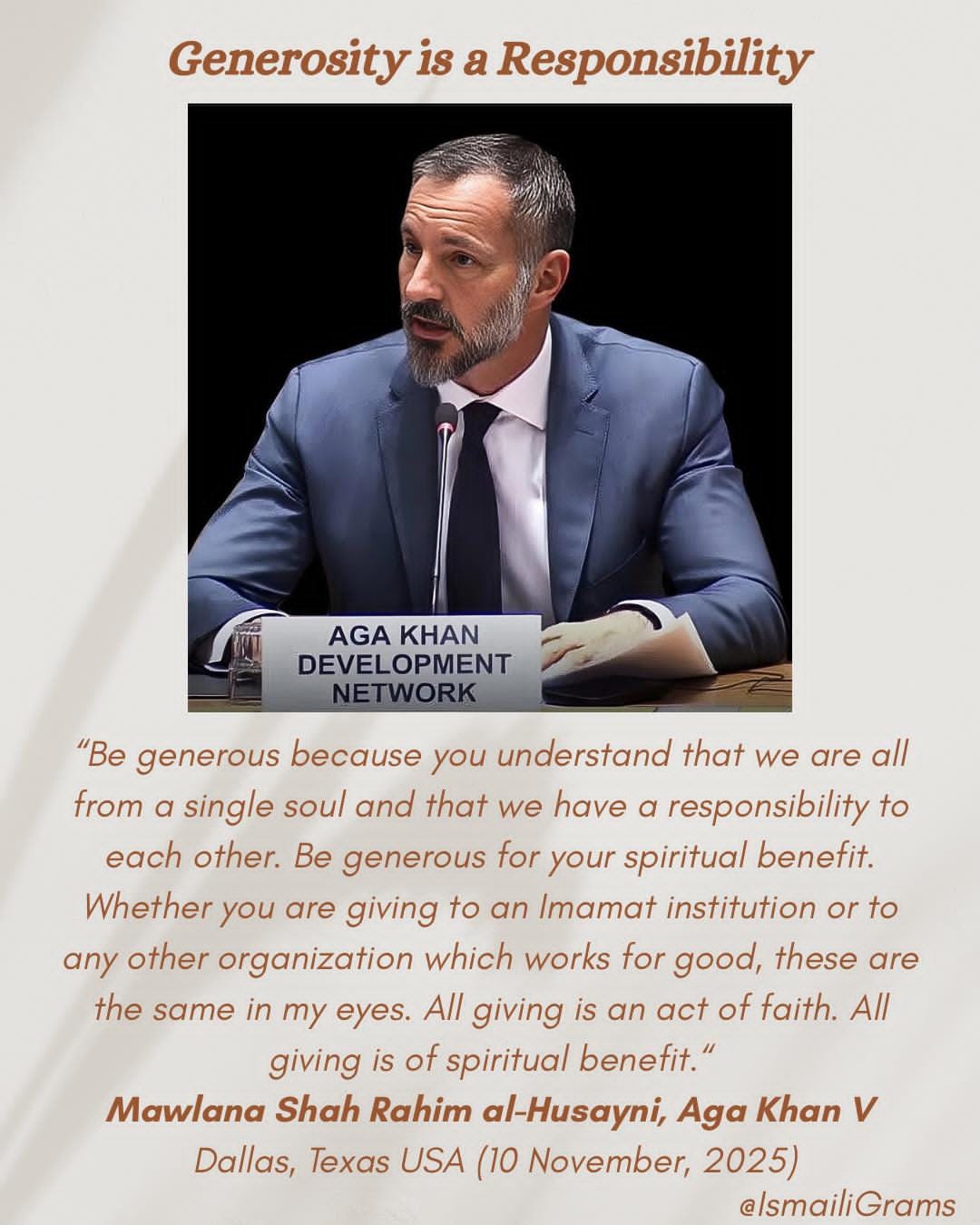
“Whether you are giving to an Imamat institution or to any other organization which works for good, these are the same in my eyes. All giving is an act of faith. All giving is of spiritual benefit.”
— Imām Shāh Raḥīm al-Ḥusaynī⁽ᶜ⁾
(Dallas, Texas, November 10, 2025)

Pīr Nāṣir-i Khusraw, Wajh-i Dīn, translated by Faquir Muhammad Hunzai as The Face of Religion, Discourse 40 (2005 unpublished draft translation).